What a small fish can teach us about gene-environment interactions
Medaka fish help an international team of scientists study how genes and environment interact
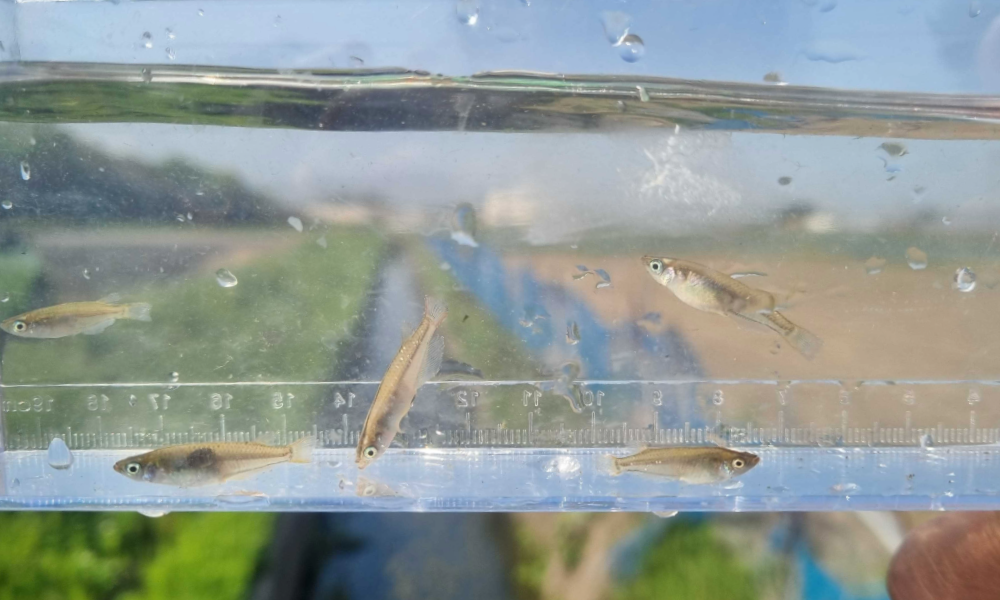
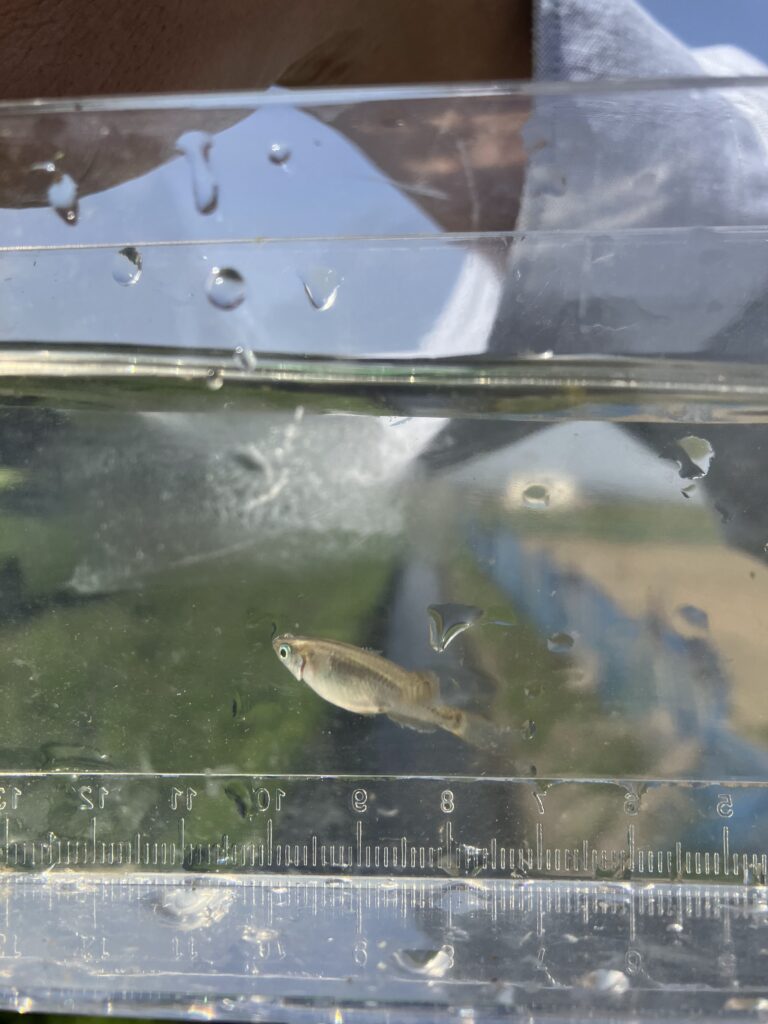
Medaka fish. Credit: Saul Pierotti
Summary
Researchers used medaka fish to study how genes and environment shape traits.
Additive models are effective for identifying genetic associations, but considering interactions with the environment is crucial for understanding complex traits.
Heart rates of 76 medaka fish strains were measured across temperatures. Results helped explain complex traits in other species, including humans.
For decades, scientists have debated how best to explain complex traits in humans and other species. Should researchers rely on simple additive models, which sum the effects of individual genes and other factors, such as the environment? Or should they use non-linear models, which capture interactions between genes and the environment?
Researchers from EMBL’s European Bioinformatics Institute (EMBL-EBI), Heidelberg University, Karlsruher Institute of Technology (KIT), and Japan’s Institute for Basic Biology (NIBB) have tested both approaches in medaka fish. Their results suggest that additive models are adequate for the discovery of genetic associations; at the same time, considering interactions remains essential for understanding the genetics of complex traits.
The study was published in the journal Cell Genomics. Here, researchers involved in the work share insights into the project. This includes Ewan Birney, Interim Director General of the European Molecular Biology Laboratory (EMBL); Saul Pierotti, now a Postdoctoral Fellow at Leiden University Medical Center; Jochen Wittbrodt, Professor and Principal Investigator at Heidelberg University; and Bettina Welz, now a Postdoctoral Fellow at EMBL.
A model organism with unusual power
In Japan, medaka fish are associated with idyllic rural landscapes, evoking traditional songs. But beyond their cultural significance, medaka have become a powerful model organism in genetics.Their impressive ability to thrive in diverse environmental conditions makes them ideal for studying how genes interact with the environment. Scientists can also create genetically diverse inbred strains directly from the wild, allowing them to isolate and precisely study genetic and environmental effects.
Why study gene-environment interactions
Individuals of most species differ from one another due to their genotype, meaning the DNA sequence they inherit, which influences how they respond to their environment, including factors such as temperature, diet, and stress.
Together, genotype and environment shape observable traits, which scientists call phenotypes. In humans, it is difficult to isolate genetic effects from environmental ones.
“I started thinking about this paper about 15 years ago,” said Birney. “I wanted to address a question that has been central to genetics since the 1920s and 1930s: how genotype and environment contribute to phenotypic variation.”
Birney explained that early statistical geneticists formalised additive models to describe these effects. “These models treat genetic and environmental effects as separable and additive, an assumption that still underpins much of modern human genetics. Using medaka as a model organism allows us to isolate these interactions and ask whether this additive model is really appropriate,” he said.
Wittbrodt highlights that addressing this question required an unusually tight integration of experimental and computational approaches. “Throughout their PhD work, Bettina and Saul exemplified this spirit,” said Joachim Wittbrodt. “They showed that combining their complementary expertise leads to a genuine gain in insight that neither side could achieve alone. Such deep collaboration demands trust and a shared mindset – in this case, it was the only way to succeed.”
Using genetically uniform medaka strains newly established from the wild by the Loosli (Karlsruher Institute of Technology) and Wittbrodt (Heidelberg University) labs allowed the team to study complex interactions in ways that would not be possible in humans. “Having a collection of genetically diverse inbred strains derived from a single wild population meant we could control both genetic background and environmental conditions,” Welz explained.
Testing genetic models in medaka
The researchers used 76 medaka strains tested and maintained at Heidelberg University. While the strains differ genetically from one another, individuals within each strain are almost identical, which is similar to having access to thousands of identical twins.
Researchers exposed medaka embryos to different temperatures and measured their heart rates, a trait sensitive to environmental changes.
“This setup allowed us to compare heart rates from thousands of individuals with different genetic backgrounds at ecologically relevant temperatures and combine these data with complex statistical models. We used a microscope that allows high-throughput imaging,” explained Welz. “Because heart rate responds strongly to temperature changes, differences between fish strains become very clear. That makes it possible to link variation in the phenotype back to genetic differences, and see how those effects depend on the environment.”
The experiments let the team compare the use of additive and non-additive statistical models under controlled conditions.
How temperature revealed genetic effects
Temperature proved to be a powerful tool for revealing how genetic effects changed across environments. In this study, eight of the 16 genetic loci linked to heart rate in medaka produced phenotypic differences under different temperature conditions. For one of these loci, genetic differences had no effect on heart rate at lower temperatures (21ºC) but strongly influenced it at higher temperatures (26ºC). However, the response was strain-specific.
“Depending on the strain, the response to temperature was quite drastic,” said Welz. “For some strains, the heart rate increased a lot at higher temperatures, but for others it didn’t change very much.”
This flexibility highlights why environmental context is essential when interpreting genetic effects. Interpreting genetic influence without accounting for the environment can result in missing important aspects of how traits are expressed in real biological settings. This is something Welz is now pursuing further with single-cell methods as a postdoc in EMBL Heidelberg’s Dorrity Lab.
Lab predictions confirmed in the wild
To check the results in a more natural context, the team led by the Heidelberg group returned to Japan with biologist and medaka expert Kiyoshi Naruse from the National Institute for Basic Biology (NIBB). They went to the same rice fields where the original medaka strains were collected 15 years earlier. Working directly with wild fish caught from this site, the researchers sequenced the medaka genomes.
“Seeing lab predictions match nature was a key moment for us,” said Welz. “It showed that the genetic models we built from the lab data weren’t just statistically sound, they reflected what’s happening in real populations.” Pierotti agreed.
Handling large-scale data and lots of fish
The experiments handling large numbers of fish (100,000) in the Heidelberg University and KIT facilities generated vast amounts of information, including thousands of video recordings of the medaka fish. This made the data both storage-intensive and computationally demanding to analyse.
Because part of the work was carried out in Japan using specialised imaging equipment generously provided by Bruker Germany, the team initially planned to transfer the data digitally. However, the sheer size of the files made this impractical.
“We tried to transfer the data digitally, but it was going to take an extremely long time,” said Pierotti. “In the end, we copied everything to hard drives and physically brought them back with us.”
Most of the analysis was conducted using data collected at Heidelberg University. Pierotti developed computational pipelines to process the sequencing data and run large-scale genetic association analyses. These workflows were designed not just for this study, but to be reusable for future projects dealing with similarly complex datasets.
Implications for human genetics
Gene-environment interactions shape complex traits in humans, but they are difficult to measure.
Medaka experiments show that key non-additive genetic effects can be detected if environmental factors are carefully measured. “The experiment with medaka revealed patterns that would otherwise remain hidden in humans,” explains Pierotti. “They give us a way to test which assumptions in human genetics hold up and which ones don’t.”
Why this research is important
This study clarifies gene-environment interactions, validates widely used genetic models, and highlights the value of model organisms for genetic research.
By revealing how genes and the environment interact, medaka fish offer insights that could reshape how scientists study complex traits in humans, and how genetic models are interpreted more broadly.