Protein degradation rate helps explain why humans develop more slowly than mice
EMBL researchers have uncovered differences in protein degradation rates between humans and mice that could underlie their different developmental tempos
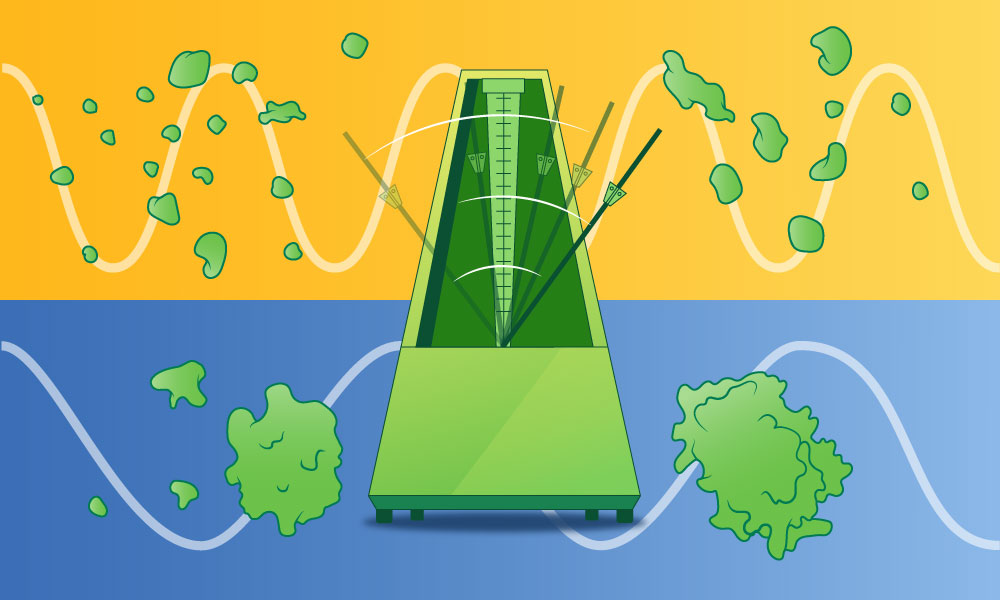
Researchers at EMBL measured the protein degradation rate of around 4,000 proteins in human and mouse cells. Credit: Daniela Velasco/EMBL
Humans develop at a slower rate than other mammalian species, like mice, but scientists are still trying to understand the molecular basis of these differences. Now, researchers from the Ebisuya Group at EMBL Barcelona and PoL-TU Dresden and from the Savitski Team at EMBL Heidelberg show that across 4,000 proteins shared between humans and mice, there is a clear tendency for protein degradation in humans to be slower than in mice. Protein degradation is the cellular process of breaking down proteins into amino acids. This is a recycling system that keeps cells healthy. During embryo development, protein degradation is important because it contributes to the pace of the segmentation clock.
The link between protein degradation and the pace of the segmentation clock was already shown in previous work from the Ebisuya Group at EMBL Barcelona: the developmental gene HES7 produces a protein that is degraded more slowly in human cells than in mouse cells, contributing to the slower pace of the human segmentation clock and to embryo development.
What is the segmentation clock?
The segmentation clock is the oscillatory expression of a group of genes. Each oscillation controls the formation of a pair of body segments. The frequency of the oscillations differs across species, each oscillation taking two to three times longer in humans compared to mice.
In this new study, published in Developmental Cell, the researchers asked whether this difference extends beyond a single gene. They analysed around 4,000 human genes with corresponding mouse counterparts and compared the degradation rates of the proteins encoded by these genes. Although not every protein followed the same pattern – and some were even degraded more slowly in mouse cells – the researchers found a clear overall tendency for proteins to persist longer in human cells.
“Initially, we expected to find a special type of proteins that are degraded differently between species,” said Miki Ebisuya, Group Leader at PoL-TU Dresden, former EMBL Group Leader, and senior author of the work. “Instead, we discovered that slower protein degradation in humans is a general feature across the proteome.”
This trend was not restricted to particular types of proteins or cellular compartments. Proteins with diverse functions showed similar differences, and slower degradation in human cells was observed regardless of whether proteins were broken down through the proteasome or the lysosome – two very different ways of disposing of old proteins. Together, these findings suggest that slower protein degradation is a general property of human cells, rather than a characteristic of specific proteins, providing a unifying explanation for differences in developmental tempo between species.
To investigate what drives this consistent difference, the Ebisuya Group examined the role of cellular metabolism. By reducing metabolic activity in mouse cells, they slowed protein degradation, causing the cells to adopt a degradation and developmental speed that resembled that of human cells. The findings identify metabolism as a key regulator of protein turnover and reveal a link between cellular physiology and developmental timing, offering new insights into how fundamental biological processes shape the pace of life across species.