A new genetic tool helps researchers uncover the logic of gene regulation
Researchers use synthetic biology approaches to test hundreds of DNA sequences for their effect on regulating gene expression
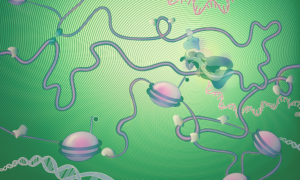
mCHIRA, a new method developed by the Krebs Group for this study, allows scientists to insert regulatory DNA sequences into a specific section of the genome and test downstream effects inside the cell. Credit: Daniela Velasco/EMBL
Summary
Cells tightly control which genes are activated when and where, and misregulation of this process can lead to dysfunction or disease.
Using cutting-edge methods that allow them to test subtle variations in regulatory DNA sequences called enhancers, researchers investigated how binding of proteins called transcription factors regulates gene activity.
The researchers found that when multiple transcription factors bind to an enhancer, this increases the accessibility of the nearby genomic region through a collective effect, allowing gene expression to take place.
The human genome contains over 20,000 genes. However, at any given time and in a given cell, only a fraction of them are active. Researchers from EMBL Heidelberg’s Krebs Group have come up with an innovative experimental approach to understand how cells determine which genes to turn on and when.
The approach involves a genetic tool which allows researchers to insert hundreds of regulatory DNA sequences at a specific location in the genome and study their effects on gene regulation one at a time. Through this synthetic biology approach, researchers can easily test the consequences of small sequence variations on gene regulation while controlling for confounding factors.
When more is more: understanding transcription factor effects
A growing field of research has been focusing on understanding the fundamental principles that determine which genes are active in which contexts. When active, the information in a gene gets copied to a messenger molecule called RNA in a process called transcription. The messenger RNA then delivers this information to a molecular machine called the ribosome. The ribosome uses the information to build proteins, which then carry out most of the functions inside the cell.
To use an analogy, imagine if the genome were a recipe book, each page containing instructions to make a particular protein. Certain pages of the book are open at any given time, and these pages get copied and passed on to the molecular ‘cooks’ who create the final protein ‘dishes’. The pages of the book are also marked with sticky notes, bookmarks, and annotations of various kinds. Arnaud Krebs and his team have been trying to understand how these markings determine which recipes end up getting made into dishes.
As part of this, the team has been studying DNA sequences called enhancers, which play an important role in regulating gene expression. Certain proteins called ‘transcription factors’ can bind to enhancers, and this increases the chance that the associated gene would become active. In our genome recipe book, transcription factors are like sticky notes on a page that draw the reader’s attention to particular recipes.
To understand how enhancers influence transcription factor binding, the researchers studied the effect of subtle variations in enhancer sequences across the genome on how accessible a particular gene is to the transcription machinery. They found that when multiple transcription factors bind to an enhancer, it increases the probability of an enhancer gene becoming accessible, much more than single transcription factors can achieve alone. In essence, this is like saying that multiple notes stuck to a recipe increase the chance that we would open the book to that page.
Studying gene regulation in context
However, on any such page, there are multiple annotations – called epigenetic marks. It can be difficult to tease out which effects the researchers observed were due to the specific genetic variations being investigated, and which were due to the overall genomic environment in the region being studied.
To solve this problem, the researchers developed a genetic tool, called mCHIRA, which allows scientists to tease apart the effects of gene sequence and the genomic microenvironment. This involves a synthetically designed section of the genome where scientists can insert any sequence they want to test.
“Basically, this method enables us to insert, in a specific locus in the genome, hundreds or thousands of regulatory elements, such as enhancers or promoters, so that we could study how the genomic environment is shaping transcription factor binding, enhancer accessibility, and finally transcription,” explained Valentina Baderna, one of the first authors of the study and former PhD student in the Krebs Group.
Using this method, the researchers could further dissect out the effects of specific epigenetic signatures on the effects of transcription factor binding.
The study relied on single-molecule footprinting – a method that allows scientists to study variations in DNA sequences and epigenetic marks inside individual cells in a population. The analysis was supported by FootprintCharter, a novel computational framework developed by co-first author Guido Barzaghi, a PhD student in the Krebs Group, in collaboration with the computational biology group of Judith Zaugg, Group Leader at EMBL Heidelberg and the University of Basel.
“Measuring multiple aspects of DNA regulation at once, single-molecule footprinting makes for an excitingly data-rich technology,” explained Barzaghi. “In that context, FootprintCharter has been our first attempt at distilling its information in an unsupervised way. Tech development on both experimental and computational fronts is what allowed us to quantify molecular states at unprecedented resolution.”
“The mechanisms used by the cell to regulate gene expression are incredibly complex but follow certain basic principles,” said Krebs. “The problem is that our genomes are so complex that those principles are difficult to uncover directly. By combining synthetic biology with quantitative genomics, we can break this complexity into manageable pieces and begin to understand the rules that connect DNA sequence to gene regulation. In the future, combining these approaches with artificial intelligence will make it possible to study gene regulation at an entirely new scale.”