New findings show the wide-ranging involvement of the brain when you feel sick
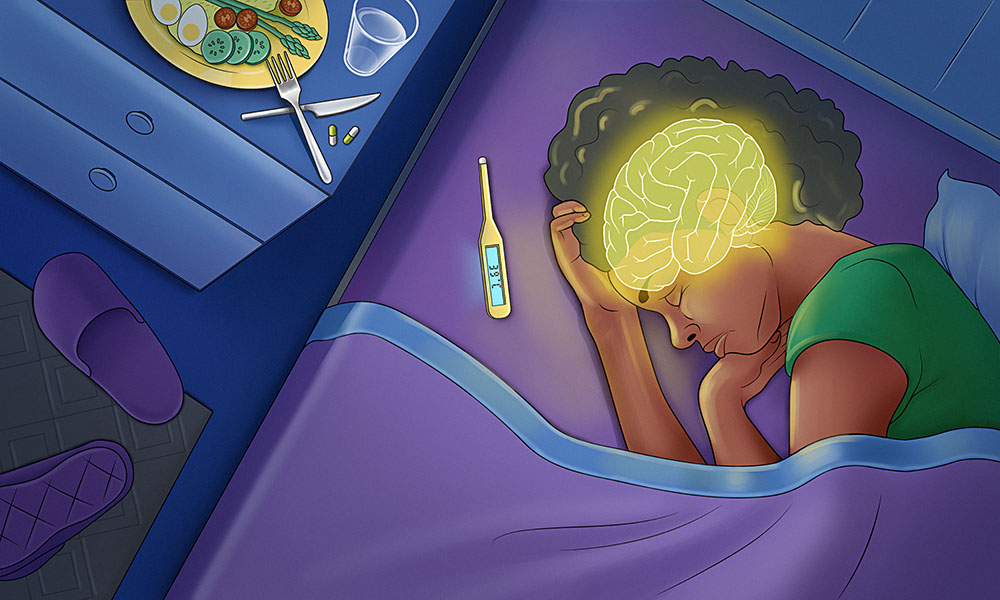
Typical symptoms such as loss of appetite, fatigue, and fever shape the experience of being sick. However, research shows that the brain plays a central role in creating and coordinating this overall sickness state. Credit: Daniela Velasco/EMBL
Summary
Scientists have long known that the brain plays a role in signalling the onset of illness, triggering the typical symptoms of an ongoing infection, such as fever and fatigue.
While past research has focused on sections of the brain that control autonomic activities, a new study finds that brain involvement in sickness behaviour is widespread and also involves sections associated with higher-level activities such as conscious thought, language, and sensory perception.
To pinpoint how neural activity in certain brain regions is connected to the sickness state, the researchers introduced a new method of quickly and reversibly triggering disease symptoms in mice by using a molecule called prostaglandin E2 that acts as a local alarm signal.
We are all familiar with that dreaded sensation: a whole-body achiness and fatigue, waves of both bone-chilling cold and acute sweating that cause one to pull cosy blankets closer and only moments later kick them away. A loss of appetite turns us off even our favourite foods. This state may stem from any number of infections, but one thing is certain: our brain is telling us we are sick.
Sickness is an evolutionarily old, protective response that helps the body recover better and faster from illness, and scientists have sought to determine where exactly in the brain these signals originate. Research from scientists at EMBL Heidelberg, applying a new methodology, has provided evidence to show the brain’s involvement is not localised to one or two regions, but widespread.
“Many things are happening. It’s not one specific isolated group of neurons in some hidden area of the brain. It probably requires engagement of large parts of the brain, or multiple brain areas, to achieve this state,” said Gretel Kamm, a former postdoctoral fellow in Robert Prevedel’s team at EMBL, who led the research and brought this hypothesis to the group. The findings have now been published in the journal Current Biology. “Our main hypothesis is that we can understand sickness as a distinct brain state, and that it changes our decisions and behaviour when we have an infection,” she said.
These findings expand the school of thought on brain involvement in sickness, while introducing an efficient, effective way to study this phenomenon further.
Old brain, new brain
Scientists have known for a while that the parts of the brain deep below the surface, such as the hypothalamus and brainstem, help control symptoms associated with infections, but they were unclear about the role the outer layer of the brain played.
The brain has evolved by inheriting foundational circuits from old, ancestor species. Natural evolution over millions of years has modified these circuits and added new structures, allowing the brain new functionalities such as higher order thinking. These older, foundational brain structures are involved in basic functions such as bodily regulation, movement, emotion, and threat response. Not surprisingly, scientists focused on these areas and pathways as they worked to better understand the brain’s involvement in detecting and reacting to infection.
In Kamm’s research, the scientists were specifically interested in the neocortex, the outermost layer of the brain associated with interpreting information, thinking, planning, and controlling voluntary behaviour. This section of the brain also constantly interacts with the older brain structures.
Finding a new way to study illness and the brain
The scientists already knew that when one develops an infection, the immune system naturally produces a small chemical messenger known as prostaglandin E2 (PGE2). This acts much like an alarm system, triggering the symptoms we associate with illness, such as fatigue, chills, fever, and loss of hunger. But it was not clear whether PGE2 produced these effects by activating some parts of the brain’s autonomic system or if the effects emerged from a distributed activation extending beyond it.
In this study, the researchers found that when they injected PGE2 into the mice’s brains, the onset of symptoms was much quicker than with classic methods that mimic infections in the lab. In fact, the onset was almost immediate, compared to hours or days with these other approaches. Additionally, the duration of symptoms decreased significantly as well – only 30-45 minutes.
The scientists then analysed the mice’s behaviour, mapped their brain activity, and made recordings of individual neurons to study how the whole brain’s activity changed during sickness.
“Gretel found an approach to study sickness with many technical advantages over previous techniques,” said Robert Prevedel, senior author on the paper. “We were able to essentially get a very comprehensive picture of sickness in a much shorter period of time.”
The mice quickly developed fever, became sluggish, and ate less. As the scientists looked at which areas of the brain were active, they found that PGE2 had activated many parts of a network known to monitor the body’s internal state. Specifically, they saw individual groups of nerve cells in the insular cortex engaged, suggesting the insular cortex’s central role in the brain as it responds to a state of illness.
The right place for this research
As Kamm described the work involved in this research, she also noted how essential the involvement of EMBL Rome was in this study.
“Our colleagues at EMBL Rome were crucial for our work. Cornelius Gross (Head of EMBL Rome) and Hiroki Asari (former EMBL Rome Group Leader) are well connected within the neuroscience research community, and thus provided important links to key people and resources,” she said. “Additionally, our close interactions with the Rome unit, for example, during seminars, led to important knowledge exchange.”
Gross notably introduced Kamm and her research team to Nicola Renier, who pioneered a method called iDISCO to visualise neuronal activation across the entire brain, using activity markers.
Prevedel also pointed to how EMBL’s EIPOD fellowship and the lab’s own expertise came together to support Gretel’s idea.
“Gretel is taking a different look at a common problem, and she’s a great example of what the EIPOD programme looks for: interdisciplinary postdocs who bring their own ambitious research ideas to EMBL,” Prevedel said. “In her case, the various methods we had established over time in our lab – imaging, electrophysiology, plus others – helped make her idea a reality.”
“The idea of looking at sickness as a brain state is relevant to the general public, and potentially medicine,” Kamm said. “Many people associate sickness with the bacteria or viruses attacking you, but most symptoms we associate with being sick are actually produced by the brain. So the main takeaway is that the whole brain is probably involved in changing our decisions and behaviour when we have an infection.”