Welcome: Ilya Osterman
New Group Leader at EMBL Hamburg will investigate how bacteria use their metabolism to fight phages, and how phages fight back
Bacteria and bacteriophages, the viruses that infect them, have been running an arms race for billions of years, and neither side is giving up. Over eons, bacteria have developed a remarkable arsenal of defences. Some have learned how to turn even their own metabolism into a weapon. In response, phages have evolved ingenious ways to counter these defences. Studying these mechanisms can provide useful insights into host–pathogen interactions between bacteria and phages, as well as many broader questions.
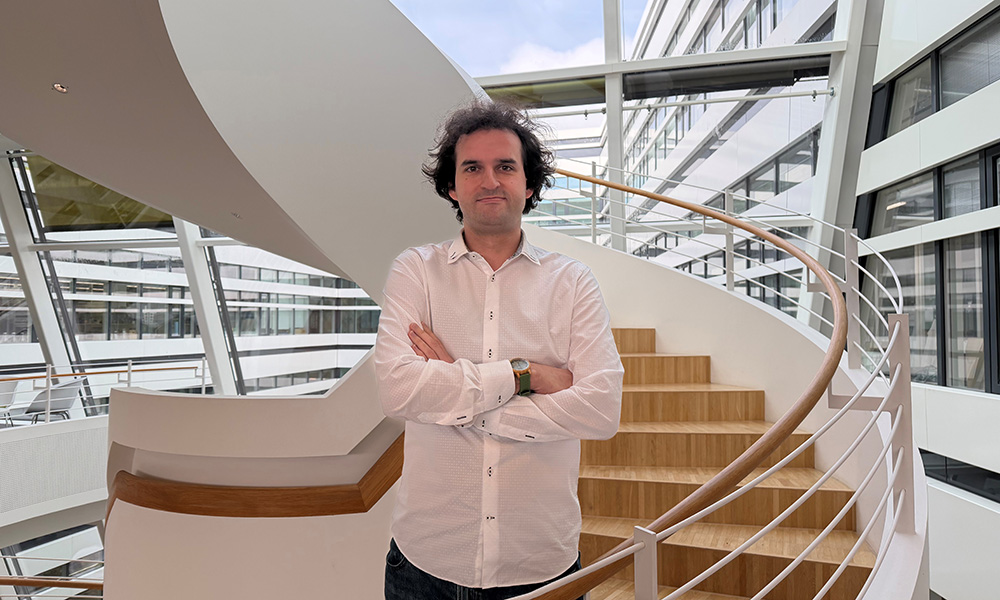
Ilya Osterman, new Group Leader at EMBL Hamburg and Centre for Structural Systems Biology (CSSB), will combine genome mining, microbiology, biochemistry, metabolomics, and structural biology to investigate the molecular mechanisms underlying bacterial metabolic defence systems, and phages’ countermeasures. He also plans to go further, investigating the origins of immunity and exploring the ‘dark matter’ of phage genomes to uncover new enzymes, molecules, and pathways.
What will your group focus on?
My group will study how metabolism becomes part of bacterial immunity and how bacteriophages evolve to overcome these defence mechanisms.
We are particularly interested in the arms race between bacteria and phages. Bacteria can defend themselves by destroying essential metabolites or converting them into signalling molecules, while phages have evolved ways to counter these strategies. In my recent work, for example, I found phage enzymes that can rebuild nicotinamide adenine dinucleotide (NAD+) – central metabolites essential for numerous core metabolic processes – and thereby overcome bacterial defence mechanisms that deplete this metabolite.
I would like to expand this idea beyond NAD+. We want to discover new enzymes, metabolites, and immune mechanisms by combining computational genome mining, microbiology, biochemistry, metabolomics, and structural biology.
A central question for the group will be whether metabolism simply supports immunity, or whether it is itself an active layer of immunity and host–pathogen conflict. Phage–bacteria interactions provide a particularly powerful system in which to explore this question, because evolution has generated an enormous diversity of molecular solutions.
How did you first get interested in bacterial defence and phage counter-defence strategies?
For a long time, when we thought about bacterial immunity, the best-known examples were restriction–modification systems and CRISPR-Cas. Both were enormously important discoveries: they changed our understanding of evolution and, of course, eventually led to technologies that transformed genetic engineering and genome editing.
But these systems also made bacterial immunity seem quite different from the immune systems we know in eukaryotes. What became particularly exciting to me was the realisation that this picture is changing. Recent discoveries have revealed intriguing parallels and possible evolutionary connections between bacterial and eukaryotic defence mechanisms, including systems involving CBASS and cGAS-like signalling, TIR domains, viperin-related chemistry, and gasdermin-like proteins.
This made me interested in phage–bacteria interactions as a way of asking a much broader question: how did immunity evolve, and what fundamental principles are shared across very different forms of life?
Studying the arms race between bacteria and phages gives us an unusually rich system for exploring this question.
Why are phages such a powerful system for discovering new biology?
Phages are often considered very simple biological entities, but their evolutionary history tells a different story. They are under enormous pressure to overcome bacterial defence systems, and bacteria are constantly evolving new ways to stop them. This creates an extraordinarily active evolutionary arms race.
As a result, phages have evolved counter-defence mechanisms that sometimes rely on completely unexpected chemistry. We have seen examples in which phage proteins perform new biochemical reactions, produce or rebuild metabolites, or interfere with bacterial immune signalling. The NAD+ systems are a good example of how this conflict can reveal biology that can not be predicted from sequence alone.
There is also what I think of as the ‘phage universe’. Phages contain an enormous amount of unexplored genetic diversity, with a very large fraction of their genes having unknown or poorly understood functions. This has sometimes been described as the ‘dark matter’ of biology.
For me, that is an incredible opportunity. These unexplored genes may encode new enzymes, molecules, and pathways that evolution has developed in the context of host–pathogen conflict. By studying them, we can use the phage world as a discovery engine for biology.
What do you think we still do not understand about bacterial immunity?
I think we are still far from understanding the full diversity of ways in which a cell can recognise an infection and respond to it.
One particularly interesting possibility is that metabolism is much more closely connected to immunity than we have traditionally appreciated. We often think of metabolites as the molecules that keep the cell running, while immune systems are treated as a separate layer of biology. But in bacterial defence, we increasingly see metabolites being deployed as weapons, converted into signalling molecules, or used to detect what is happening inside the cell.
The evolutionary connections between some bacterial and eukaryotic immune mechanisms make this even more interesting. They raise the possibility that some basic principles of immunity are much older and more broadly distributed than we previously realised.
I do not think we know yet how far this connection extends. That is one of the questions I would like my group to explore: whether there is a more general molecular framework linking metabolism, immunity, and host–pathogen conflict.
You are increasingly integrating structural biology into your research. What does it add, and why is EMBL Hamburg/CSSB a particularly good environment for this?
For me, structural biology is a way to connect what we observe in vivo or in vitro with what is happening at the molecular level.
We may discover that a protein is important during infection, or that it performs an unexpected biochemical reaction, but those observations do not necessarily explain why it works. A protein structure can show us where a substrate or signalling molecule binds, how binding activates a protein, which residues determine specificity, or how different parts of a protein work together.
What I find particularly exciting is that structural biology is not only about explaining an observation after it has been made. A mechanistic understanding can also allow us to make new predictions – about mutations, substrates, related proteins, or even how an activity might have evolved. Those predictions can then lead to new experiments and new discoveries.
This is why I want structural biology to be an integral part of my group’s research. I am not primarily interested in developing structural methods themselves; I want to use structural biology to turn biological and biochemical discoveries into mechanistic understanding, and then use that understanding to generate new questions.
EMBL Hamburg and CSSB are particularly attractive because they bring together the structural, biophysical, biochemical, and infection-biology expertise needed for this approach.
What inspires you to do science?
The feeling that we can know today what was not known yesterday.
When I was at school, I read ‘Microbe Hunters’ by Paul de Kruif, and I was impressed by the feeling that microbiology was a kind of terra incognita. There were enormous numbers of fundamental questions that could be asked, and the field still offered the possibility of making discoveries in areas that were barely understood.
I think that feeling is one of the reasons I am still attracted to microbiology today. In some ways, I see something similar in phage biology. We now have much more powerful experimental and computational tools, but the biological landscape remains incredibly unexplored.
There are huge numbers of phage genes whose functions we do not understand, and behind them may be completely unexpected enzymes, molecules, and mechanisms. So for me, phage biology feels like another kind of unexplored territory – a place where asking a relatively simple question can lead to an answer that is completely different from what you expected.