3 August 2026
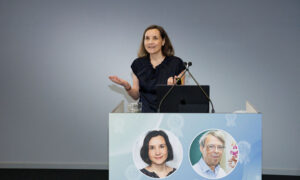
EMBL alumna Lisa Maier, recipient of the 2026 John Kendrew Award, discusses her scientific achievements, the importance of science engagement, and how she carries on the ‘EMBL spirit’
PEOPLE & PERSPECTIVES
13 May 2026
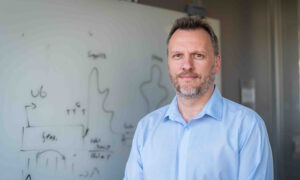
EMBL-EBI and collaborators release a step-by-step guide to making research compliant with the Nagoya Protocol.
CONNECTIONS
2026
connectionsperspectives
29 January 2026
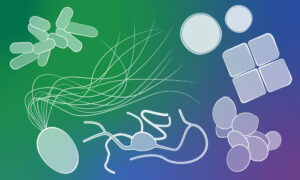
Possibly the least researched microorganism domain, archaea seem to survive anywhere. Yet it is extraordinarily challenging to study and unlock their secrets of adaptability. EMBL researchers hope to change that.
SCIENCE & TECHNOLOGY
19 November 2025
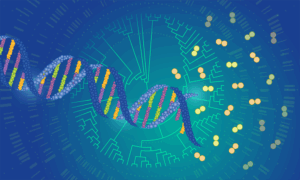
A new genomic analysis tool developed at EMBL-EBI, is helping NHS Scotland tackle antimicrobial resistance and improve outbreak response.
SCIENCE & TECHNOLOGY
2025
research-highlightsscience-technology
18 November 2025

New online portal connects bacterial genomes with experimental resistance data to support antimicrobial resistance research.
SCIENCE & TECHNOLOGY
2025
science-technologytechnology-and-innovation
13 November 2024
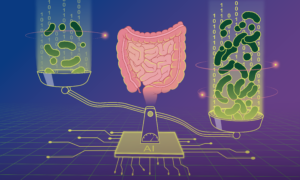
Scientists have developed a new machine-learning model to predict microbial load — the density of microbes in our guts — and used it to demonstrate how microbial load plays an important role in disease-microbiome associations.
SCIENCE & TECHNOLOGY
24 September 2024
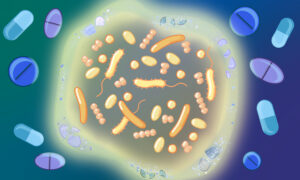
EMBL Heidelberg researchers compared the effect of drugs on isolated bacteria versus those growing in communities. This is the first study showing that bacteria are more resilient when in community due to cross-protection strategies. This could help researchers design more efficient therapies.
SCIENCE & TECHNOLOGY
27 November 2023
An interdisciplinary collaboration between Hamburg scientists has yielded new insights into the structure and function of a heat-resistant enzyme from an exotic microbe. In this interview, EMBL Hamburg’s Matthias Wilmanns and TUHH’s Garo Antranikian discuss how their collaboration developed and…
SCIENCE & TECHNOLOGY
2023
sciencescience-technology
11 January 2023
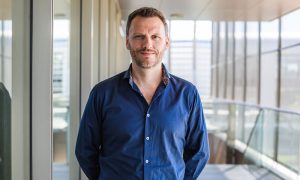
Rob Finn, one of the co-chairs of the Microbial Ecosystems theme, discusses his work, the challenges of multidisciplinary research, and how the theme is already helping to promote the exchange of scientific ideas.
LAB MATTERSPEOPLE & PERSPECTIVES
2023
lab-matterspeople-perspectives
21 December 2022
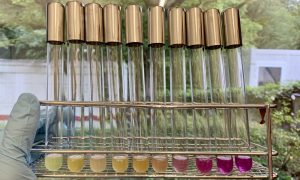
To identify which drugs disrupt bacterial envelope integrity, the Typas group uses a molecule called chlorophenyl red-β-D-galactopyranoside.
LAB MATTERSSCIENCE & TECHNOLOGY
2022
lab-matterspicture-of-the-weekscience-technology
4 January 2022
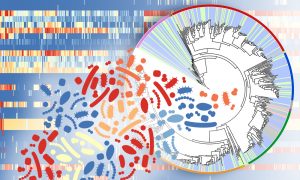
Researchers have identified hundreds of new bacterial species and viruses in the human skin microbiome.
SCIENCE & TECHNOLOGY
2022
sciencescience-technology
10 November 2021
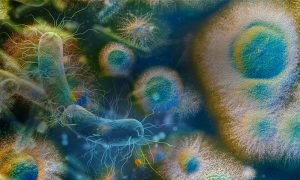
A vast, curated collection of bacterial genomes is now organised, searchable and open to the community.
SCIENCE & TECHNOLOGY
2021
sciencescience-technology
4 January 2021
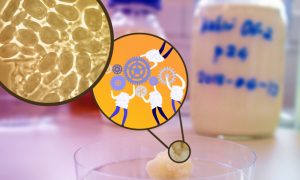
Researchers discovered the dominant species of bacteria in kefir grains cannot endure without other species that help the 'team' survive.
SCIENCE & TECHNOLOGY
2021
sciencescience-technology
18 October 2019
Funding awarded to EMBL-EBI for tuberculosis monitoring tool
SCIENCE & TECHNOLOGY
2019
sciencescience-technology
27 September 2018
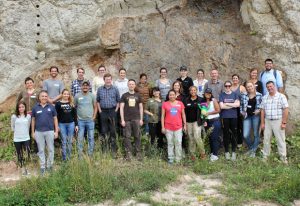
Meet the organisers of EMBO’s first course on molecular geobiology
SCIENCE & TECHNOLOGY
2018
eventsscience-technology
19 March 2018
EMBL scientists show how to grow a wide range of gut bacteria in the lab
SCIENCE & TECHNOLOGY
2018
sciencescience-technology
4 March 2010
The thousands of bacteria, fungi and other microbes that live in our gut are essential contributors to our good health. They break down toxins, manufacture some vitamins and essential amino acids, and form a barrier against invaders. A study published today in Nature shows that, at 3.3 million,…
SCIENCE & TECHNOLOGY
2010
sciencescience-technology