EMBL in Poland: connecting communities, advancing discovery
The first EMBL in Poland event strengthened connections between EMBL and the wider Polish life science community
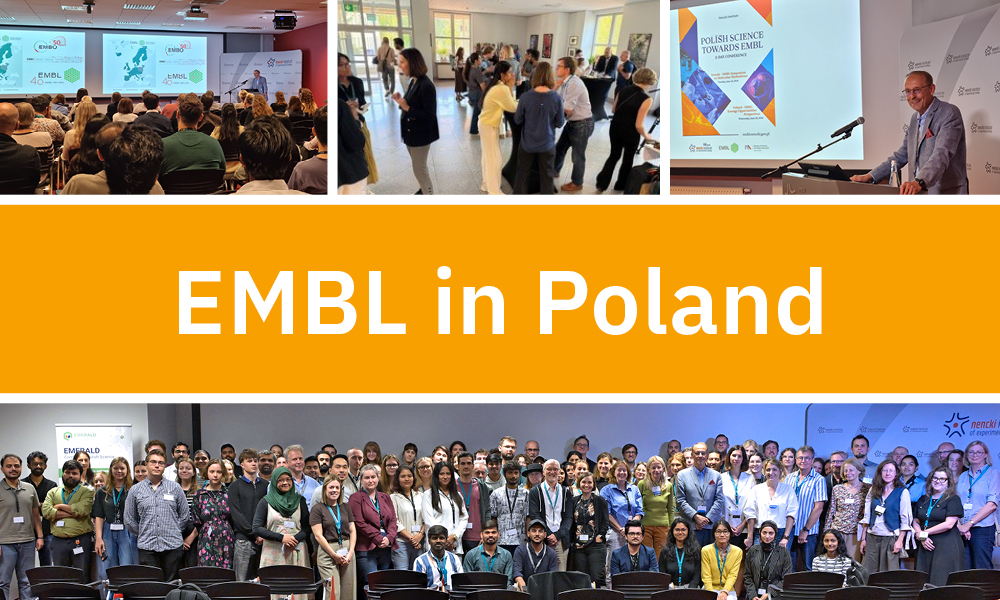
The first ‘EMBL in Poland’ event brought together around 150 scientists at the Nencki Institute in Warsaw on 7–8 September. Researchers from EMBL, EMBL alumni based in Poland, and scientists from institutions across the country shared their latest work and explored new opportunities for collaboration.
The event was hosted by the Nencki Institute and supported by EMERALD, a strategic project implemented by the Nencki Institute and commissioned by Poland’s Minister of Science and Higher Education. EMERALD supports collaborations between EMBL and EMBO and the wider Polish scientific community by providing funds for researchers to carry out scientific visits, and for organising joint workshops and symposia in Poland.
The programme featured speakers from EMBL and institutions across Poland, covering topics such as cell biology, epigenetics, and RNA biology, as well as training and exchange opportunities offered by EMBL. The event closed with a compelling and inspirational plenary by Director of EMBL-EBI Ewan Birney, who shared his vision of how genomics, imaging, and AI are transforming life sciences research, and of EMBL’s role in shaping that future.
With the ‘EMBL in…’ events, EMBL engages with science communities in its member states, shares latest developments, and highlights research and resources available locally, facilitating exchange and collaboration across borders.
How scientists in Poland benefit from EMBL
Several participants of the event shared how EMBL and its ties with Poland have benefited their work.
Urszula McClurg is relocating her research group from the University of Liverpool to the Institute of Medical Biology of the Polish Academy of Sciences (IMB PAS) in Łódź. She has received an EMBO Installation Grant as well as funding from the Polish government to study meiotic genes and their role in cancer. Her group’s work depends heavily on proteomics, and access to EMBL’s Proteomics Core Facility has been essential. She believes the connection with EMBL and EMBO is very beneficial to scientists and wishes for it to develop further across Poland.
The access [to EMBL facilities] has been transformational for our work and for our ability to deliver good science.
EMBL Hamburg alumnus Nishit Goradia recently moved to Warsaw to start his own research group at the International Institute of Molecular Mechanisms and Machines of the Polish Academy of Sciences (IMol PAS) in Warsaw. Building on his postdoctoral work in integrative structural biology and cancer, he plans to shift to cell biology and investigate the molecular mechanisms of transcriptional regulation through protein assembly. He remains connected to the EMBL network and is interested in collaborating with fellow alumni in Warsaw.
My career (…) towards the end of it will be basically defined by my time at EMBL.
Keyvan Hemmatvand, a PhD student at the Nencki Institute, works in the lab of EMBL alumna Aleksandra Pękowska, who leads the Dioscuri Centre for Chromatin Biology and Epigenomics. He attended the event to learn about the various opportunities offered by EMBL, and hopes to make use of them in his future work.
Joining this kind of meeting where you can hear different kinds of topics from different backgrounds (…) it will broaden your view, and maybe it will broaden your career.
The Poland-EMBL connection
Poland became a prospect member state of EMBL in 2014 and proceeded to full membership in 2019. That same year, EMBL launched its partnership with BRAINCITY, the Centre of Excellence for Neural Plasticity and Brain Disorders at the Nencki Institute.
Poland’s path to membership developed over decades. From the 1990s onwards, leading scientists in Poland pushed for closer ties with EMBL, and their efforts gradually led to full membership in 2019. Former EMBL Director General Iain Mattaj reflected on how Poland benefits from close connections with the organisation today.
It’s always wonderful when a new member state really grabs the possibilities that EMBL offers with both hands and makes use of them.