Building momentum towards Bulgaria’s full EMBL membership
EMBL Heidelberg welcomed a delegation from Bulgaria to strengthen scientific connections and explore opportunities for deeper collaboration
In 2024, Bulgaria became an EMBL prospect member state, marking an important step on the country’s path towards full membership. This milestone has brought Bulgaria closer to EMBL’s extensive network of member states, united by a shared commitment to excellent, open, collaborative, and inclusive science.
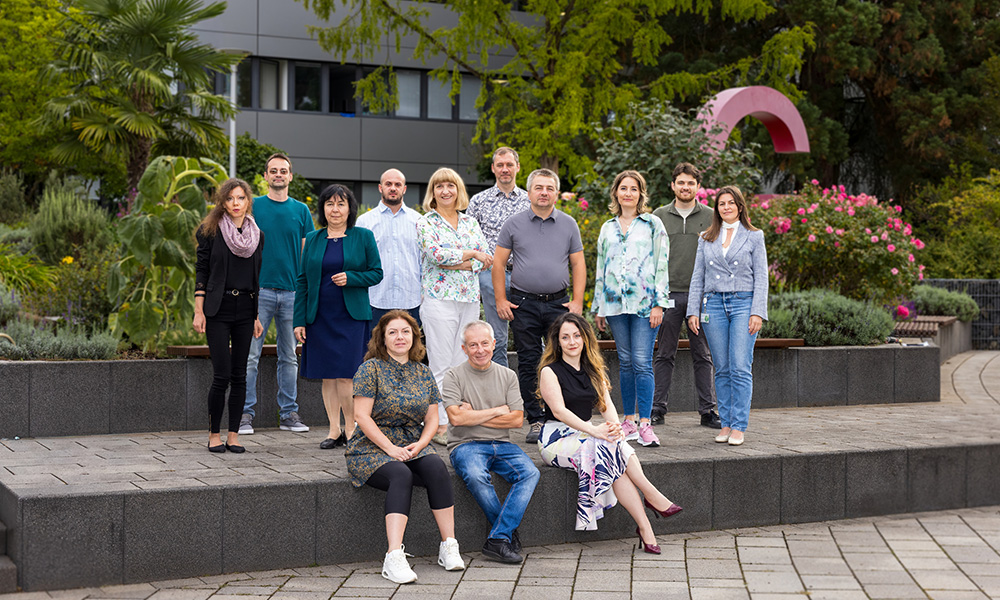
This September, EMBL Heidelberg hosted a contingent of Bulgarian scientists for a two-day visit showcasing the breadth of research conducted at EMBL, with particular focus on genomics, molecular systems biology, and infrastructure. The programme offered participants opportunities to engage directly with EMBL scientists, exchange expertise, and explore potential avenues for closer cooperation.
The delegation included various scientists from the Bulgarian Academy of Science (BAS), the Medical Universities of Varna and Pleven, and Sofia University St Kliment Ohridski. They were joined by the EMBL delegates Stoyno Stoynov, Deputy Director of the Institute of Molecular Biology of BAS, and Mikaela Stancheva, Chief Expert at the Science Directorate, Bulgarian Ministry of Education and Science.
“Bulgaria’s membership in EMBL is an important investment in the future of Bulgarian research and the national life sciences community,” said Mikaela Stancheva. “It gives our researchers access to world-class infrastructure, expertise, and international partnerships, all the while creating new opportunities for our young and established scientists to work and contribute at the highest European level. This is not a simple membership, but a long-term commitment to strengthening Bulgaria’s position in the European Research Area and the broader life sciences ecosystem.”
The visit built on Bulgaria’s growing engagement with EMBL, offering the guests a first-hand insight into opportunities to engage with EMBL across its five missions. During the visit, the guests met with EMBL group leaders and explored the organisation’s facilities for advanced light and electron microscopy (including the EMBL Imaging Centre) and omics. They also explored the capabilities of the EMBL Mobile Laboratories.
“Our visit to EMBL was truly eye-opening. Beyond the state-of-the-art facilities, the conversations with EMBL group leaders were especially valuable,” said Rositza Milcheva, Associate Professor at the Pathology Section of the Institute of Experimental Morphology, Pathology and Anthropology (BAS). “They showed a genuine willingness to help us, offering guidance to clarify our ideas and shape a strategy for reaching our full potential.”
“It was inspiring to see the research happening at EMBL and to compare work with what we’ve done back in Bulgaria,” said Penka Petrova, Professor and Director of the Institute of Microbiology, BAS. “We’re excited about future collaborations, especially having our PhD students work with EMBL and learn new techniques. I was especially drawn to the work in genomics and immunology, a growing field we want to expand and strengthen in Bulgaria.”
Looking ahead, EMBL will continue to engage with the Bulgarian scientific community, exchanging scientific expertise, services, as well as training opportunities. “This visit is an important step in deepening EMBL’s relationship with Bulgaria as we build on the momentum of prospect membership towards full accession,” said Plamena Markova, EMBL’s Chief of International Relations. “Direct exchanges like these are essential: they allow researchers to explore first-hand how EMBL’s expertise, facilities, and international network can open up new opportunities for collaboration, training, and scientific development. We look forward to building lasting connections with the Bulgarian scientific community that strengthen research in Bulgaria while enriching EMBL’s wider European network.”