Nordic EMBL Partnership brings its research community together in Umeå
The EMBL Director General visited the Nordic EMBL Partnership annual meeting, highlighting opportunities for collaboration with EMBL in molecular medicine
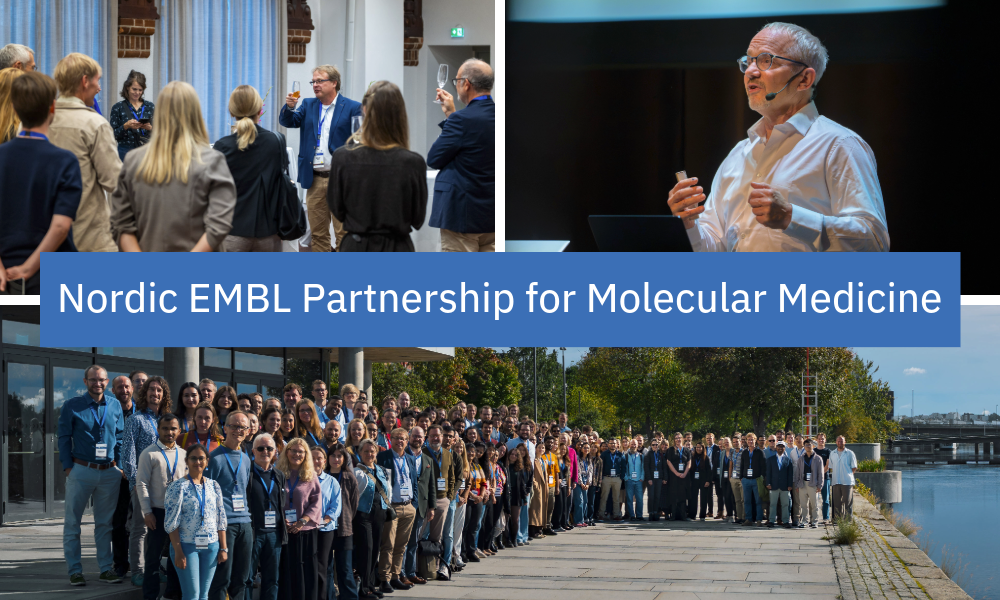
The Nordic EMBL Partnership held its 14th annual meeting in Umeå, Sweden, bringing together scientists from all career stages and representatives from across the Partnership for several days of scientific exchange, networking, and discussion. Hosted by MIMS, the meeting took place 7-10 September and included a Young Investigator Meeting, a Group Leader Satellite Meeting, and the main scientific programme.
The annual meeting provides an opportunity for researchers from the four Nordic EMBL Partnership nodes (DANDRITE in Denmark, FIMM in Finland, MIMS in Sweden and NCMBM in Norway) to share their latest research, explore new collaborations, and strengthen connections across the network. The 2026 meeting also welcomed the VU-LSC EMBL Partnership for Genome Editing Technologies from Vilnius, Lithuania.
Connections that look forward
This year’s meeting also provided an opportunity to reflect on the Nordic EMBL Partnership’s place within the wider European research landscape. New EMBL Director General Anthony Hyman joined the meeting and met with vice chancellors, directors, council members, and funders at a reception held alongside the programme. His keynote, “Understanding complexity, connecting Europe – EMBL’s vision for the next era of biological discovery,” emphasised how AI will help solve key questions in biology and enable the next era of discovery as a methodological shift in analysing molecular biology phenomena and by generating complex hypotheses.
The meeting also discussed the Nordic EMBL Partnership’s future as well. Janna Saarela, Speaker of the Partnership, shared an update from the Steering Committee, setting out priorities and ambitions for the Partnership’s next phase.
Science and collaboration across borders
The scientific programme showcased the breadth of research within the Nordic EMBL Partnership, spanning fundamental biology, molecular mechanisms of disease, and translational research. Alongside presentations from researchers across the four nodes, Guillaume Duménil presented on bacterial infection and pathogenesis in acute meningococcemia.
Through scientific presentations, poster sessions, discussions, and informal networking, researchers at different career stages could exchange ideas, establish new connections, and identify opportunities for collaboration. This reflects one of the Partnership’s central strengths: bringing complementary expertise together across institutional and national borders.
Supporting the next generation
The meeting began with the Young Investigator Meeting (YIM), bringing together PhD students and postdoctoral researchers from across the Partnership. The dedicated programme allows early-career researchers to develop scientific networks, exchange experiences, and discuss their research and career development with peers and senior researchers.
This support is an important activity for the Nordic EMBL Partnership, alongside fostering scientific collaboration and providing access to shared expertise, infrastructure, and training opportunities. The annual meeting brings these different aspects of the Partnership together in one place.
The 14th meeting in Umeå continued this tradition by strengthening connections across the Nordic research community while creating new opportunities for collaboration.
About the Partnership
The Nordic EMBL Partnership for molecular medicine, established in 2007, connects four institutes that cover different parts of the molecular medicine landscape: FIMM in Helsinki works on precision medicine and population genomics, MIMS in Umeå on infection biology and host-pathogen interactions, NCMBM in Oslo on regulatory genomics and computational medicine, and DANDRITE in Aarhus on translational neuroscience. The partnership is one of the most developed examples of EMBL’s fifth mission: to coordinate and integrate European life science research. Together, the four nodes employ 23 group leaders recruited through international searches on fixed-term contracts, following the EMBL model of regular scientific renewal that has defined the laboratory.
This article was adapted from the article published by the Nordic EMBL Partnership for Molecular Medicine.