BioContextAI is a community hub for agentic biomedical systems
Nature Biotechnology 6 November 2025
10.1038/s41587-025-02900-9
Julio Saez-Rodriguez discusses how MCP servers are helping AI connect to life science databases, making AI a more reproducible tool for research
Artificial intelligence is increasingly being woven into biology and life science research. But for AI systems to be used reliably in science, they need to give accurate and consistent answers.
A new standardisation layer for AI tools, called Model Context Protocol (MCP) servers, is helping to address this challenge. MCP servers offer a standardised way for large language models (LLMs) to connect to external resources, such as biological databases. This helps make AI systems more accurate and reproducible by obtaining information directly from a trusted source.
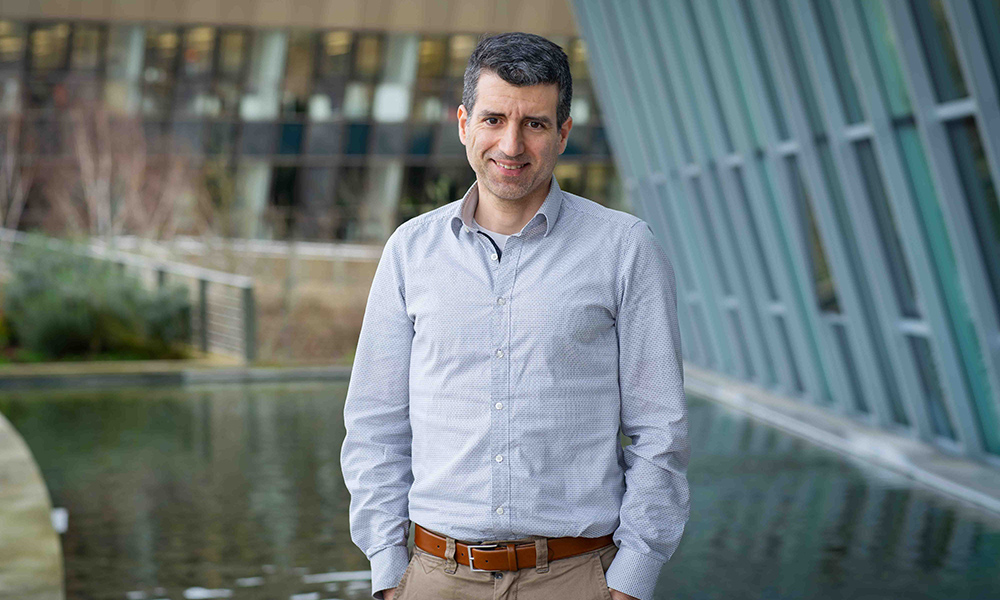
Below, Julio Saez-Rodriguez, Head of Research at EMBL-EBI, talks about MCP servers and their potential impact on the life sciences. Saez-Rodriguez is also an author on a recent paper published in Nature Biotechnology introducing BioContextAI, a community initiative to make biomedical MCP servers more discoverable and interoperable.
MCP servers are essentially connectors. They provide a standard way for large language models to plug into external resources and use information directly from a trusted source. Think of MCP servers as universal plug adapters. Each database has its own, unique API – like a special type of wall socket. With a universal plug adapter in place, any AI system can connect to any database without needing a custom connector.
For biologists and bioinformaticians, the biggest benefit of using MCP servers is reliability. LLMs generate answers based on their training data, which in biology is often quickly outdated or incomplete. By connecting to MCP servers, LLMs can directly query trusted sources such as EMBL-EBI databases. This reduces hallucinations, makes answers more reproducible, and allows researchers to bring AI into workflows that depend on up-to-date curated data.
One type of user is database and tool providers. They can make their resources available via MCP so that AI systems can use them correctly. This is something we are exploring across the EMBL-EBI services.
Other users include workflow developers and researchers. They can combine MCP servers to automate multi-step tasks. For example, imagine asking an AI assistant to take a protein sequence, find related proteins in UniProt, and then check for drug targets in the Open Targets Platform. With MCP servers, all of that can happen within one conversation.
Most bioinformatics resources already provide a REST API, but each one is a little different, with its own data formats and conventions. That means if you want an AI model to work with ten different databases, you usually have to create ten separate connectors, one for each API. MCP doesn’t replace REST APIs. Instead, it adds a common interface on top. In other words, MCP standardises the way AI models discover and interact with many different APIs.
Right now, there is a problem with discoverability and standardisation of biomedical MCP servers. Anyone can build an MCP server. BioContextAI is a community-driven registry that catalogues MCP servers with proper metadata and documentation, in accordance with the FAIR principles of Findability, Availability, Interoperability, and Reusability. It also provides example implementations to help lower the barrier for both building and using MCP servers in the biomedical domain.
For example, the BioContextAI project has developed a knowledgebase MCP server that connects AI systems to resources such as UniProt, the Open Targets Platform, Reactome, STRING, OmniPath, and ClinicalTrials.gov. This makes it easier for researchers to see how MCP servers can be applied in practice and to start integrating trusted biomedical data into AI-driven workflows.
It is important to note that, for the moment, the MCPs available in BioContextAI are often developed by third parties, in this case, the project contributors, rather than directly by the services themselves.
BioContextAI is also a collaborative project, initiated by Malte Kuehl and Victor Puelles from Aarhus University Denmark and it has brought together researchers from other institutes and initiatives including EMBL-EBI, Helmholtz Center Munich, Heidelberg University, Open Targets, scverse and more.
Some challenges are technical, like ensuring security and sustainability for hosted servers. Others are community-driven, such as agreeing on metadata standards and licensing. For MCP to become a true standard in bioinformatics research, we need community buy-in. Achieving this will require database providers, developers, and researchers to work together to make their resources interoperable and reusable.
The vision is that instead of manually navigating multiple databases, researchers could simply ask an AI assistant complex questions, and the assistant would fetch, combine, and interpret information from multiple trusted sources via MCP. This doesn’t replace traditional bioinformatics, but it could make exploratory research, hypothesis generation, and even routine data analysis much faster and more accessible.
Nature Biotechnology 6 November 2025
10.1038/s41587-025-02900-9