When the genome speaks
The 17th EMBL Conference ‘Transcription and chromatin’ brought together researchers to discuss new advances in understanding how cells decide which genes to turn on and when
By Umesh Bhati, PhD student, CSIR-Institute of Himalayan Bioresource Technology, India
There is a particular kind of energy that fills the EMBL Advanced Training Centre in late August. The air smells faintly of pine from the Königstuhl forest rising behind the campus, the summer light hits the glass facade of the ATC at an angle that makes the whole building glow amber by late afternoon, and somewhere inside, several hundred of the world’s most obsessive chromatin biologists are arguing constructively, passionately about how a cell decides which genes to switch on and which to leave silent.
This was the 17th edition of the EMBL Conference ‘Transcription and chromatin’, one of the longest-running globally respected gatherings in molecular biology.
Here are five key themes that emerged from the conference.
1. For the genome, one-dimensional sequence and three-dimensional context are inseparable
The opening talk by Wendy Bickmore (University of Edinburgh) set the tone immediately, probing how certain regulatory DNA sequences called enhancers drive gene activation in the context of both their linear sequence and their spatial folding. Marieke Oudelaar (MPI for Immunobiology and Epigenetics, Germany) picked up this thread on Day 3 with a focused look at enhancer function within 3D chromatin structures, showing how regulatory elements don’t simply broadcast their signals but do so through exquisitely organised spatial environments. Approaching the question from a different angle, Cees Dekker (Delft University of Technology, the Netherlands) discussed his single-molecule biophysics work on SMC motor proteins and DNA loop extrusion, showing how this highly coordinated process occurs in real time.
2. Polycomb, methylation, and the grammar of silencing
Polycomb repression is an epigenetic silencing mechanism that plays an important role in embryonic development and was first described in fruit flies. The conference advanced a new view of polycomb repression, as a dynamic, instructable system that is only now beginning to yield its full mechanistic complexity. Jürg Müller (MPI Biochemistry, Germany) presented findings unpacking how the Polycomb Repressive Complex 1 (PRC1) finds and holds its genomic targets. Danny Reinberg (University of Miami, USA) discussed how disruptions to Polycomb memory can drive pathological cell states, a question with implications for cancer and developmental disorders.
Talks by Rob Klose (University of Oxford, UK) and Dirk Schübeler (Friedrich Miescher Institute, Switzerland) framed a related question: is methylation at CpG islands – another common epigenetic modification – a cause of silencing, a consequence, or something more complicated?
3. The epigenome in time: memory and inheritance
One of the longstanding questions in the field is: how does an epigenetic state survive cell division? Several lectures provided pieces of the answer and tools to probe further. Edda Schulz (MPI Molecular Genetics, Germany) illuminated the molecular decision-making at the Xist locus, showing how a heterochromatin switch governs X chromosome inactivation. This is a system where epigenetic inheritance is not a side effect of gene regulation but its primary purpose. Jamie Hackett (EMBL Rome) described an approach that uses precise epigenetic perturbations to probe function, rather than simply correlating marks with states.
4. Condensates, contacts, and the physics of the nucleus
Phase separation and biomolecular condensates are relative newcomers to the field of chromatin biology, but are rapidly gaining momentum. Liling Wan (University of Pennsylvania, USA) provided a closer look at chromatin-associated condensates in gene regulation and cancer, demonstrating how cancer cells exploit condensate properties to dysregulate oncogene expression. Ali Shilatifard (Northwestern University, USA) also connected condensate biology to the clinic through a talk on RNA Polymerase II elongation in development and human disease.
5. AI, algorithms, and the new mechanistic imagination
As a computational biologist working at the intersection of deep learning and genomics, I had a particular personal interest in watching how the field is engaging with machine learning. Till Schwämmle (EMBL Heidelberg) presented a talk on generative deep learning to identify sequence-encoded trajectories of cooperative transcription factor assembly. Bing Ren (New York Genome Center, USA) closed the final session with a sweeping single-cell multimodal atlas of regulatory programs across human and mouse brains. The scale of the data spanned hundreds of thousands of single cells, multiple modalities, across developmental time points. The computational infrastructure required to make sense of it is, in itself, a kind of scientific achievement. What struck me most about these computational talks was not the power of the algorithms themselves but the quality of the questions being asked of them.
For me, the conference drove home several ideas, including the following: (1) the 3D nature of the genome is an integral component of how cells make regulatory decisions, (2) epigenetic memory is a quantitative, not a binary, phenomenon, (3) AI is a tool for generating hypotheses, not replacing them, and (4) the epigenome is druggable, but only if we understand it. The meeting made clear that basic and translational research are not in competition; they need each other urgently. I look forward to the next edition of this conference, in two years!
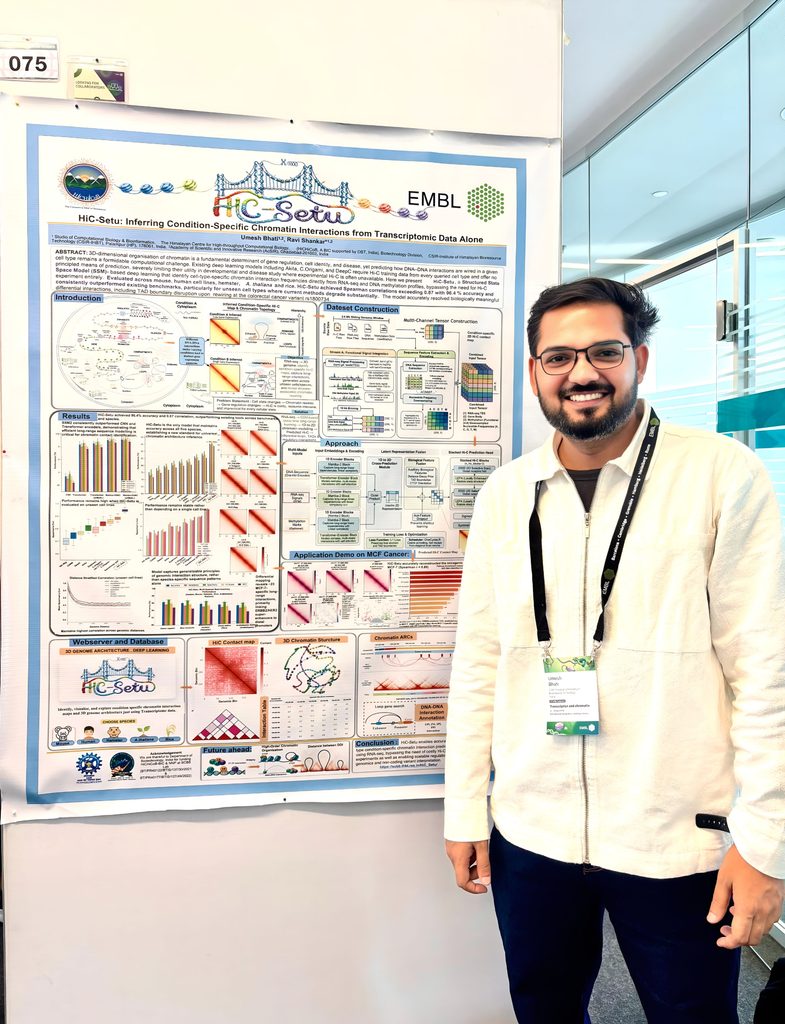
Umesh Bhati is a fifth-year PhD student at the CSIR-Institute of Himalayan Bioresource Technology (CSIR-IHBT), Palampur, India, working under the supervision of Ravi Shankar. His research sits at the crossroads of bioinformatics, deep learning, and chromatin biology. He builds computational tools that ask structural questions from sequence and expression data. When he is not chasing chromatin, he can be found somewhere in the hills of Himachal Pradesh, likely thinking about genomics anyway. He attended this event as an event reporter and presented a poster on his work on HiC-Setu, a deep learning framework that infers condition-specific 3D chromatin interactions from transcriptomic data alone, eliminating the need for costly Hi-C experiments.