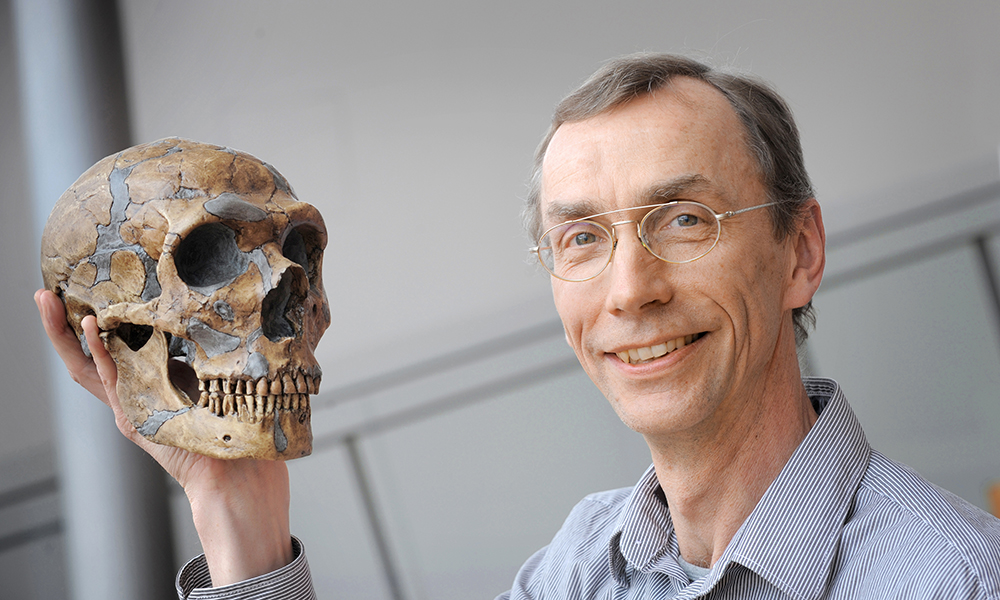
Svante Pääbo rewrote the genetic history of Homo sapiens, and in doing so, he founded the now burgeoning field of paleogenetics. The Swedish scientist, who got the Nobel Prize for Medicine in 2022 “for his discoveries concerning the genomes of extinct hominins and human evolution”, is a director at the Max Planck Institute for Evolutionary Anthropology in Leipzig, Germany.
On 9 October, Pääbo will give the 2026 Kafatos Lecture organised by EMBL in Heraklion, the birthplace of late EMBL Director General Fotis Kafatos, on the island of Crete, Greece. We discussed with him his life’s work and its implications.
Decoding human evolution through genomics
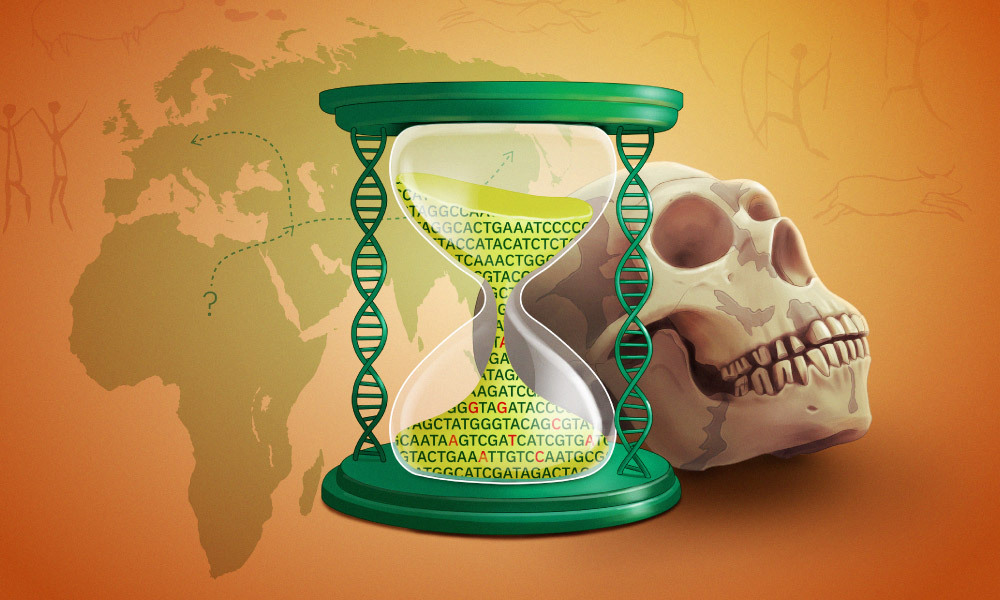
Svante Pääbo led the Neandertal Genome Project, achieving the first sequencing of a Neanderthal genome and revealing that Neanderthals and modern humans interbred. His team later discovered a previously unknown hominin group, Denisovans, identified through DNA extracted from a small bone fragment found in Siberia. These breakthroughs fundamentally transformed our understanding of human evolution and the genetic legacy shared with our extinct relatives.
How does it feel to have established a new scientific field?
It’s amazing that the sort of delusions of grandeur that I had as a student in the eighties (laughter) – of saying we should be able to go back in time and follow genetics and selection and evolution over time – are on some level becoming reality these days.
Was the journey straightforward?
Not at all! The first attempts to extract DNA from Egyptian mummies were unsuccessful due to contamination. Switching to other remains such as mammoths found in Siberia was key to working out how to extract DNA that was indeed ancient and devoid of contamination.
Which of your findings surprised you the most?
It has to be the finding that modern humans mixed with Neanderthals. I was biased towards thinking otherwise due to our initial work with mitochondrial DNA, which is maternally inherited and offers a limited view of our history. Having found that Neanderthals fall outside the variation for the mitochondrial DNA of everyone alive today, there was no indication of any mixture between the groups. Then, when we started to be able to look at the nuclear genome, I was very surprised to find evidence that ancestors of people living outside sub-Saharan Africa today had mixed with Neanderthals.
What are the consequences of this mixture that happened thousands of years ago?
If your genetic roots are outside Africa, something like 1–2% of your DNA comes from Neanderthals. But each person carries different parts of the Neanderthal genome, so if we could puzzle together parts of the Neanderthal genome from different people, we find that 60-70% or even more of the Neanderthal genome is still walking around on two legs today. Similarly, large parts of the Denisovan genome exist in modern humans with Asian origin.
Have you studied the impact of those genes on modern humans?
Both my team and others are studying those genes, and we have had some interesting findings. For example, during the pandemic we found that a specific genetic variant inherited from Neanderthals almost triples the risk of developing severe respiratory failure and dying from COVID-19. We can even calculate how many extra deaths we had in the pandemic due to this contribution from Neanderthals, and it is well over one million.
Has this DNA variant any effect on other infections?
Yes! If you’re exposed to HIV, it’s in fact a good thing to have this Neanderthal variant because it decreases your risk of being infected by about 25%. Together, these findings are very instructive: they show that often gene variants aren’t ‘good’ or ‘bad’. It all depends on the environment. In this case, it depends on what viruses you are exposed to.
And the idea of engineering our genome to make it ‘better’ is mostly deluded, because it’s all a question of environment and we cannot predict future environments. We couldn’t have predicted HIV, nor SARS-CoV-2.
What would the story of humankind be, based on your work so far?
It would largely be a story of mixing. When modern humans emerged in Africa, they were a mixture of at least two groups. And when modern humans spread across the planet, starting around 70,000 years ago, they met other groups and almost always mixed with them.
Do you believe that there is something special about modern humans?
Neanderthals, Denisovans, and all the other forms of humans were never more than a few hundred thousand individuals at any time in their history. And they behaved pretty much like other mammals. They spread across land. They didn’t cross water where you don’t see land on the other side, et cetera. All this changed with modern humans, who developed complex technology and culture.
So, I think there is something special about modern humans. And the outstanding question is what is special and if there is a biological component to that.
Have you tried to address the above questions?
Yes, we believe we could use the genomes of our closest evolutionary relatives, the Neanderthals and Denisovans, to address some aspects of that question. So, we are very interested in genetic changes that have happened in modern humans since we separated from Neanderthals and that have spread to many of us, or almost all of us. The dream would be that some of them have something to do with our readiness to absorb modern human culture from a young age.
Has your work with brain organoids given you any clues concerning said readiness?
We studied a few genes that may influence brain development or brain function, and found some interesting things, but none of them makes one think, “This must be it!” I actually do not believe it would be one gene. It must be a combination of genes and perhaps other factors.
It seems you have some interesting times ahead of you.
Yes, I do hope so!
Finally, do you have any advice for young scientists?
I do not have any great advice other than that one should follow one’s interests. To my mind, the whole reason for being in science is that you enjoy what you do. One advantage of working on what you are really interested in is that at least you have a good time while doing it, no matter what happens to you in the longer future.
Attend the 2026 Kafatos Lecture
Svante Pääbo, Nobel Laureate and Director of the Max Planck Institute for Evolutionary Anthropology, will deliver the 2026 Kafatos Lecture on Friday 9 October 2026, IMBB-FORTH, Heraklion, Crete, Greece. His talk is titled: “A Neandertal Perspective on Human Origins and Health: How Ancient DNA is Revealing New Insights into Disease and Biology”. Register here.
The Kafatos Lecture series was launched in 2021 to honour the considerable legacy of Fotis Kafatos, former EMBL Director General and Founder and first President of the European Research Council (ERC). The series aims to bring groundbreaking and relevant life science research to the worldwide public, making it accessible and highlighting its day-to-day societal impact.