A journey through the microbiome, shaped by growth and support
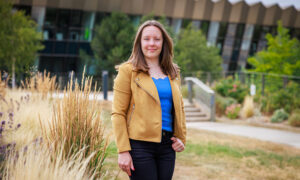
EMBL alumna Lisa Maier, recipient of the 2026 John Kendrew Award, discusses her scientific achievements, the importance of science engagement, and how she carries on the ‘EMBL spirit’
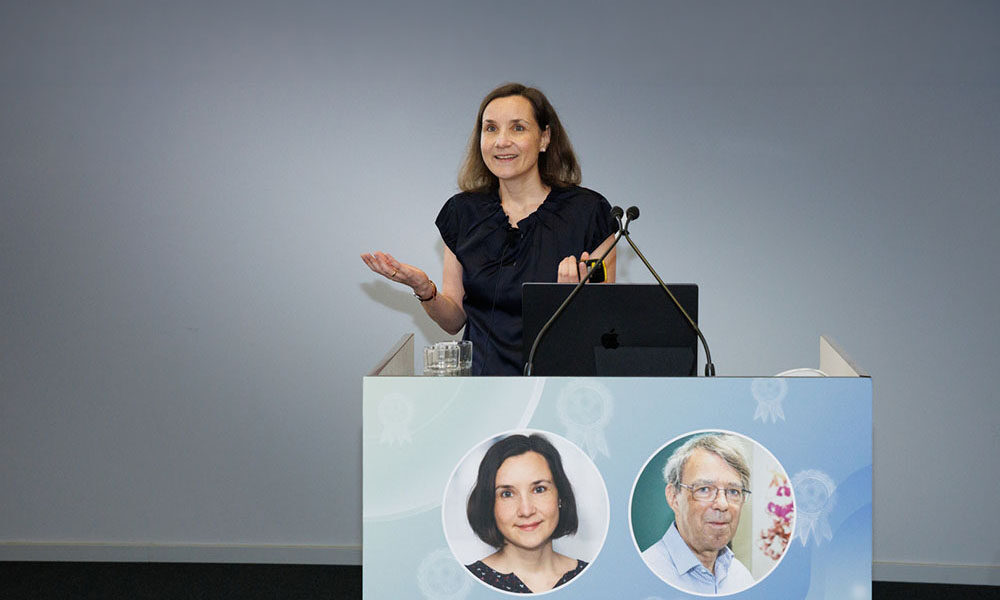
When Lisa Maier was filling out her application for the EMBL Interdisciplinary Postdoctoral Fellowship (EIPOD) in 2014, she also prepared an answer to the typical question “Where do you see yourself in 10 years?” She would never have guessed that just a little over a decade later, she would be giving an acceptance speech for the 2026 John Kendrew Award for her transformative work in microbiome research.
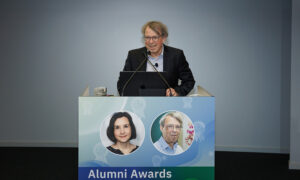
In her speech, Maier attributed her professional growth and scientific achievements to the crucial role EMBL played in her journey, emphasising how much support she had received from day one. “I had this amazing sense of community and very tailored career support, including from my close mentors,” Maier said, “And I am very grateful for that.”
As a postdoc in the Genome Biology Unit at EMBL Heidelberg from 2015 to 2018, Lisa Maier worked on drugs in clinical use, demonstrating how they can have unexpected effects on human gut microbiota, and developed a strategy to preserve the gut ecosystem during antibiotic treatment while retaining antibiotic efficacy against pathogens. Her work in the Typas Group significantly influenced the field of microbiome research, with implications for how drug development pipelines and regulatory policies could be improved. After leaving EMBL, she established her own laboratory at the University of Tübingen, becoming full professor in 2022, and continued her work on drug-microbiome interactions, demonstrating how specific non-antibiotic drugs can disrupt colonisation resistance, increasing infection risk.
We recently had the pleasure of learning more about her early inspirations, her reflections on her past and current work, how her time at EMBL shaped her journey as a scientist, and how science engagement is key to her research.
What first drew you to microbiome research?
I studied biochemistry, and among my peers, microbiology was usually taken in the fifth semester, and had a reputation for being the most boring course. So, as a first-semester student, I decided to get it out of the way early and enrolled with low expectations. It turned out to be love at first sight, and from then on, I gravitated toward microbiology whenever I could.
I was, and still am, fascinated by the intricacies of different microbes. Studying the microbiome allows me to explore many of them at once and understand how they interact with one another.
Now, when I teach microbiology classes myself, I always begin by making the case for why microbes are so fascinating. Invisible yet immensely powerful and breathtakingly diverse, they shape everything from human health to soil fertility, ocean chemistry, and even the climate.
Your research has revealed how non-antibiotic drugs can disrupt colonisation resistance and increase susceptibility to infection. What do you see as the most important implications of these findings for medicine and drug development?
Many drugs produce side effects that cannot be explained by their primary mechanism of action alone. They often arise from interactions with unintended biological targets. Our finding that certain non-antibiotic drugs disrupt the microbiome and weaken its protection against pathogens is a good example: side effects that once seemed unrelated suddenly make sense.
This has significant implications for medicine and drug development. Microbiome impact should become a standard part of preclinical safety assessment, and drug design should account for off-target effects on the microbiome from the start. Ultimately, this could help minimise such side effects and improve the safety profile of both existing and future treatments.
What are the biggest scientific questions you’re currently exploring in your lab, and what are you most excited about pursuing next?
Our research focuses on three interconnected areas: (1) elucidating how antibiotic and non-antibiotic drugs shape the gut microbiome and affect host health; (2) identifying the mechanisms that drive microbial colonisation and long-term persistence in the gut ecosystem; and (3) leveraging systems microbiology to systematically uncover gene functions in non-model members of the human gut microbiome.
Currently, I am very excited about recent findings on the interactions between antidepressants and the gut microbiome – a topic that takes us deep into neuropharmacology and blends wonderfully with microbial physiology.
How did your time at EMBL shape your scientific journey and influence the way you approach innovation and research today?
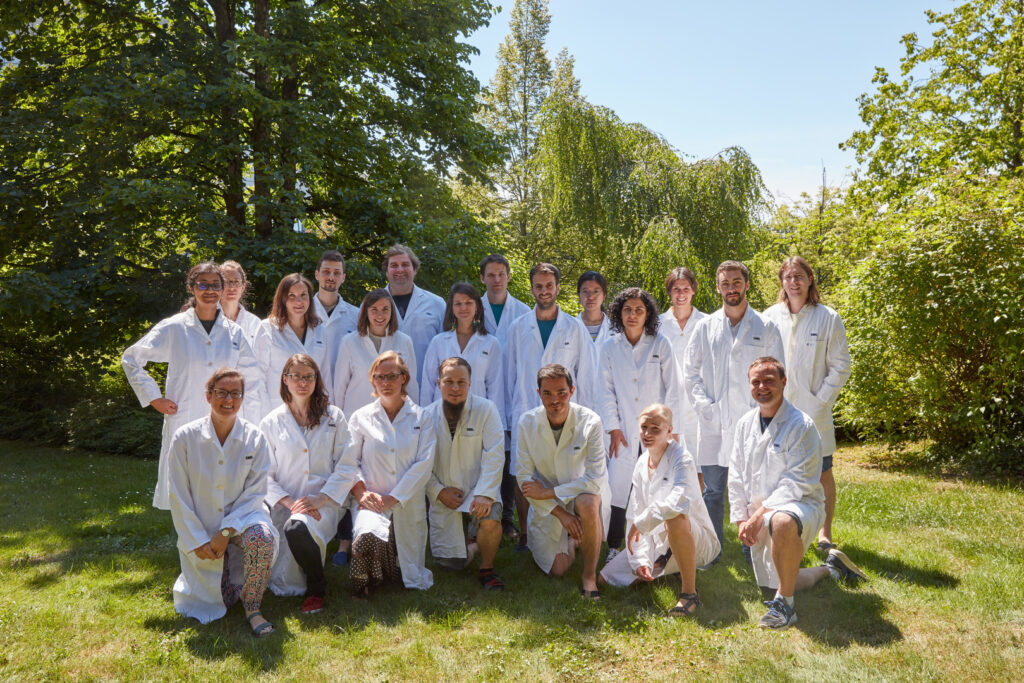
My time at EMBL was deeply inspiring, and I would not be the scientist or the person I am today without it. Everyone around me knows this, because I frequently catch myself talking about how much I miss EMBL, or slipping into “at EMBL, we used to…”, sometimes to the point of testing people’s patience. This is why I take every opportunity to collaborate with or return to EMBL to stay connected.
One thing EMBL instilled in me is a deep appreciation for diversity in all its forms – from the diversity of backgrounds and expertise of those around me to the disciplines and methodologies applied every day. Equally important for me was the drive to identify gaps in scientific knowledge and technology, and to bring together the right people, perspectives, and approaches to pursue ambitious questions and advance bold, sometimes unconventional ideas.
You’ve gone on to lead your own research group. In what ways have you tried to bring elements of the ‘EMBL spirit’ into your lab culture and mentorship style?
At EMBL, I was fortunate to work in wonderful labs and to have superb mentors, whose support I still benefit from today. I try to give my own lab members the same level of support my mentors gave me. At the same time, I am aware that EMBL is special in many ways, and not everything that works there can simply be transferred elsewhere. This is obvious when it comes to infrastructure and the exceptional level of science, but even conveying the ‘EMBL spirit’ requires considerable effort and convincing at the organisational level. Within my own lab, however, it is much easier, and I implement it wherever I can: flat hierarchies, an open-door culture, lab retreats, and building a team of scientists from around the world with diverse backgrounds, experiences, and perspectives.
You’ve also been active in communicating microbiome research to wider audiences. Why is public engagement important to you, and what have you learned from those experiences?
Public engagement wasn’t something I actively sought out at the start, and public speaking still doesn’t come naturally to me. What happened was more organic: the microbiome turned out to be a topic that resonates with people in a very direct way: it deals with food, health, and everyday choices. As a result, I started receiving more requests for interviews and TV shows than my peers, simply because our research felt more intuitive and relevant to non-scientists. That natural curiosity from broader audiences is a real opportunity to start the conversation, because when science doesn’t reach the public, it loses relevance, leaving space for misinformation, oversimplification, or pseudoscience to fill the gaps. Major societal decisions – for example, about diet, health policy, and biotechnology – depend on people having access to reliable scientific knowledge in the life sciences. That only works if scientists are willing to step out of the lab and into the conversation.
What I’ve learned from these experiences is that broader audiences ask really great questions, ones that specialists rarely raise. Why are bacteria so small? Do bacteria age? These sound simple, but they cut to something fundamental. Trying to answer them forces you to examine assumptions you didn’t even know you were making. It makes you a sharper thinker, and sometimes even points to questions worth pursuing in the lab.
What does receiving the John Kendrew Award mean to you, both personally and professionally?
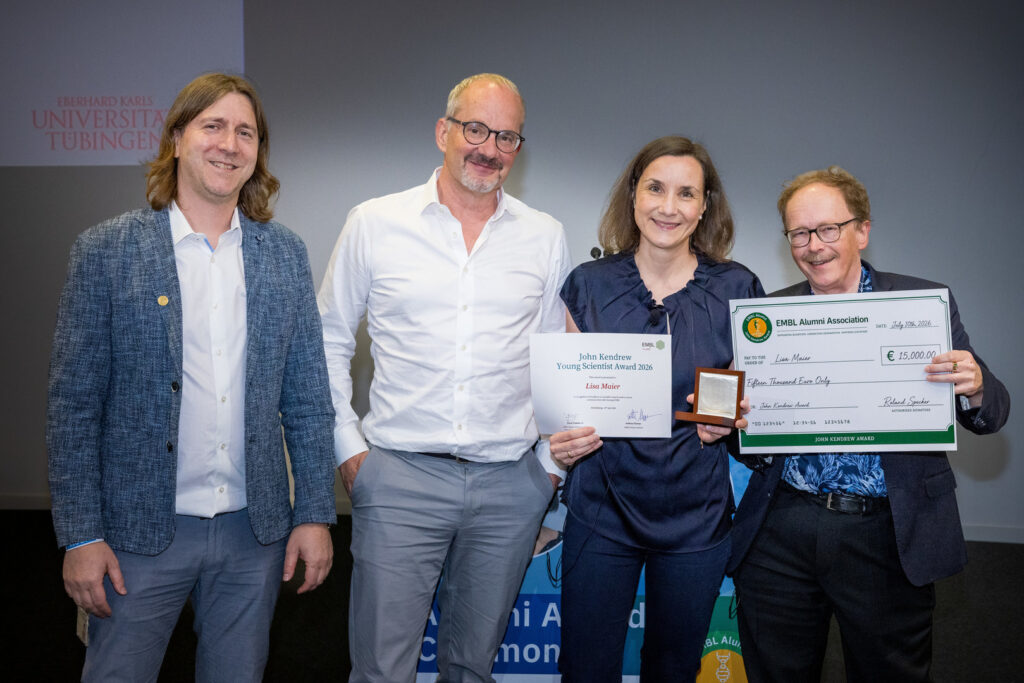
On a personal level, I am deeply honoured to receive the John Kendrew Award. This recognition is not mine alone, as it reflects the dedication of everyone who contributed along the way: my team, our collaborators, mentors, and the many people behind the scenes, from administrative staff and animal caretakers to the family support that makes it all possible.
Professionally, it feels like an acknowledgement of wet-lab-based approaches to microbiome science, where microbiology is increasingly shifting its focus toward the biology of non-model organisms and community setups. That shift matters, and having it recognised at this level is truly meaningful.