ARISE programme network comes together for first ARISE2 Symposium and Partnership Event
ARISE and ARISE2 fellows, EMBL faculty, and research infrastructure scientists from ARISE partner organisations gathered to discuss emerging technologies and challenges within research infrastructures
By Lis Albert, ARISE Programme Intern
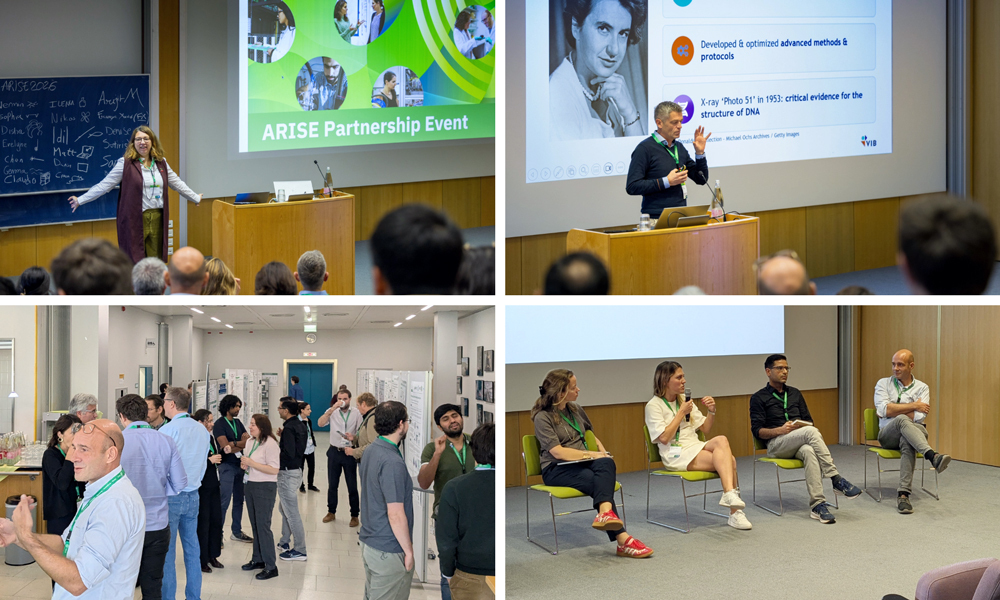
The first ARISE2 Symposium and Partnership Event on ‘Technology Development in Life Science Research Infrastructures’ took place on 16 October 2026 at EMBL Heidelberg. The event brought together senior research infrastructure (RI) scientists, ARISE and ARISE2 fellows, and representatives of partner organisations including SciLifeLab, VIB, GSK, VBCF, CEITEC, ARINAX, ESRF, Weizmann Institute of Science, Thermo Fisher Scientific, and Université Grenoble Alpes. The symposium offered a platform to discuss emerging technologies and strengthen connections across the ARISE community.
“ARISE is a unique training programme that leverages EMBL’s strengths, combining its main missions of training, research, and services,” said Monika Lachner, Head of EICAT and ARISE2 Programme Director. “With this event, we wanted to bring together the ARISE community – fellows, group leaders and partner organisations – to encourage exchange of ideas and create opportunities for new connections.”
ARISE and ARISE2 are Marie Skłodowska-Curie Actions co-funded fellowship programmes aimed at training the next generation of scientists and engineers in technology development and research infrastructure management in the life sciences. Reflecting this mission, the symposium highlighted the importance of connecting and supporting technology developers across disciplines.
In his keynote lecture, Geert Van Minnebruggen, Technology Director at VIB, highlighted how technologies developed within research infrastructures often provide the basis for major scientific discoveries. The discovery of the structure of DNA relied, for example, on the work of X-ray crystallography expert Rosalind Franklin. He also emphasised the need for a greater recognition of research infrastructure scientists’ contributions to scientific progress.
The importance of technological advances was further illustrated through a series of presentations by senior RI scientists and current and former ARISE and ARISE2 fellows. Showcasing their projects, the speakers demonstrated how their work supports scientific research and services across a wide range of fields, from data and computational sciences to imaging, structural biology, mechanical engineering, biotechnology, and more.
During two lively panel discussions, representatives of partner organisations, ARISE fellows and EMBL group leaders explored the role of technology development in enabling scientific breakthroughs and addressed the need to create sustainable career pathways for technical experts – also a key focus of the ARISE programmes. As Disa Hammarlöf, Research Coordinator at SciLifeLab, put it: “We need to highlight these alternate career trajectories and increase their visibility. This includes making sure that it is well understood what it means to be a technology developer and what impact you can have.”
Another key theme emerging from the panel discussions was the importance of building a sustainable community of technology developers. Participants pointed to the value of collaboration across disciplines and institutions, which is also central to ARISE’s partnerships with external organisations.
ARISE and ARISE2 work with a number of academic and non-academic partner organisations that contribute to the training and supervision of fellows. While partners in the initial ARISE programme mainly supported fellows during their secondments, some have taken on a more substantial role in ARISE2, becoming full collaborators and contributing funding to individual projects.
“The real value of programmes like ARISE lies not only in the technologies being developed and the knowledge being exchanged, but also in the community we build around research infrastructures and the recognition of this career path,” said Silvie Van Den Hoecke, Senior Technologies Project Manager at VIB, reflecting on the symposium. “By connecting people across organisations and countries, we can learn from each other, tackle shared challenges, and turn our enthusiasm for technology development into impact through scientific collaboration.”
Beyond the scientific presentations and panel discussions, the event offered many opportunities for participants to network and explore potential collaborations during poster sessions, breaks, and meals.
Nermin Akduman, an ARISE2 fellow at EMBL Heidelberg, particularly valued learning about other fellows’ projects and the work of experienced research infrastructure scientists from EMBL and partner organisations. “I especially appreciated the opportunity to meet people working in different fields but facing similar challenges and sharing a common interest in advancing research infrastructures,” she said. “I hope to build on these connections in the future, as I believe they can benefit not only my own development but also my facility and the wider community we work with.”
For ARISE alumni, the event also provided a chance to share their experience and reconnect with the community. “The ARISE community has a great convening power and can be tapped into on so many levels,” reflected Christopher Thorpe, EMBL-EBI ARISE alumnus, now at University of Oxford. “Experienced practitioners can share hands-on experience on running infrastructures at scale, fellows at different levels of their projects can (re)connect and renew conversations about potential collaborations, and experts on RI funding can support scaling up fellows’ projects. Having a community that supports at all of these levels will act as a force multiplier on the experience of the fellowship and truly accelerate progress and practice.”
“The ARISE2 partnership event was the first of its kind, and it set a starting point for continued exchange and future collaborations across the ARISE network,” said Tanja Ninkovic, Managing Director of ARISE implementing partner RIcapacity. “I see it as a showcase for technology development in scientific services and research infrastructures, and I hope it can grow into a symposium on this important topic, encouraging technology development to become a part of how facilities grow.”