New research shows the Golgi complex is involved in DNA repair control
Researchers have discovered a previously unknown layer of control over DNA repair in cells, exerted from outside the nucleus
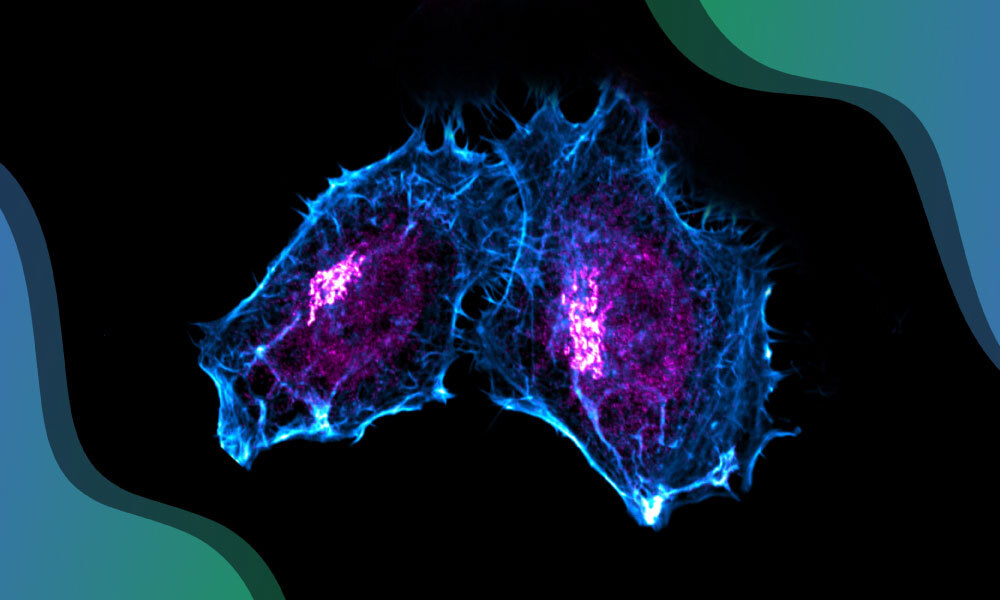
Fluorescent microscopy image of human cells, with RAD51C at the Golgi and the nucleus shown in magenta while the cellular cytoskeleton is shown in cyan (f-actin staining). Credit: Karolina Kuodyte/EMBL
Summary
Cells must constantly repair damage to their DNA that, if left unfixed, can lead to cell death, cancer, or accelerated ageing.
EMBL researchers and their collaborators show that the Golgi complex, an organelle best known as the cell’s sorting and shipping centre, stores DNA-repair proteins and dispatches them to the nucleus when damage occurs.
When DNA is damaged, the cell recruits the relevant repair proteins from the Golgi to the nucleus, matched to the type of damage, and clears the proteins it doesn’t need out of the nucleus, sequestering them back at the Golgi.
This work reveals a new layer of regulation of DNA repair pathways from outside the nucleus, opening up new opportunities to modulate these pathways and to target related diseases such as cancer.
Our DNA is under constant threat. Chemicals, radiation, and the everyday errors of cell division all damage it, and if left unrepaired, this can lead to diseases such as cancer. Cells invest heavily in finding and fixing these errors. A new study from EMBL Heidelberg’s Pepperkok Group finds that part of the control over this repair process lies in an unexpected place – outside the nucleus, at the Golgi complex.
First described in 1898 by renowned Italian biologist Camillo Golgi, after whom the organelle was later named, the Golgi complex is best known as the cell’s sorting and shipping hub. Proteins, the workhorses of the cell, arrive at the Golgi to be processed, packaged, and sent to their appropriate destinations within the cell.
The Pepperkok Group is interested in how proteins move within the cell and how organelles such as the Golgi are built and maintained. George Galea and Karolina Kuodyte joined the group to address the question of which proteins travel between the Golgi and the nucleus, and why.
The answer was unexpected: a whole network of proteins that repair DNA, normally associated with the nucleus, also reside at the Golgi. “Finding DNA-repair proteins at the Golgi at all was unexpected; this is machinery you expect to see in the nucleus,” said Kuodyte, co-first author of the study, a former PhD student in the Pepperkok Group, and currently a postdoc at MPI-CBG in Dresden.
These proteins belonged to many different DNA-repair pathways, with almost every known pathway being represented. The team wanted to understand what these proteins were doing at the Golgi, and what would happen when the cell’s DNA was actually damaged.
When the team induced different types of DNA damage using chemical agents, the repair proteins did not stay static. For each kind of damage, the proteins needed to fix it were recruited from the Golgi into the nucleus, while the proteins not required for that repair were cleared out of the nucleus and sequestered at the Golgi. This dynamic, damage-specific localisation is the heart of the finding. It suggests the cell uses the Golgi as part of a system for controlling when and where DNA-repair proteins act, a layer of regulation that sits outside the nucleus.
To probe how this control works, the team followed one protein in detail: RAD51C, which plays a key role in homologous recombination, a major pathway for repairing breaks in DNA. Mutations in RAD51C are strongly associated with increased risk for certain cancers such as breast and ovarian cancers. They found that RAD51C was held at the Golgi through its interaction with Giantin, one of a family of large Golgi proteins. When DNA was damaged, RAD51C was released and moved to the nucleus, gathering at the sites where DNA is mended. When the researchers disrupted this arrangement by removing Giantin, RAD51C’s normal localisation broke down, and DNA repair was stopped.
“This was a very exciting finding, one of the first of its kind,” said George Galea, Research Scientist in the Pepperkok Group and co-first author. “It supports the idea that DNA repair isn’t only a nuclear process – it’s a global process, coordinated across the cell, with organelles like the Golgi helping to control it. This opens up a lot of new questions about how the cytoplasm and the nucleus influence each other.”
The initial screen that helped uncover this pathway was done in collaboration with the Human Protein Atlas, a Swedish-led effort begun in 2003 that maps where human proteins are found across cells, tissues, organs, and blood. It also involved a collaboration with Emma Lundberg’s lab at Stanford University, USA, which specialises in the spatial proteomics of human cells.
RAD51C is only one of more than 300 proteins the team found in both the Golgi and the nucleus, and DNA repair is only one part of what the screen uncovered. The shared proteins span many different cellular pathways, pointing to a connection between the Golgi and the nucleus that is far more extensive than previously appreciated and tying cytoplasmic processes directly to what happens to the genome. It raises the question of whether the Golgi’s other functions are linked to nuclear processes in a similar way.
“The work reframes the Golgi as an active participant in the DNA damage response rather than a bystander, an organelle that stores, releases, and times the deployment of repair factors,” said Rainer Pepperkok, senior author of the study and Director of Scientific Core Facilities and Services at EMBL. “More striking still, it points to cytoplasmic processes being far more closely linked to DNA repair than we assumed.”