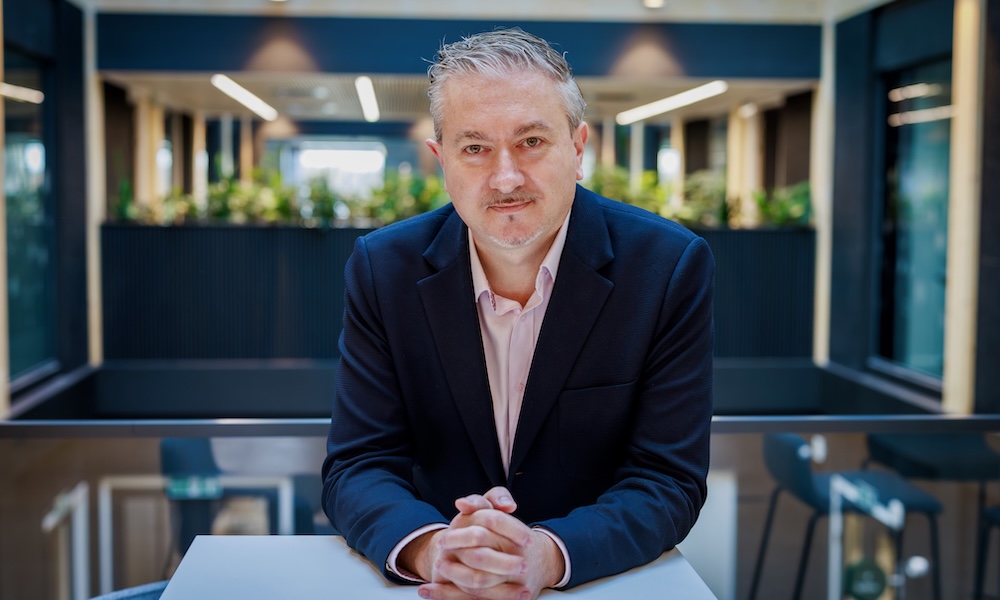
Welcome: Alex Picchianti
EMBL-EBI’s new Head of Infrastructure Services brings experience from the London 2012 Olympics and Paralympics and more to support the institute’s growing data needs
Life science research relies heavily on high-performance computing and robust data storage. As the volume of scientific data grows exponentially, the underlying IT infrastructure must be scalable, secure, and reliable to ensure scientists can access and analyse data without interruption.
Alex Picchianti has joined EMBL-EBI as the new Head of Infrastructure Services. We spoke to Picchianti about his experience delivering high-stakes IT services for large-scale institutions of national and international relevance, his transition from the corporate world to a scientific environment, and striking a balance between innovation and efficiency.
What is your background?
I have over 25 years of experience in IT, having started my career as a Unix Administrator. I shifted into senior management roles in 2009. I was responsible for designing and delivering the core IT infrastructure for the London 2012 Olympic and Paralympic Games.
Following that, I headed the payment services at Transport for London, specifically the entire contactless payments infrastructure that allows transport on buses, underground trains, overground trains, Docklands Light Railway, and Thames River Boats. I later managed the entire IT infrastructure supporting 4 million daily journeys throughout the London transport network. Before joining EMBL-EBI, I was with Allwyn – formerly Camelot – managing the IT infrastructure for the UK’s National Lottery services, giving away £30 million to good causes weekly. I am originally Italian, but have lived in the UK since 2005.
You lead the EMBL-EBI Infrastructure Services team. Can you please explain what your team does, in simple terms?
The EMBL-EBI Infrastructure Services team is the foundation that enables the institute’s world-class biological research and data sharing across Europe and beyond. In simple terms, we ensure that scientists, researchers, and institutions worldwide can access the vast amounts of biological data we host at EMBL-EBI, reliably and securely. We are the backbone of IT at EMBL-EBI.
What is unique about supporting IT infrastructure at a large bioinformatics institute like EMBL-EBI?
Compared to the corporate world I came from, the goal at EMBL-EBI is not to generate profits. Here, the mission is far more noble; it is about ensuring that we support research while balancing openness with security, performance, and reliability.
We provide the infrastructure that allows researchers to share data, run complex computational analyses, and collaborate. Doing this while preparing for the exponential growth of data presents a unique challenge that few organisations face.
What new technologies or approaches are you exploring to help EMBL-EBI’s infrastructure keep up with future growth?
There is an increasing demand to introduce AI tools to take advantage of large datasets. I see EMBL-EBI positioned as a natural leader in AI for research over the next decade.
However, despite the excitement about these relatively new technologies, it is important to balance efficiency with innovation. We need to ensure that as we adopt these tools, our infrastructure remains robust enough to handle the increased computational demands they bring.
What are some of the first things you’re hoping to achieve in your new role?
I hope to keep the right balance between innovation and efficiency. That is ultimately the constant challenge in any organisation that has a large-scale infrastructure to maintain. I also want to focus on establishing myself as a trusted leader within the organisation, ensuring my team has the support they need to deliver on our mission.
What are your hobbies and interests?
Most of my spare time has been spent supporting my 12-year-old son in his football journey. Despite the fact that neither his mother nor I will be remembered for our sports achievements, for some reason, nature has gifted him with talent, so I support him with no pressure.
I love Japanese culture and food, and I am a technology enthusiast. I still play video games when I can; they were the original reason why I started to have an interest in computers more than 40 years ago.