Best poster prizes at ‘Cellular mechanisms driven by phase separation’
The EMBO | EMBL Symposium ‘Cellular mechanisms driven by phase separation’ took place in May at EMBL Heidelberg and virtually.
This interdisciplinary conference brings together scientists from diverse fields to foster new discoveries and discuss emerging principles in condensate biology. Topics range from basic biophysical principles of condensate formation to the role intracellular phase transitions play in cellular adaptation to the impact condensate dysregulation has on human disease.
For this year’s edition of the meeting, we had 265 people attending on-site and 104 participants tuning in remotely. There were 16 financial assistance grants provided by the EMBL Corporate Partnership Programme and EMBO. With a total of 156 posters to view, we held three poster sessions during which the presenters could discuss their research; their work was then voted for by all participants. There were six best poster prizes awarded during the meeting, and we’re pleased to share with you more information on the winners and their research!
Physicochemical microenvironments of biomolecular condensates: redox regulation in stress granules
Authors: Silja Zedlitz, Xiao Yan, Simon Alberti, Karina Pombo-García, Ji-Young Youn, Yifan Dai, Anthony Hyman
Presenter: Silja Zedlitz

Max Planck Institute of Molecular Cell Biology and Genetics, Germany
Abstract:
Biomolecular condensates are membrane-less cellular compartments that are characterized by a high local concentration of proteins and RNAs and exhibit therefore unique physicochemical microenvironments. Due to selective molecular and ion partitioning and resulting differences in charge distribution, condensates can have altered local properties, including distinct pH landscapes relative to the surrounding cytoplasm.
Recently, it has been shown in vitro that liquid-like protein droplets accumulate elevated levels of reactive oxygen species (ROS) which led to the hypothesis that condensates may have an intrinsic electrochemical activity. However, direct evidence for interface-driven ROS production within condensates in living cells has remained limited. The underlying open question of this poster is if cells possess and how they manage condensate-associated redox activities. To address these questions, redox dynamics within biomolecular condensates were interrogated using a suite of genetically encoded and chemical redox-sensitive probes in live-cell imaging. Additionally, we examined the spatial organization and activity of redox enzymes such as peroxiredoxins to provide insights into how antioxidant systems are recruited to and function within condensates.
Elucidating these mechanisms can help to clarify how dysregulated redox environments influence the oxidation state and phase behavior of disease-associated proteins such as TDP-43, with direct implications for stress granule dynamics and neurodegenerative pathogenesis.
Due to the confidentiality of the unpublished data, we cannot share the poster.
A 25 amino acid region modulates liquid-liquid phase separation and aggregation of hnRNPA2
Authors: Luis Fernando Durán Armenta, Attila Meszaros, Annelore Stroobants, Tamás Lázár, Dominique Maes, Remy Loris, Peter Tompa
Presenter: Luis Fernando Durán Armenta
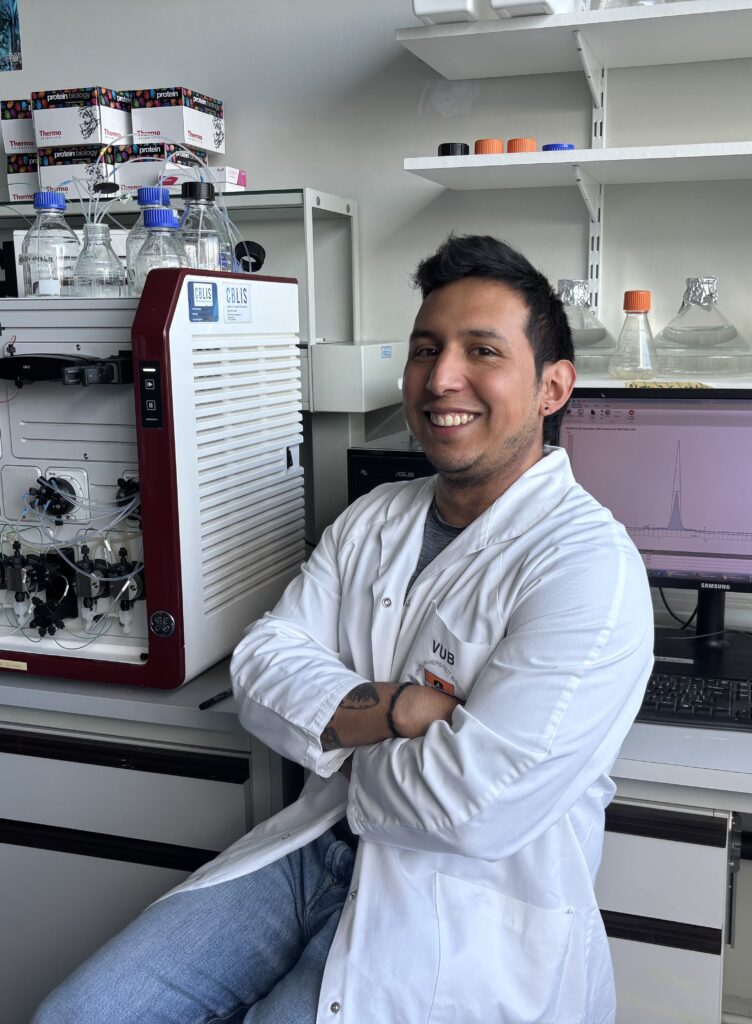
Vrije Universiteit Brussel, Belgium
Abstract:
Heterogeneous nuclear ribonucleoprotein A2 (hnRNPA2) is a multifunctional RNA-binding protein involved in RNA maturation and mRNA transport. It has recently been shown to undergo liquid-liquid phase separation (LLPS), contributing to the assembly of membraneless organelles. Moreover, dysregulation of LLPS is associated with the formation of pathogenic protein aggregates, in which hnRNPA2 is frequently found. Notably, two mutations in the low-complexity domain (LCD) of hnRNPA2 (D290V and P298L) have been linked to neurodegenerative diseases. However, the effects of these mutations on the phase separation behavior of hnRNPA2, as well as their contribution to aggregation, remain poorly understood.
We identified a 25 amino acid amyloidogenic region within the LCD of hnRNPA2, which harbors the mutation sites, and studied its behavior in the context of LLPS. Deletion of this region from the LCD severely affect LLPS propensity and abolishes aggregation. Moreover, we demonstrate a 25 amino acid peptide encompassing this region has an intrinsic propensity for β-sheet formation, which is enhanced by the mutations. Although unable to phase separate, these peptides form ThT-positive aggregates following amyloid-like aggregation kinetics, with the P298L mutant being the most aggregation-prone.
We also observed pre-formed peptide aggregates can alter droplet dynamics and seed aggregation of hnRNPA2 LCD. We expect that these results will shed light on the underlying pathological mechanisms, contributing to a broader understanding of neurodegenerative disorders caused by aberrant phase transitions and protein aggregation.
Finally, we present a novel and robust method for purifying full-length hnRNPA2, suitable for LLPS and aggregation studies, without denaturing agents or solubility tags.
Due to the confidentiality of the unpublished data, we cannot share the poster.
Decoding the interactome of biomolecular condensates
Authors: Alessandro Bevilacqua, Swantje Lenz, Jonas Poehls, Doris Richter, Barbara Szewczyk, Anna Shevchenko, Andrej Shevchenko, Agnes Toth-Petroczy
Presenter: Alessandro Bevilacqua

Max Planck Institute of Molecular Cell Biology and Genetics, Germany
Abstract:
Biomolecular condensates are dynamic, membraneless organelles organize cellular components by selectively concentrating proteins and nucleic acids in response to internal and external cues. Despite their central role in cell biology, two key aspects remain largely unknown: their comprehensive molecular composition and the network of interactions (“interactome”) that governs their assembly and function. Existing proteomic approaches are low throughput and fail to capture the transient, weak, and condition-dependent interactions that define condensates, leaving gaps in our understanding of the function of these dynamic organelles.
This project establishes an in vivo cross-linking mass spectrometry (CL-MS) pipeline to map the interactome of biomolecular condensates with high sensitivity and structural resolution. In order to validate the approach, we investigate stress granules in HEK293 cells, using the well-characterized protein G3BP1 tagged with ALFAtag. After live-cell cross-linking G3BP1-associated proteins are identified by the cross-linked peptides through mass spectrometry. Structural modelling by AlphaLink, reveals the interaction sites, guiding models of the weak, multivalent interactions that drive condensate formation and interactome network.
By delivering a high-throughput, in vivo CL-MS method tailored to study biomolecular condensates, this work elucidates the molecular, structural and network organization of these assemblies. This tool can be applied to map the interactome of uncharacterized condensate-forming proteins, to advance our understanding of how condensates contribute to cellular physiology and stress adaptation, and how their dysregulation is linked to neurodegeneration, cancer, and other pathologies involving aberrant phase separation.
Due to the confidentiality of the unpublished data, we cannot share the poster.
Packing done right: mRNP condensates in oocyte adaptation to stress
Authors: Sreeparvathy Vayankara-Edachola, Bahri Alia, Andrés Cardona, Arnaud Hubstenberger
Presenter: Sreeparvathy Edachola
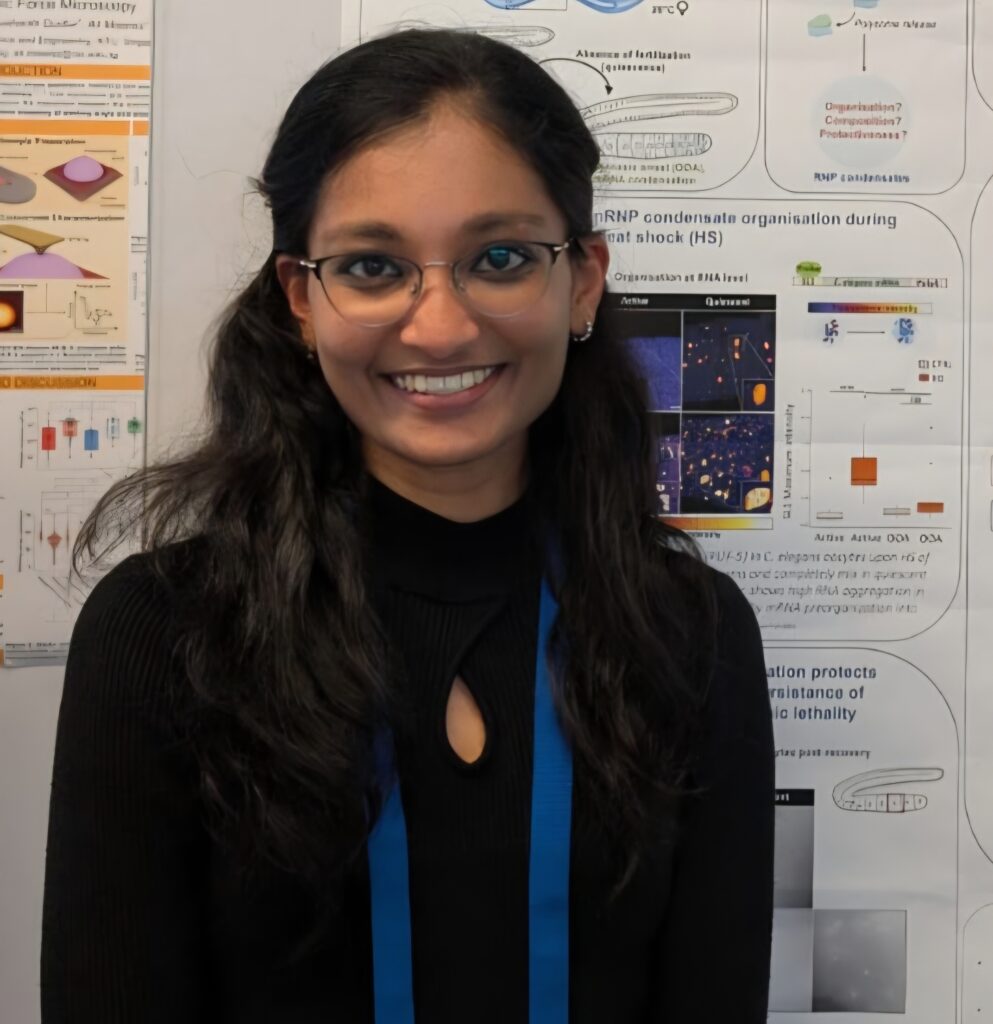
Université Côte d’Azur, France
Abstract:
Maintenance of cellular homeostasis in the face of stress requires robust control of gene expression, associated with extensive remodeling of the transcriptome across diverse mRNP condensates. We previously demonstrated that the accumulation of non-translated mRNA upon oocyte quiescence is buffered by dynamic P-body reservoirs that are critical to maintain RNA:protein stoichiometry (Cardona et al, Cell 2023). Whether these maternal mRNA reservoirs could structurally protect mRNPs from environmental stress, what distinguishes them from stress-induced pathological RNP aggregates and if these mRNA super-assemblies can control transcriptome composition during the cellular adaptation to stress, remain poorly understood. We address these questions in the C. elegans germline via a combinatorial approach involving single-molecule sensitivity RNA imaging, live protein dynamics, functional assays and FAPS purification (Hubstenberger et al., Mol Cell 2017) and sequencing of stress-induced RNA condensates.
We demonstrate how, depending on whether thermal stress is applied to a quiescent or metabolically active oocyte, transcriptome condensate partitioning and the interaction between preexisting P-bodies and de novo stress granules is strikingly different. Surprisingly, preorganizing mRNA into quiescence-induced physiological condensates before heat shock preserves RNPs from hyper-compaction, improves RBP solubilization, and rescues embryonic fitness, suggesting a protective role for condensate organization in cellular adaptability. Additionally, when comparing between different temperature stresses, while classic transcriptomics does not identify major differences in the whole cell transcriptome composition, sequencing of stress-specific RNA condensates after FAPS reveals a dramatic reorganization of the condensate transcriptome. Interestingly, the identity of condensate mRNAs is selectively remodeled, suggesting an adaptive mechanism tailored to the kind of stress.
Altogether, our study provides evidence that quiescence-induced condensation may preserve RBPs from stress-induced pathological aggregation and show that through their stress-dependent composition and selectivity, RNA condensates might be major players in the adaptive oocyte stress response.
Functional dissection of the NUP98::KDM5A condensome in pediatric leukemia
Authors: Gabriel Kaufmann, Pablo Fernandez Pernas, Thomas Eder, Melanie Allram, Florian Grebien, Bernhard Hochreiter, Anna-Maria Husa, Christina Horstmann
Presenter: Gabriel Kaufmann

University of Veterinary Medicine, Vienna, Austria
Abstract:
Pediatric Acute Myeloid Leukemia (AML) is a highly aggressive disease with poor outcomes and limited treatment options. In NUP98-fusion AML, the intrinsically disordered N-terminus of NUP98 is fused to >30 partner genes. The resulting fusion oncoproteins lead to aberrant gene expression that disrupts myeloid differentiation.
We and others have shown that NUP98 fusion oncoproteins undergo liquid-liquid phase separation to form biomolecular condensates in the nucleus of AML cells. While it is known that these “onco-condensates” drive aberrant gene expression, it is unclear which factors influence condensation of NUP98::KDM5A fusion oncoproteins and how they can be directly targeted. To identify and perturb components that are critical for NUP98::KDM5A condensation we mapped the interactome of NUP98::KDM5A using bioID. We identified several H3K9me2-histonedemethylases (KDMs), including KDM3B, JMJD1C and PHF8 among 60 proteins that were abundantly enriched in biomolecular condensates driven by the NUP98::KDM5A fusion oncoprotein. CRISPR/Cas9-mediated knockout as well as pharmacological inhibition of H3K9 KDMs caused differentiation arrest and apoptosis in NUP98::KDM5A-driven AML.
To investigate direct effects of NUP98::KDM5A interactors on biomolecular condensation, we developed a flowFRET assay that combines flow cytometry and Förster-Resonance-Energy-Transfer. By co-expression of NUP98::KDM5A variants tagged with mCherry and eYFP, respectively, this assay allows to test proximity and interaction strength of NUP98::KDM5A within biomolecular condensates and how these parameters change upon perturbation of H3K9me2 KDMs.
We expect that this approach will identify new potential targets for direct targeted therapy of AML that will block leukemia development and maintenance via the perturbation of “onco-condensates”.
Due to the confidentiality of the unpublished data, we cannot share the poster.
Engineering of tunable condensate systems for membrane proteins and metabolons
Authors: Aditi Kakkad, Dmitri Linnik, Bert Poolman
Presenter: Aditi Kakkad

University of Groningen, The Netherlands
Abstract:
Liquid–liquid phase separation (LLPS) of membrane proteins remains relatively unexplored, yet membrane-associated biomolecular condensates may be a mechanism for the spatial organization of cellular processes. The physical principles governing their formation, localization, and functional consequences, however, remain poorly understood. Previously, we showed that fusion of the engineered condensate-forming domain of PopZ (named PopTag) to the Escherichia coli inner membrane lactose transporter LacY induces functional membrane-associated condensates that preferentially accumulate at bacterial cell poles. Initial observations suggest that membrane curvature drives the polar localization.
We now study how membrane curvature, lipid environment, and potential cytoskeletal contributions influence condensate positioning and stability. In parallel, we are engineering condensate systems based on the PopTag architecture to modulate valency, interaction strength, and spatial organization, while systematically controlling the strength of condensate formation. These engineered systems serve both as mechanistic probes and as platforms for incorporating membrane proteins together with metabolic enzymes, with the goal of achieving control and spatial organization of metabolism in synthetic cells.
Together, this combined mechanistic and engineering approach aims to advance understanding of membrane-associated phase separation in bacteria, while establishing design principles for programmable biomolecular condensates in living cells and cell-like systems.
Due to the confidentiality of the unpublished data, we cannot share the poster.
The prize was kindly sponsored by FEBS Letters
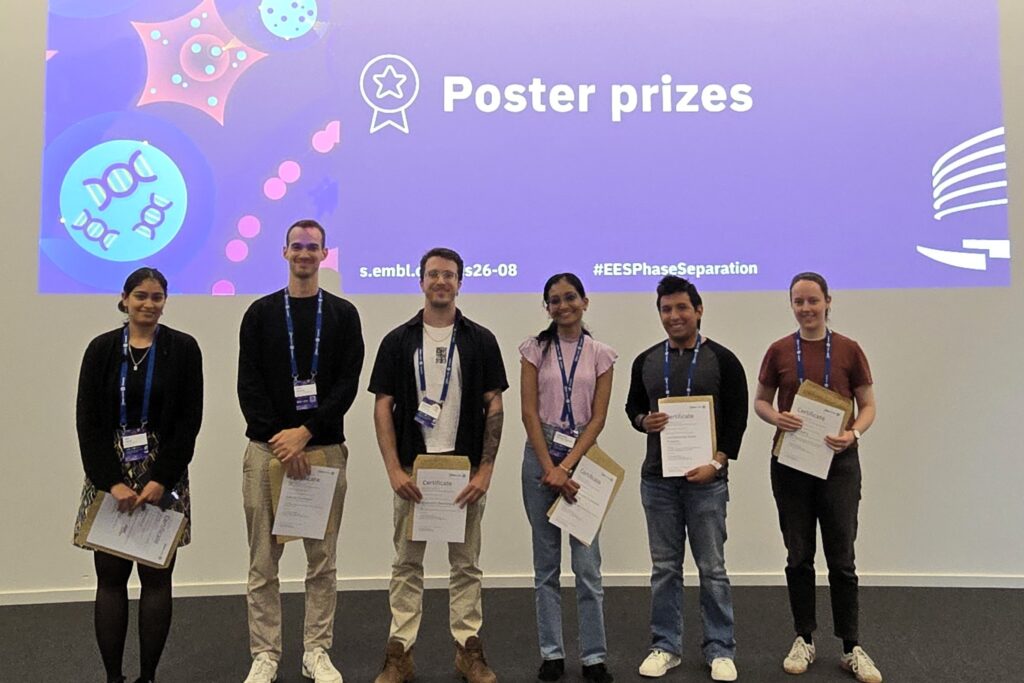
The EMBO Workshop ‘Cellular mechanisms driven by phase separation’ took place from 19 – 22 May 2026 at EMBL Heidelberg and virtually.
Find out more about the cellular phase separation research done at EMBL Heidelberg by the Cuylen Group and sign up for our newsletter not to miss any upcoming events and news on the topic.