Gorka Bravo on combining computer skills and field work at AZTI
While in Spain, ARISE Fellow Gorka Bravo gained practical experience in marine biology and developed a data tracking platform for FAIR data management of environmental DNA experiments.
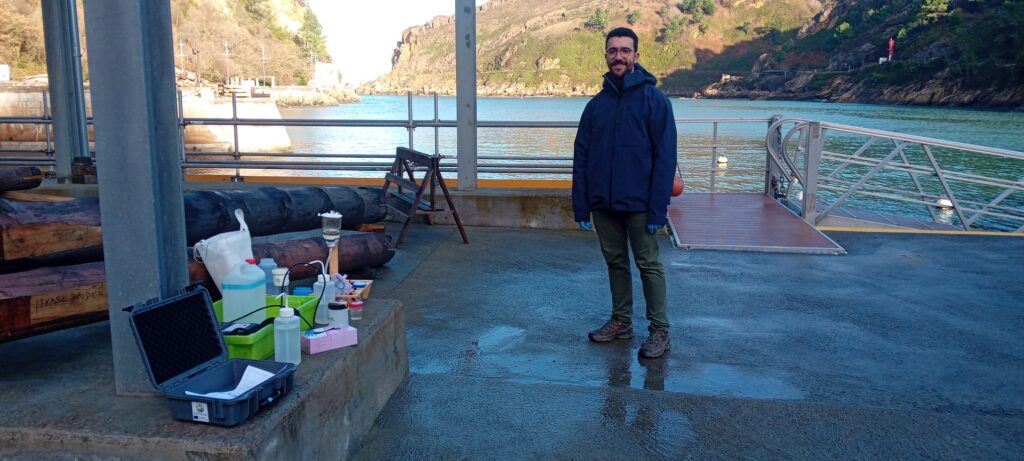
ARISE fellow Gorka Bravo on his field work expedition during his secondment at AZTI. Credit: Anders Lanzén
Tell us about your scientific background.
My background is in Computer Science. I studied at the University of the Basque Country and later at the University of Grenoble Alpes. Before joining EMBL, I worked at CERN on service provisioning and research infrastructure projects. Here, I was exposed to large-scale infrastructure projects involving thousands of people from many countries and universities. Additionally, this experience gave me an understanding of how international organizations operate, with their own distinctive ways of conducting research, managing contracts, and administering operations.
With that previous experience at CERN, I joined the ARISE programme in the group of Josan Marquez at EMBL Grenoble. Here, I work on building data workflows for fragment screening and crystallization experiments at the high-throughput crystallization facility, where we serve many users worldwide with their protein targets and fragment screening experiments. The protein’s diffraction occurs at the synchrotron, which produces vast volumes of data, and we manage them. Thus, we have built pipelines for long-term storage, data sharing, and deposition into EBI repositories.
What drew you to the ARISE Programme?
I applied for a position that was advertised at EMBL, but it had already been filled. However, my supervisor, Josan, reached out to me and suggested writing a project proposal for the ARISE programme. I then joined the team for a year on a supernumerary contract, during which we successfully wrote the ARISE project proposal.
The program seemed very appealing to me from the start, and I’m glad I was accepted. It provided me with an opportunity to learn and gain new skills. For instance, one notable aspect was how the ARISE summer school opened doors for us to various working groups at EMBL, not only in scientific fields but also in areas such as administration, strategy, recruitment, and more. This experience gave me a broad perspective on the organization and, in retrospect, helped me understand many aspects of large institutions like EMBL and CERN.
What did you do during your secondment, and why did you decide to go to AZTI?
It was a coincidence that I chose AZTI. I came across a paper from Anders Lanzén, a senior researcher at AZTI, and after reading it, I thought it would be nice to do my secondment there. I contacted him, and he was very welcoming and supportive. During my four-month stay, we worked together on adopting technologies for data FAIRification (Findable, Accessible, Interoperable, and Reusable), similar to my work at EMBL, but in a totally different field, specifically in Marine Biology and environmental DNA (eDNA) experiments.
To provide some context, eDNA experiments generate substantial amounts of data that need to be openly available to enable monitoring of environmental changes over time. Additionally, many grant applications require you to publish your data in a repository and ensure it complies with FAIR principles. When a project is finalized, consolidating the data for deposition and publication might be a massive task, especially when multiple people work on the same project and use different Excel files and data-processing scripts. It is therefore essential to track data throughout the generation cycle and ensure it is ready for publication or deposition in the most automated way possible. In light of this need, we developed a data-tracking platform at AZTI for eDNA experiments, building it on existing research from the University of Maine. An installed, working version of our software is now available at AZTI and on GitHub for anyone looking to manage eDNA samples and metadata.
What new experiences or opportunities did the secondment provide for you?
I had a first approximation to marine biology, particularly to eDNA and how this technique is used to monitor the environment. More concretely, I learnt about metagenomics and metabarcoding, which I had never seen before. Additionally, I had the opportunity to go on a few field outings, which was nice to see and experience, since, as a Computer Scientist, I don’t have many opportunities to do so.
Furthermore, it helped me expand my network a lot. I got to know many people at AZTI, and in my case, it opened new opportunities in a field I didn’t know existed. It even helped me meet people from different departments at EMBL. Thanks to this experience, I got in touch with people at TREC once I returned.
What are your thoughts on AZTI as a secondment option for ARISE?
I think AZTI offers a great environment for any ARISE fellow seeking a secondment. It has 3 sites in the Basque Country and offers a wide variety of research lines: marine climate change, oceanography, biotechnology solutions for the food industry, environmental monitoring, etc. It is especially interesting for those fellows looking for applied, interdisciplinary research with clear societal and industry links. The institute has a strong applied-research network, as well as advanced infrastructures for marine research and working groups with a range of skills.
What interests or hobbies do you enjoy outside of work?
Many of my hobbies are related to the city; Grenoble has an excellent location for outdoor activities. I like to ski in the winter and climb in the spring and summer. When I have more time, I enjoy traveling by bike. When I ended working at CERN, I rode across France to return home by bike, and I believe I’ll do it again once I’m finished at EMBL.
About AZTI
The Marine and Food Research Center (AZTI) is a private foundation and a member of the Basque Research and Technology Alliance (BRTA). AZTI develops scientific and technological knowledge across three broad areas: marine environment and climate change; healthy and sustainable food; and digital transformation and industrial innovation. As a partner in the ARISE Programme, AZTI collaborates with EMBL to support the training of fellows by hosting them for their secondments. EMBL is grateful to AZTI for its support of the ARISE mission. Applications for the ARISE2 programme will be open from June 29 – September 30.