From static papers to living models: turning limb development research into interactive science
LimbNET is a new online platform that integrates computer modelling, experimental data, and 2D live simulations
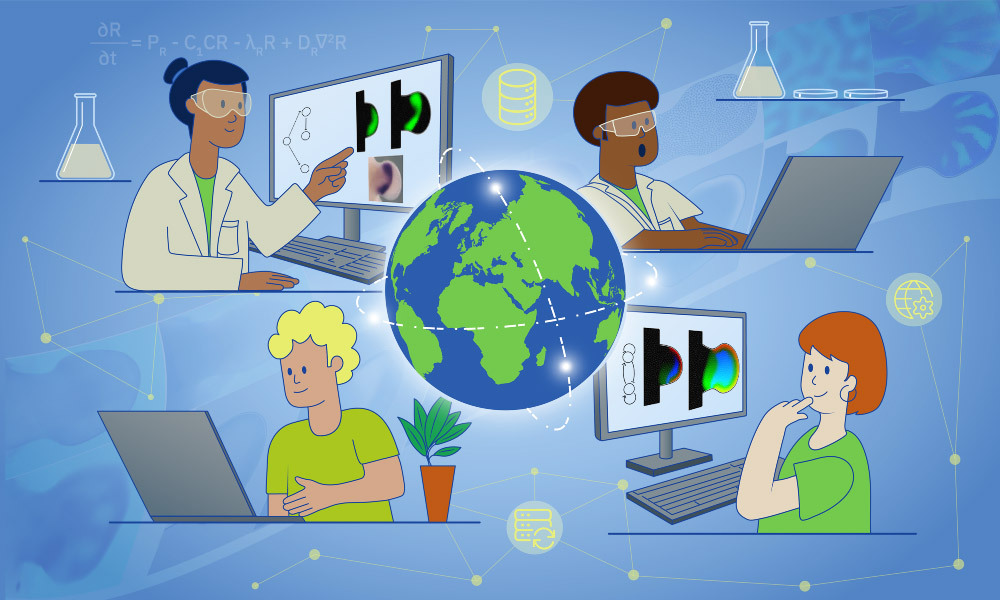
LimbNET is a new type of platform allowing researchers to define and simulate custom gene regulatory networks, making it easier to test and compare hypotheses within a shared framework. Credit: Daniela Velasco/EMBL
Summary
LimbNET, a new open-access and user-friendly platform from EMBL Barcelona, enables scientists to simulate how gene networks pattern the embryonic limb as it develops, integrating data on gene expression over time and space with live 2D modelling.
By centralising models and simulations, LimbNET aims to foster collaboration, transparency, and cumulative knowledge-building within the global limb development community.
The platform represents a new mode of scientific publishing by allowing researchers to share fully interactive models – data, equations, and simulations – through a single integrated portal, promoting reproducibility and engagement with published research.
The choreographed movements that cells perform to form complex biological shapes, like our hands, have fascinated scientists for centuries. Now, researchers at EMBL Barcelona have launched LimbNET, an open-access online platform that allows scientists to directly choreograph this dance by computationally simulating how genes guide these intricate growth processes. Their work has recently been published in the journal Molecular Systems Biology.
LimbNET is much more than a simple data repository. It is a new type of platform allowing researchers to define and simulate custom gene regulatory networks, making it easier to test and compare hypotheses within a shared framework. Having all existing models for limb development together will empower users to explore, simulate, and challenge or build upon each other’s work, promoting cumulative knowledge building.
Antoni Matyjaszkiewicz (left) and James Sharpe (right), authors of the publication. Credit: Carla Manzanas/EMBL
“Our aim with LimbNET is to have everything in one place, so that the data, the models and the simulations are not scattered across research groups, countries and institutes,” said Antoni Matyjaszkiewicz, first author of the work and Research Staff Scientist in EMBL’s Sharpe Group. “The limb development community is not huge, so we feel like this is a realistic way of enhancing collaboration, transparency and empowerment for our peers to collectively advance in this field of research.”
The cherry on the cake is that one does not need to download or install any software to use LimbNET – any user in the world can access it through their browser and start experimenting. The project thus helps democratise access to advanced modelling tools for the global scientific community.
“One of LimbNET’s most revolutionary aspects is how it changes the way scientists can publish their work,” said James Sharpe, Head of EMBL Barcelona and senior author of the study. “In addition to the traditional approach in which text, figures, and movies are presented as a fixed piece of work in a journal, researchers can now also present an interactive and extendable version of the study that captures the entire logic of their ideas. It presents an accessible, dynamic version of the simulations that anyone can adjust, explore and challenge.”
“This is like going from a static cookbook with text and photos to a kitchen where you can try the recipe yourself, tweak the ingredients, or see what happens if you change the oven temperature,” he explained.
LimbNET introduces a clear shift in how developmental biology research can be communicated and challenged. By making all aspects of a study, from the experimental images and mathematical models to the dynamic simulation itself, openly accessible and executable, the platform allows other researchers to fully interrogate, validate, or challenge published work. This represents a new model of scientific publishing where the underlying logic of a paper can be tested directly and immediately by any other scientists, fostering reproducibility and critical engagement. It opens the door to a living ecosystem of models that evolve as new data and insights emerge.
While it’s early days yet for the LimbNET project, the authors believe it will help the rest of the community get into modelling, especially those who have little or no experience with computer simulations, and eventually grow the portfolio of available models. The platform’s simplicity and user-friendly interface make it approachable for researchers without prior experience in modelling. For example, researchers can start by tweaking an existing model, rather than creating one from scratch. This will enhance interdisciplinarity and promote discussion among scientific peers with different backgrounds.
“Another important aspect of this project is creating conversations in the community, between experimentalists and computational researchers,” said Matyjaszkiewicz. “This tool, like many others, can help us refine experiments, rethink aspects of the way we approach hypotheses, but it is also about creating a cohesive way of understanding what models are. Models, for me, are a set of equations that can be translated into simulations and support or challenge hypotheses. Currently, the more common type of hypothesis is a verbal model – a qualitative description of how a mechanism works, so one of our goals is to bring those verbal models into our computational systems to make them tangible, reproducible, and quantitative.”
The platform has been well received by the community, which highlights its innovative way of studying limb development.
“LimbNET opens an exciting and innovative new avenue as it facilitates moving from studying gene interactions to integrative analysis of complex networks.” said Rolf Zeller, Professor at the University of Basel. “I like very much that LimbNET is a platform open to the community at large.”