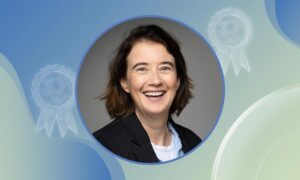
The EMBL Grenoble group leader joins this network in recognition of his significant achievements in the field of structural biology research.
EMBL group leader Wojciech Galej has been elected as an EMBO member. Credit: Wojciech Galej/EMBL
Wojciech Galej, EMBL Grenoble Group Leader, was elected as a new member of the European Molecular Biology Organisation (EMBO) in recognition of his outstanding achievements and research excellence in the life sciences.
The structural biologist joined EMBL in 2016 to set up a research group focusing on pre-mRNA splicing, a crucial step in gene expression. During this process, a protein complex known as the spliceosome edits out numerous RNA sequences (called introns) that are not needed for making new proteins. Dysfunction of this molecular machine can lead to genetic diseases. In 2020, Galej received an ERC Starting Grant to study the minor spliceosome – a specialised spliceosome variant, which removes a rare but important class of introns from our genetic information. More recently, he obtained an ERC Consolidator Grant to study splicing regulation in the native cellular context using cutting-edge structural biology methodologies.
Alongside a new cohort of 71 researchers, he is joining a network of more than 2,200 leading life scientists in Europe and beyond. Elected members of EMBO support the organisation’s programme and activities, shaping the future of European science and fostering stronger research networks across the continent and globally.
“I am truly honoured to receive this recognition. EMBO is a unique organisation that has long played a pivotal role in promoting fundamental research and shaping the global scientific landscape,” said Galej. “I look forward to contributing to the EMBO community through my research, collaborations, and other activities that support scientific excellence.”
The EMBL Group Leader will be moving his lab to the International Institute for Molecular and Cell Biology (IIMCB) in Warsaw, Poland, this autumn.
This year’s nominations also include the following EMBL alumni: Brian Burke, A*STAR Skin Research Labs, Singapore; Arshad Desai, University of California San Diego; Roderic Guigó, Centre for Genomic Regulation and Universitat Pompeu Fabra, Barcelona; Virginie Hamel, University of Geneva; Karen Oegema, University of California San Diego and Ludwig Institute for Cancer Research; Elena Seiradake, University of Oxford; Maria Tosches, Columbia University; Jaak Vilo, University of Tartu.