Nuage Therapeutics obtains €2.7 million to develop a pioneering treatment against the most aggressive lung cancer
The funding will support a research project focused on developing a new drug against the most common subtype of small-cell lung cancer.
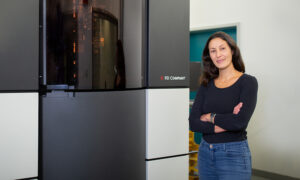
Dayton and her group will lead the development of patient derived tumour organoids, that are grown directly from patients’ tumour tissue to closely mimic real tumours. Credit: Montserrat Coll Lladó/EMBL
Joint press release with Nuage Therapeutics
Nuage Therapeutics has secured €2.7 million in funding from the Spanish State Research Agency (AEI)of the Ministry of Science, Innovation and Universities under the R&D&I State Programme for Transfer and Collaboration. The funding will support a research project focused on developing a new drug against the most common subtype of small-cell lung cancer (SCLC-A), in collaboration with the Spanish National Cancer Research Centre (CNIO), the European Molecular Biology Laboratory in Barcelona (EMBL Barcelona), and the Vall d’Hebron Institute of Oncology (VHIO). The main objective of the project is to reach the clinical phase with a robust dataset demonstrating the efficacy and safety of the drug candidate NTX-A, which has been one of the primary focus of resources over the past year.
The consortium has already initiated the development of NTX-A, a pioneering drug targeting the ASCL1 protein, which plays a key role in the onset of the most common type of small-cell lung cancer (SCLC-A). This subtype is associated with a pronounced neuroendocrine profile and rapid tumour progression, contributing to its particularly aggressive clinical behaviour.
“This grant validates our approach to tackling intrinsically disordered proteins and accelerates our mission to deliver a new generation of transformative precision therapies for severe illnesses where effective treatments are still lacking,” says Stuart Hughes, recently appointed CEO of Nuage Therapeutics.
The spin-off from the Institute for Research in Biomedicine (IRB Barcelona) is dedicated to pioneering a novel drug discovery approach, directly targetingintrinsically disordered proteins (IDPs) — therapeutic targets traditionally considered undruggable and associated with serious diseases such as cancer, which have so far remained beyond the reach of conventional treatments.
“We are very excited to be a key partner in this project and bring the expertise of organoid development that we have at EMBL Barcelona. It is through interdisciplinary partnerships like this one that we can effectively advance in the field of cancer research,” says Dr. Talya Dayton, Group Leader at EMBL Barcelona. Dayton and her group will lead the development of advanced laboratory models, called patient derived tumour organoids (PDTOs), that are grown directly from patients’ tumour tissue to closely mimic real tumours. Once developed, the organoids will be classified by their molecular subtypes and ASCL1 status to test protein inhibitors and their ability to stop tumour growth. The effects of the drugs will be assessed against cell survival, gene activity, ASCL1 expression, and toxicity, helping the team identify the most effective and safest candidates for future preclinical development.
“The main goal of the project is to inhibit ASCL1, a protein that not only gives the name to a subtype of small cell lung cancer, SCLC-A, but is also known to drive this disease,” indicates Dr. Marcos Malumbres, Director of the Systems Oncology programme and head of the Cancer Cell Cycle laboratory at VHIO. “However, we also know that aggressive tumours evolve, especially under some therapies, and may lose their dependence on ASCL1. We will investigate these mechanisms of tumour evolution and resistance to ASCL1 inhibitors for a better future application of this type of therapies in the clinic.”
Innovation for ‘undruggable’ proteins
A large proportion of the human proteome contains proteins with high levels of intrinsic structural disorder and, therefore, are not suitable for conventional drug discovery methods. Around 40% of human proteins include intrinsically disordered regions (IDRs). These regions — and, in some cases, entire proteins — do not adopt a fixed and stable three-dimensional structure but instead remain flexible and dynamic, like ‘molecular chains’ in constant motion. This flexibility allows them to interact with many other molecules and participate in a wide range of cellular processes, but it also makes them elusive targets for traditional drugs.
In cancer, this property is particularly relevant, as many proteins involved in tumour onset and progression — such as oncogenic transcription factors — exhibit a high degree of structural disorder. These proteins regulate the activity of numerous genes and control processes such as cell division and differentiation, but their flexible nature keeps them beyond the reach of classical therapeutic approaches, representing one of the major challenges in modern biomedicine.
Nuage Therapeutics has developed an innovative technology that enables interrogating intrinsically disordered proteins (IDPs) in their transient more ordered structures, in which they are susceptible to being recognised and inhibited by drugs. This strategy opens up a new avenue for designing therapies against proteins that, until now, were considered undruggable.
The company’s patented platform enables to zoom in on the temporarily adopted IDP structures, which are relevant in the native cellular context. This allows researchers to design drugs capable of recognising and acting on them — something that was previously impossible. This breakthrough represents a paradigm shift in drug discovery, turning protein ‘disorder’ into a therapeutic opportunity. For years, these proteins were considered unreachable targets due to their flexibility and the difficulty of controlling their function with traditional compounds.
A new strategy against the most aggressive form of lung cancer
Among the diseases that could benefit from this technology, small-cell lung cancer (SCLC) stands out as one of the most aggressive and difficult-to-treat forms. Despite advances in immunotherapy and chemotherapy, treatment options remain limited, and patient survival has barely improved in recent decades.
In cancer, many proteins involved in tumour initiation and progression — such as oncogenic transcription factors — exhibit a high degree of structural disorder. These proteins regulate the activity of numerous genes and control processes such as cell division and differentiation, but their flexible nature keeps them beyond the reach of classical therapeutic approaches, representing one of the major challenges in modern biomedicine. In this type of lung tumour, the ASCL1 protein drives the growth and survival of cancer cells by reactivating neural development genes that, when out of control, fuel the spread of the disease.
In this context, Nuage Therapeutics is opening a new path to tackle small-cell lung cancer of the SCLC-A subtype, a form responsible for a significant proportion of SCLC cases and one that currently lacks effective treatments. By allowing to interrogate the ASCL1 protein’s transiently adopted stable structures, this technology could allow the identification of molecules that bind to it and neutralise its oncogenic activity.
Beyond this tumour, Nuage Therapeutics’ breakthrough could extend to other diseases driven by disordered proteins, establishing a new frontier in the rational development of drugs.
Funding Acknowledgement
The Public-Private Partnership Programme is awarded by the Spanish State Research Agency (AEI) under the Spanish State Plan for Scientific, Technical and Innovation Research 2024-2027.
Research Project Reference: CPP2024-011304. Funded by MICIU/AEI.