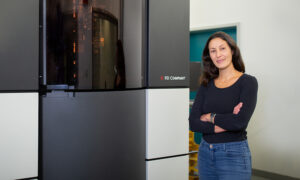
EMBL scientist honoured with the German Research Foundation award for her work on in-cell structural biology.
Julia Mahamid honoured with the German Research Foundation award for her work on in-cell structural biology. Credits: Photolab/EMBL
The German Research Foundation (Deutsche Forschungsgemeinschaft, DFG) has named 10 scientists as the recipients of the 2026 Förderpreis im Gottfried Wilhelm Leibniz-Programm today. Among the researchers honoured for outstanding work in all scientific disciplines is Julia Mahamid from the European Molecular Biology Laboratory (EMBL).
Julia Mahamid receives the Leibniz Prize for her “contributions to in situ structural biology, which have taken our understanding of molecular architecture and cellular processes to a new level.”
Mahamid will receive a prize of 2.5 million EUR, which she will be able to use for research in the field of structural cell biology over the next seven years.
Following a PhD at the Weizmann Institute of Science, Mahamid worked as a postdoctoral researcher at the Max Planck Institute of Biochemistry. She joined EMBL as Group Leader in 2017 and became a senior scientist in 2021. Since 2024 she heads the Molecular Systems Biology Unit together with Nassos Typas. She is a member of the European Molecular Biology Organisation (EMBO) and has received numerous awards, including the EMBO Gold Medal (2023), the Frankfurt Biophysics Prize (2022), and the Ernst Ruska Prize (2021).
The Mahamid Group brings together disciplines in structural and cell biology, specifically the understanding of protein biogenesis, biomolecular condensates and state-of-the-art cryo-electron tomography. Together with her colleagues she works to advance our understanding on the functional organisation of diverse cells. In doing so, Mahamid continuously develops and advances cutting-edge techniques for in-cell structural biology to study three-dimensional structures of biological macromolecules.
“This recognition reflects the collective efforts of my team and our dedication to uncovering how molecular structures organise and function within living cells. I look forward to continuing to push the boundaries of in-cell structural biology and to reveal the fundamental principles that govern cellular life. I am deeply honored to receive the Leibniz Prize.”