We are EMBL: Daniel Santos-Oliván on staying flexible as AI reshapes research
Daniel Santos-Oliván, Computational Scientist in the Torres-Sánchez group at EMBL Barcelona, talks about bringing the tools of theoretical physics to biology and how artificial intelligence is reshaping the way we do science
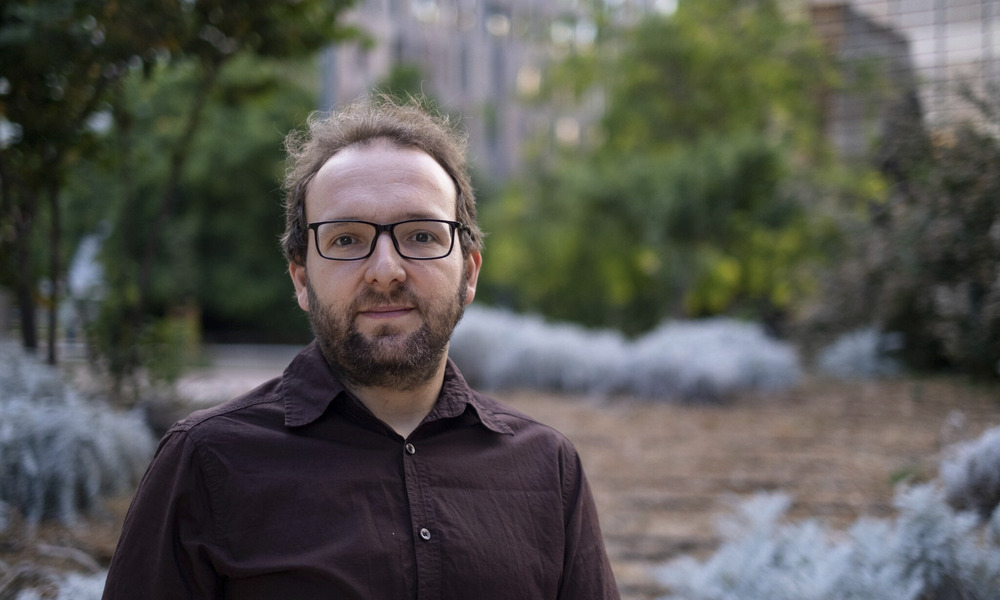
written by Arnau Fabra Ruiz, ARISE Research Fellow at the Torres-Sánchez Group
To grow, living tissues must fold, curve, and flow into precise shapes. Describing that geometry needs some surprisingly heavy mathematical machinery, the same differential geometry once reserved for describing black holes and the fabric of spacetime. This is why, increasingly, researchers trained in physics are putting it to work on understanding living matter.
Daniel Santos-Oliván is one of those researchers: he builds mathematical and physical models of biological systems in which mechanics and geometry play a central role. Here, he reflects on what keeps the work exciting, how artificial intelligence is reshaping not only how science is done but how it is published and reviewed, and why rigour, ethics, and flexibility matter more than ever.
Tell me a little bit about your background.
I did both my bachelor’s degree and my PhD in physics, with my doctoral work focusing on general relativity. Since then, I’ve had a good journey: I first worked as a computational scientist, then as a software engineer in industry, and in recent years I’ve been a computational scientist in the Torres-Sánchez group. Here, I develop mathematical and physical models for biological systems, in particular, questions related to embryonic development and problems where geometry is especially relevant.
What’s the most exciting part of your work?
The most exciting part is the constant challenge of facing completely different biological systems. Each one requires you to learn the particular biology of that system and sometimes to search for new tools or new ideas. We’re always learning something new, not only on the biological side but also on the physical and computational sides. Every project and collaboration that comes up opens new doors, and that’s what appeals to me most: the constant challenge that keeps you learning and discovering new things.
How do you apply physics to biology?
I think there are two ways. The first one is how physics trains you really well in problem-solving and in addressing challenges from a mathematical point of view, across very different and very diverse problems. The second is that many of the mathematical tools I used in general relativity, differential geometry in particular, are very similar to the ones we apply in our lab, where we work with complex geometries, especially surfaces. For example, I have worked on reconstructing and analysing the complex shapes of the developing zebrafish heart and of malaria-infected red blood cells.
How do you see your work evolving over the next few years?
I think we are currently at a crossroads, mainly because of artificial intelligence. In recent years, we’ve seen it evolve at a speed and in ways that very few people were able to predict, and that’s transforming science rapidly. We’re seeing not only how it has influenced us on a day-to-day basis, with the constant use of AI tools, but we’re also starting to see how it’s affecting science as a whole. Not only how we do it, but how it is reviewed and published. It is now very difficult to make predictions about what our work will look like in five or 10 years. Our field has been one of the first to feel this, because one of the first things AI did quite well was to write code. But in the last few months we’re also seeing how good it is at solving mathematical problems that until recently seemed out of reach. All of this presents big opportunities but also enormous risks from the political, ethical, and environmental points of view that I am not sure we are prepared to address.
What advice would you give to scientists, especially those starting out?
One important thing I’d say to everyone is that now, more than ever, it’s important to stay flexible in our skills and in our mindset, because in this changing world, we can’t imagine what the next five years will bring. On the science side, I think this is the moment to take ethics and rigour very seriously. AI is opening up paths to do science much faster, but we have to make sure that it also helps us do better science. Not just more and faster, but more rigorous and with more impact. And to young people in particular I’d say: don’t be guided by whatever is trendy right now. Let yourself be guided by what you think is important, or by what you find most interesting. If you move towards what you’re most passionate about, I think that will also help you achieve your goals.
A book you’d recommend?
One of the books I recommend to almost anyone is The Dispossessed: An Ambiguous Utopia by Ursula K. Le Guin. One of the reasons I love it is because it helps us think about a better world, about a utopia. It makes us reflect on important topics like what the word freedom really means, but it doesn’t do it from a naïve or idealised standpoint, but from a realistic one. It shows how even a society free by design still needs to be built every day. And I think that today, imagining and reflecting on better worlds, or even just different ones, is very relevant.
A song for the rest of your life?
One song I would choose is Stairway to Heaven by Led Zeppelin, not only because I consider it one of the best songs in the history of music and they’re my favourite band, but also because it’s complex enough that you’d never get tired of it for the rest of your life. If I can cheat, I would also choose Mayéutica by the great Robe, which is actually an album but I like to see it as a song split into four movements.
What do you do in your free time?
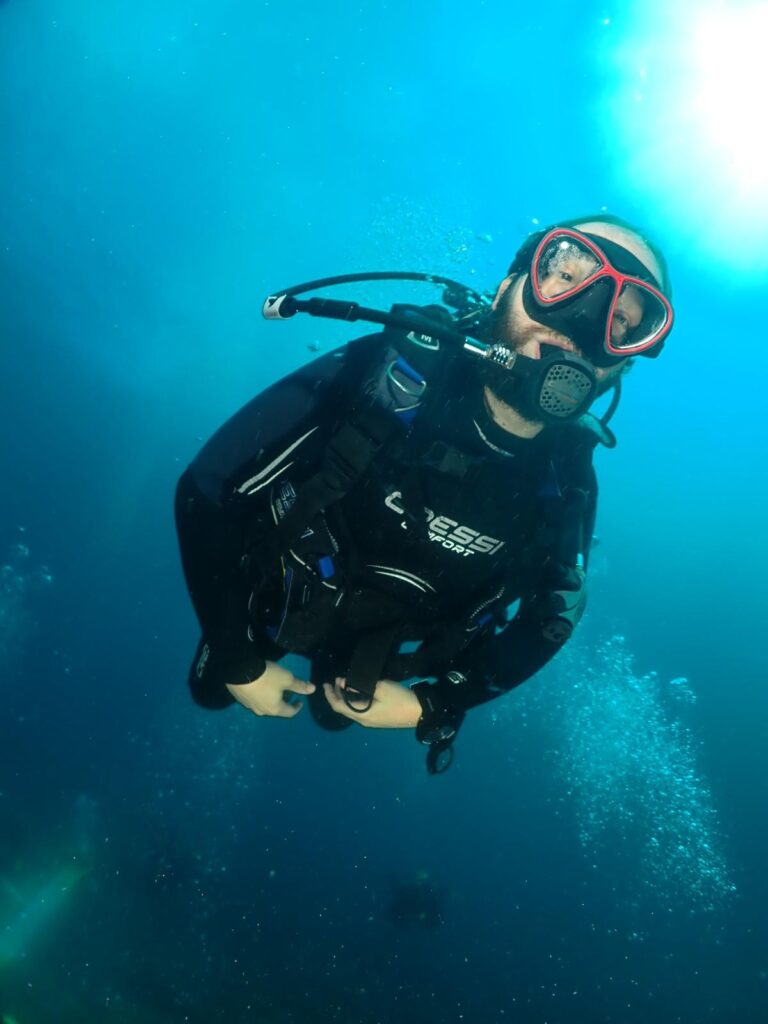
Some things that I love doing are travelling, reading, and writing, but one of my most recent passions is scuba diving. It is incredible how something as simple as going a few metres down into the sea can transport you to a completely different world and give you a sense of peace and calm that’s hard to find anywhere else.