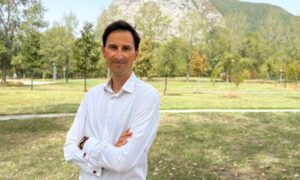
Welcome: Athanasios Athanassiadis
EMBL’s new Head of Scientific Instrumentation Workshops discusses how building customised experimental setups can enable exciting new research
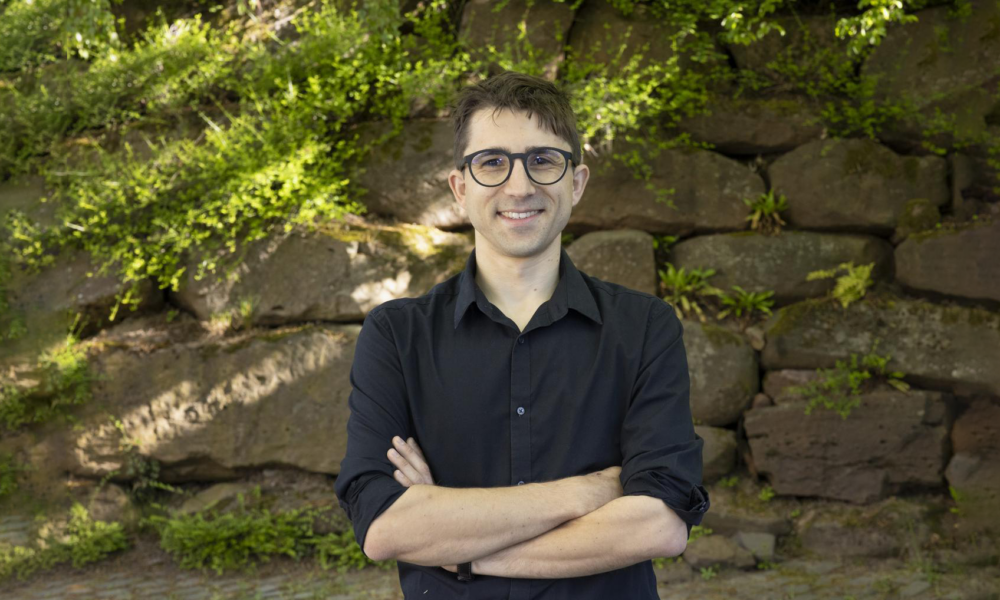
From fluid mechanics to nanomaterials to medical devices, Athanasios Athanassiadis has had a career spanning many research fields. His work led him to appreciate the important role customised experimental setups play in expanding the range of questions scientists can answer with their experiments. Recently, he has taken up the role of Head of Scientific Instrumentation Workshops at EMBL, where he will act as an interface between the scientific workshops and researchers to help create customised hardware solutions for research projects.
We had the opportunity to catch up with Athanassiadis and learn about why he believes scientific instrumentation is important, how scientific workshops can enable frontier research, and how he recharges his batteries outside of work.
Can you tell us a little about your professional background?
My undergraduate degree is in physics from the University of Chicago, USA, following which I completed my Master’s and PhD in mechanical engineering from the Massachusetts Institute of Technology (MIT). For postdoctoral training, I first moved to the Max Planck Institute for Intelligent Systems in Stuttgart, Germany, and later moved to a joint position at Heidelberg University and the Max Planck Institute for Medical Research.
During all of these experiences, I explored a range of scientific fields and technologies – from soft matter physics and fluid mechanics through various forms of imaging and sensing (x-ray, light, acoustic) to the microscale interactions between sound and responsive materials (e.g. antibubbles, nanomaterials, cells, tissues).
While my focus has shifted over time, what’s remained constant is that I’ve always been very active (and enjoyed) building custom measurement hardware and experimental setups to access information that I needed to address the research question at hand. When this role came up at EMBL, it seemed like a great fit for my expertise and an excellent opportunity to take this further.
What role do scientific workshops play in enabling cutting-edge research? Can you give an example of a project that can benefit from such instrumentation expertise?
When we want to answer a question with experiments, we need to interact with the physical world, whether to observe or to modify a sample we’re interested in. In some cases, we can do this with commercially available tools. In many cases – especially when we’re pushing the boundaries of what’s known and what’s possible experimentally – we need workflows or measurement methods that are only possible with tailor-made tools. These kinds of custom tools are the core of what the scientific workshops can provide. The workshops at EMBL house both expertise in instrumentation design and resources to produce those designs. This lets us work with EMBL scientists to define, design, and deliver custom hardware that will enable new experiments.
Concretely, we can help at all stages of the development process: whether someone wants to brainstorm new ideas, needs some input on possible new commercial systems to consider, or has concrete designs that they want feedback on or need manufactured. We’re flexible and adaptable to the user’s needs, and this is one of the unique benefits of having such a service available in-house.
Along with our development services, we also have an entire team dedicated to service and repair who can help keep instruments running effectively and quickly troubleshoot when things don’t work.
What does your role as Head of Scientific Instrumentation Workshops involve, and what are your main priorities at the moment?
I am currently focusing on meeting and listening to researchers across EMBL. I’m attending talks and reaching out to groups at all of our sites for individual discussions to understand their current needs and challenges. Of course, my door is also open for walk-ins, and I enjoy being able to help address short-term engineering challenges along with the longer-term projects we’re developing.
An exciting part of this role is that I can support research groups by co-supervising students, postdocs, and fellows, to complement their scientific expertise with formal design training and hands-on engineering experience. In the long run, I’m also happy to support codevelopment efforts with industrial partners and tech transfer of the technologies we develop with research groups in-house.
For the next year, on a high level, I am prioritising getting to know the research groups, including visits to each site, and understanding where the major instrumentation development needs will be over the next few years. This will let us identify what kinds of tools and approaches we should build up to best support the next generation of research hardware we develop. Day-to-day, my priority is of course to support my team with whatever they need so that we can effectively deliver on the requests that the research groups come to us with.
What do you like most about your job and EMBL?
I really appreciate the diversity of interesting research projects I get to contribute to, and I enjoy the process of turning an idea into a mature, useful tool that enables new scientific insights. What I love about EMBL is how dynamic it is, and this means there’s always someone coming with a new request that we’re happy to help with.
What is your favourite thing to do outside of work?
I enjoy spending time with my family and outside, doing sports, and playing music. A fantastic new album that I’ve been enjoying is Out There by Hiromi.