We are EMBL: Sam Shingles on connecting communities with data science
Public Engagement Officer Sam Shingles discusses the importance of two-way conversations for sharing science with the wider public
Opening a dialogue between scientists and diverse audiences can transform how society views science and how scientists understand the communities they serve. The aim of effective public engagement is to create spaces where everyone’s experiences are valued. This builds trust in scientific research and helps communities navigate complex topics like AI and genomics.
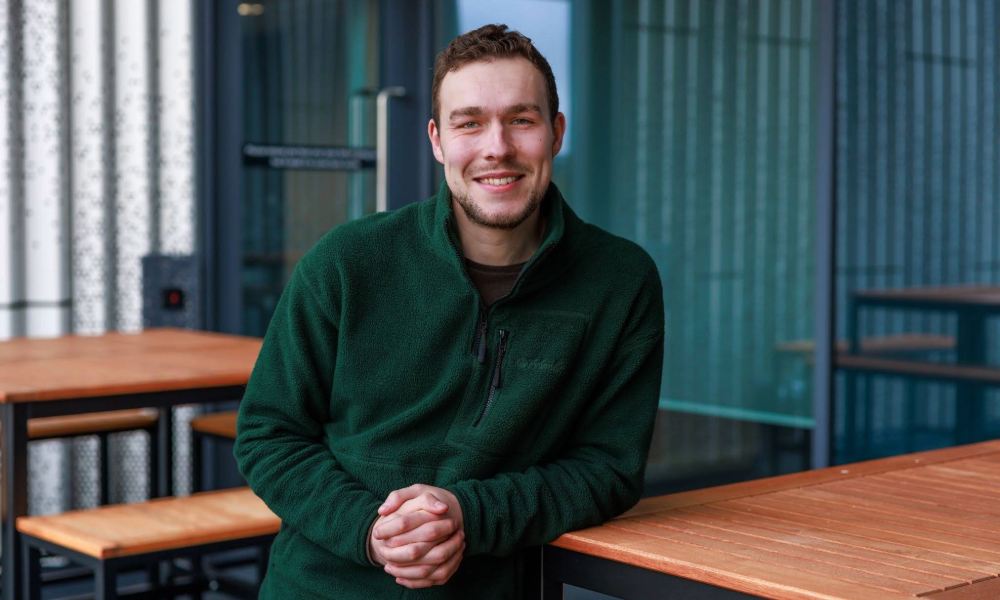
Sam Shingles joined EMBL-EBI as a Public Engagement Officer to support local communities to feel equipped, rather than overwhelmed, by science. With a background in astrophysics, he brings a unique perspective to the life sciences, focusing on demystifying data and creating a culture of open dialogue.
We spoke to Shingles to find out more about his journey and how he and his colleagues across EMBL are opening up the world of science to local communities.
Can you tell us about your background?
I studied physics with planetary science at the University of Leicester in the UK. While I was living in Leicester, I worked at the National Space Centre, helping visiting families explore the science behind space missions. That was where I first realised how much I enjoyed helping people connect with big, complex ideas in ways that felt relevant to them.
After my degree, I worked for Sense about Science, facilitating dialogue between community groups and policymakers. Before coming to EMBL-EBI, I was working just across the campus at Wellcome Connecting Science. They help people explore and engage with the latest genomic tools and technologies, which was my introduction to the world of biology and data science.
What is public engagement?
At the core of effective public engagement is an open, two-way conversation between members of the public and scientists or people working in science. It’s about opening up what scientists do, inviting people in to see how it might affect their lives, and recognising that their perspectives can and should shape how we think about scientific research.
Many people encounter concepts like genomics or AI in personal situations, during medical appointments or in the news. Public engagement is about bringing people and scientists together to navigate what it all means.
Why is it important for scientists to engage with the public?
At EMBL, we operate under an ethos of open science. Much of our work is publicly funded and has implications for the public, so we have a duty to share our work.
Navigating complex topics like AI or genetic risk can be scary for the public. Having a conversation that demystifies those terms can be incredibly impactful for a family or an individual. Conversely, engaging with the public’s questions, concerns, and challenges is vital for scientists. It reminds scientists that their work is deeply personal to people, and helps them understand the communities they serve.
What does your current role focus on?
I support our staff in getting involved in public engagement. I help them find the training they need and identify what they enjoy doing, whether it’s speaking to young people about their work, handling challenging questions, or working behind the scenes on our activities.
I also work with our community partners, who are our links to underrepresented communities. We build long-term relationships with these partners, listening to what audience groups need, whether it’s families navigating special educational needs or people facing language barriers. Having an understanding of their needs helps us to collaboratively develop initiatives and activities that support them.
How do you work with other teams across EMBL?
I’m part of EMBL’s Science Education and Public Engagement (SEPE) team. We work collaboratively to support all EMBL sites, which means we can share learnings across borders. This way of working also allows us to compare cultural differences in how science is perceived and engaged with across Europe.
What ongoing projects are you excited about?
I’ve recently met with our cohort of community partners, and we are looking at ways to explore AI, coding, and biological data more closely with them. AI is in the public conversation everywhere right now, and it can be quite daunting. We are in a good position to work with these groups to help them start exploring data science, hear their concerns, and develop activities that will allow them to feel more comfortable with concepts surrounding coding and AI.
What are your hobbies or interests?
I play field hockey for Saffron Walden. It takes up a lot of my time with training twice a week and matches on the weekends. It keeps me very active. I also have a very playful cat called Nala, whom my partner and I adopted from Cats Protection.