From biological principles to AI and back again
Key takeaways from an EMBO | EMBL symposium that brought together scientists from all over the world to discuss the role of AI in the life sciences
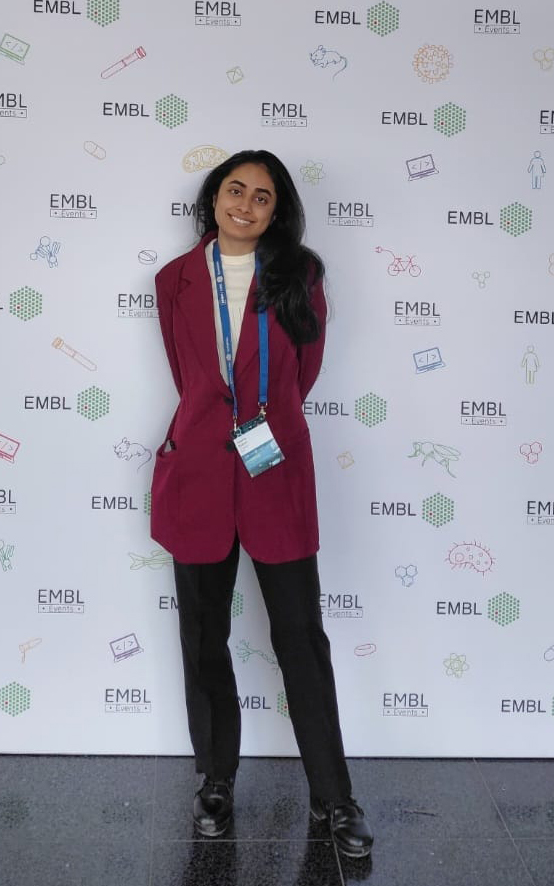
By Ananta Kapoor, PhD Student, IIT Jodhpur, India
Biology has always been a science of patterns, sequences, structures, signals, and systems. But the sheer scale and complexity of those patterns long outpaced our ability to interpret them. Then came artificial intelligence. Over four days at EMBL Heidelberg, researchers from across the world gathered to wrestle with a question that is reordering the life sciences: not whether AI belongs in biology, but how deeply, and on what terms.
The occasion was the EMBO | EMBL Symposium on AI and Biology that took place from 10–13 March 2026. As a second-year PhD researcher navigating the use of AI in precision neuro-oncology, I was captivated by the symposium’s overarching realisation: we are no longer just using AI to sort through biological data. We are using it to uncover the hidden principles of life.
Here are seven key takeaways from this transformative gathering.
1. Demanding causality from the ‘black box’
For AI to truly serve biology, it cannot merely recognise patterns; it must understand mechanisms. Deep learning models are notoriously opaque, but several speakers showcased how we can pry open the ‘black box’. Oded Regev from New York University, USA, demonstrated how his team successfully distilled highly complex deep-learning RNA splicing models into transparent, interpretable frameworks. His work revealed that while deep learning achieves high accuracy, it can suffer from blind spots, sometimes mistaking mere genomic context (like CpG islands) for true regulatory elements.
Mohammed AlQuraishi, Columbia University, USA, presented fascinating experiments probing how AlphaFold2, the celebrated AI tool that predicts the three-dimensional shape of proteins, learns to make its predictions. His work has revealed surprising insights about what AlphaFold2’s internal confidence really reflects and where it can silently go wrong. By deliberately feeding the model partial data, his team proved that the AI isn’t just memorising structures; it internalises the physical and energetic rules of protein folding.
Separately, work on scientific imaging showed that tools widely used to train AI on microscopy images can break down in subtle but consequential ways, because biological images behave very differently from the ordinary photographs most AI systems were built on. Understanding the machinery behind the output, not just the output itself, is essential.
2. Illuminating the dark matter of the protein universe
The protein universe is vast, and much of it remains uncharacterised. To navigate this ‘dark matter’, scientists are building new computational engines. Martin Steinegger (Seoul National University, South Korea) introduced Foldseek-multimer, a tool capable of rapidly searching through hundreds of millions of protein structures. By analysing structural similarities rather than just genetic sequences, his team is discovering previously unknown protein interactions and evolutionary links.
Taking a more linguistic approach, Anne Florence Bitbol (EPFL, Switzerland) showed how protein language models like ProteomeLM can ‘read’ entire proteomes, predicting complex protein–protein interactions across species with unprecedented speed and bypassing the need for traditional, time-consuming sequence alignments.
3. Mapping the spatial architecture of ‘squishy’ life
Cells do not exist in a vacuum; they live in dynamic, ‘squishy’ neighbourhoods where location dictates function. Dana Pe’er, Sloan Kettering Institute, USA, elegantly tackled this by introducing the Wasserstein Wormhole, a computational method that creates biologically meaningful ‘latent spaces’ to track how cellular niches reorganise during cancer emergence. Taking spatial biology a step further, Feng Bao (Fudan University, China) presented isoST, a deep learning model that bridges the gap between 2D and 3D. By using stochastic differential equations, isoST reconstructs smooth, isotropic 3D tissue volumes from sparse, 2D spatial transcriptomic slices, allowing us to finally see the spatial genome in three dimensions.
4. From pixels to patients: AI in the clinic
The symposium made a strong case for biological AI being ready for the clinic. Jakob Nikolas Kather, Technical University Dresden, Germany, illustrated how specialised AI systems are already functioning as medical devices, predicting crucial biomarkers such as microsatellite instability directly from standard tumour histology slides. Faisal Mahmood, Harvard Medical School, USA, expanded on this clinical horizon by presenting Apollo, a system-scale temporal foundation model. By integrating multimodal data from histology and genomics to patient visit notes and lab results, models like Apollo act as clinical agents, predicting disease progression and treatment outcomes with astonishing accuracy.
5. The dawn of the digital organism
Perhaps the most futuristic, yet tangibly close, concept discussed was the creation of ‘virtual cells’. Eric Xing (MBZUAI, UAE and Carnegie Mellon University, USA) outlined a framework for an AI-Driven Digital Organism (AIDO). Rather than predicting single outputs, AIDO acts as a ‘world model’ for biology, allowing scientists to simulate how a living system would respond to perturbations across molecular, cellular, and tissue scales. Echoing this, Charlotte Bunne (EPFL, Switzerland) presented her work on ‘Virtual Patient Labs’, which integrate multimodal foundation models to forecast disease progression and simulate counterfactual cancer treatments in silico.
Researchers also presented visions of ‘virtual patients’ and ‘virtual cells’ – computational models that can forecast how a tumour behaves, test a treatment before it is ever administered, or reproduce the complexity of a living cell. One group is building systems that integrate a patient’s imaging, genomic, and treatment history to simulate cancer progression and test therapies in silico. Another presented a vision of AI models capable of simulating biology from the molecular level upwards, with a striking demonstration of using such a system to design a more effective vaccine sequence.
The gap between current capability and genuine cellular simulation remains vast. But the conceptual shift from asking “what will happen?” to asking “why, and what if?” points toward a future where AI is not just reading biology, but reasoning about it.
6. The data we feed AI matters as much as the AI itself
Building powerful AI for biology turns out to depend just as much on the quality of the data going in as on the sophistication of the algorithms. Widely used AI tools for predicting how genes are processed – a fundamental step in how DNA gives rise to functional proteins – have been quietly learning the wrong lessons from flawed training data. As Oded Regev discussed during his talk, this can lead to errors in clinically significant cases, including a key mutation responsible for cystic fibrosis. Separately, an automated audit of the standard datasets used to benchmark genomic AI found widespread hidden biases baked into their construction. Like a student who memorises the answer sheet rather than understanding the subject, these models ace the exam but can fail the real test.
7. Context is everything
A recurring realisation across sessions was that cells, proteins, and tumours do not exist in isolation and AI systems that ignore context consistently underperform those that embrace it. In oncology, combining a patient’s tissue images with molecular data produces far more accurate predictions than either source alone. In studies of how tissues work, knowing where a cell sits within its surroundings and what its neighbours are doing transforms what can be inferred about its behaviour. In one of the conference’s most striking talks, Dana Pe’er revealed how cells shift identity and function depending on their tissue context, a phenomenon that standard lab experiments chronically miss, and one with direct implications for understanding how cancers spread.
The same principle extended to protein science. Understanding how a protein functions requires knowing not just its sequence but its structure, its molecular neighbourhood, and how similar proteins have changed across hundreds of millions of years of evolution. New tools for exploring what researchers call ‘the protein universe’ are revealing biological relationships that were simply invisible before.
In conclusion
The relationship between AI and biology is not one of tool and user; it is a two-way street. Biology must inspire AI, and AI must answer back to biology. If DNA is the most complex code ever written, artificial intelligence is the first lens capable of reading it in full context. And the most honest thing AI has taught us about biology is how much of biology we still do not understand.
We came to this symposium, asking what AI can do for biology. We left asking what biology can teach AI. That shift, quiet as it was, may turn out to be the most important result of the week.
About the author:
Ananta Kapoor is a second-year PhD student at IIT Jodhpur, India. She works on spontaneous remission – also called miracle cases – in gliomas and the mechanism behind them. She attended the AI in Biology 2026 Symposium as an event reporter and presented a poster on a spontaneous remission model of glioma with autonomous and immune latent variables.