Best poster prizes at ‘DNA replication and genome maintenance: from basic biology to human health’
The EMBO | EMBL Symposium ‘DNA replication and genome maintenance: from basic biology to human health’ took place in October at EMBL Heidelberg and virtually.
The meeting brings together experts in DNA replication and genome maintenance to explore emerging discoveries in these fields, advance our understanding of genome stability and cancer development, and pave the way for new therapeutic approaches.
For this year’s edition of the meeting, we had 163 people attending on-site and 52 participants tuning in remotely. There were 13 financial assistance grants provided by the EMBL Corporate Partnership Programme and EMBO.
With a total of 93 posters to view, we held two poster sessions during which the presenters could discuss their research; their work was then voted for by all participants. There were five best poster prizes awarded during the meeting, and we’re pleased to share with you more information on three of the winners and their research!
DDX11 clears replication protein A from single-stranded DNA
Authors: Giuseppe Cortone, Maria Mora, Ratimanasee Sahu, Steve Jose, Bartosz Malinski, Marco Simonetta, Gijs Wuite, Francesca M. Pisani
Presenter: Giuseppe Cortone
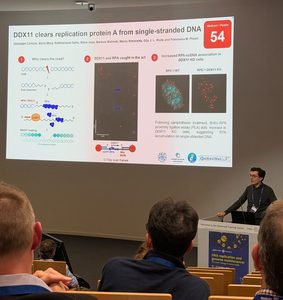
Consiglio Nazionale delle Ricerche, Italy
Abstract:
DDX11 is a superfamily 2 ATP-dependent DNA helicase essential for genome stability through its roles in DNA replication, sister chromatid cohesion, and the resolution of non-canonical DNA structures (Pisani et al., 2018). While biallelic mutations in DDX11 cause Warsaw Breakage Syndrome (van Schie et al., 2020), increasing evidence has identified DDX11 as a clinically relevant factor in several cancers, where it is frequently overexpressed and associated with poor prognosis (Su et al., 2021). DDX11 has recently emerged as a key regulator of homologous recombination (HR), functioning through a mechanism that is non-redundant with both BRCA1- and BRCA2-dependent pathways and required for efficient RAD51 assembly (Jegadesan & Branzei, 2021). However, the molecular mechanism by which DDX11 regulates these early steps of HR remains unknown.
To investigate the specific role of DDX11 in HR, we purified recombinant DDX11, RPA, RAD51 and BRCA2, generating fluorescently labelled proteins for in vitro reconstitution and single-molecule analysis using a correlative optical tweezers fluorescent microscope (C-Trap, Lumicks B.V., Amsterdam). Protein integrity was confirmed by SDS-PAGE, and gel-based helicase assays verified that fluorescent labelling did not affect DDX11 helicase activity. Using the C-Trap platform, we showed that DDX11 translocates processively along single-stranded DNA with 5′-3′ polarity in an ATP-dependent manner, whereas no movement occurred in the absence of ATP. We next investigated whether DDX11 remodels RPA-coated single-stranded DNA, a key intermediate during HR. Following RPA loading, incubation with unlabelled DDX11 resulted in progressive, directional displacement of RPA, consistent with the 5′-3′ translocation polarity of the helicase, whereas no displacement occurred in the absence of ATP.
These findings provide direct single-molecule evidence that DDX11 is a processive single-stranded DNA motor capable of actively removing RPA. This is consistent with a mechanism by which DDX11 facilitates the generation of single-stranded DNA intermediates for RAD51 loading during HR early steps. Studies are ongoing to test the effect of DDX11 on the ability of BRCA2 to promote RAD51 nucleation on RPA-coated single-stranded DNA (Belan et al., 2023).
Due to the confidentiality of the unpublished data, we cannot share the poster.
Single-molecule imaging of H2A-H2B dynamics during replication
Authors: Jessica Kelley, Guillaume Macneil, Dominika Gruszka
Presenter: Jessica Kelley

University of Oxford, UK
Abstract:
During DNA replication, parental nucleosomes are disassembled ahead of the fork and then chromatin is reassembled on the nascent DNA from a mixture of parental and newly synthesised histones. Parental histones are post-translationally modified in a variety of ways that are important to regulate genomic processes such as gene transcription. Faithful replication of these chromatin modification ‘landscapes’ alongside the DNA is important to maintain cell identity, and this process relies upon accurate recycling of modified parental histones to the same position on the daughter strands. The recycling of H3-H4 tetramers during replication has been extensively studied, however the fate of H2A-H2B dimers at the fork has been challenging to quantify due to their higher propensity for exchange both before and after replication. Here we present an optimised system for real-time single-molecule visualisation of fork progression and parental histone dynamics during replication in Xenopus laevis egg extracts. Using this platform, we characterise the behaviour of H2A and H2B during replication and show that they are more readily lost than H3-H4, supporting the view that the H3-H4 tetramer is the primary heritable histone unit. To further test this model, we investigate how H2A and H2B ubiquitylation influences parental histone dynamics and replication fork progression.
Due to the confidentiality of the unpublished data, we cannot share the poster.
The prize was kindly sponsored by Biochemical Society.
ATR enforces a fidelity-first hierarchy of translesion polymerases by regulating Pol ζ recruitment and activity
Authors: Marta Oliva-Santiago, Camilla S. Colding-Christensen, Sampath Amitash Gadi, Sidak Minocha, Norman Davey, Jesper Olsen, Julien P. Duxin
Presenter: Marta Oliva-Santiago

University of Copenhagen, Denmark
Abstract:
DNA lesions that escape repair block replication fork progression, generating stretches of single-stranded DNA and post-replicative gaps that activate the ATR replication stress response. While ATR is a well-established master regulator of checkpoint signalling and replication dynamics, its direct contribution to DNA damage tolerance remains poorly defined.
Using Xenopus egg extracts, we systematically examined the contribution of ATR to lesion bypass by translesion DNA synthesis (TLS). Using defined lesion substrates, we show that ATR-mediated signaling is dispensable for TLS reactions catalyzed by the Y-family polymerases Pol η and Pol κ. In contrast, ATR is specifically required for efficient bypass of lesions that depend on Pol ζ. ATR stimulation of Pol ζ is independent of PCNA ubiquitylation; instead, ATR promotes the efficient recruitment and/or stabilisation of the Pol ζ complex at damaged sites. Combining base editor screens in human cells with AlphaFold3 structural predictions, we further identify a potential additional layer of ATR regulation of Pol ζ activity.
Together, these findings define ATR as a selective regulator of Pol ζ-mediated bypass rather than a global regulator of TLS. We propose that ATR enforces a fidelity-first hierarchy among TLS polymerases, reserving the highly versatile but mutagenic Pol ζ as a last resort to minimize mutagenesis while ensuring efficient lesion bypass.
View the poster.
The prize was kindly sponsored by Biochemical Society.
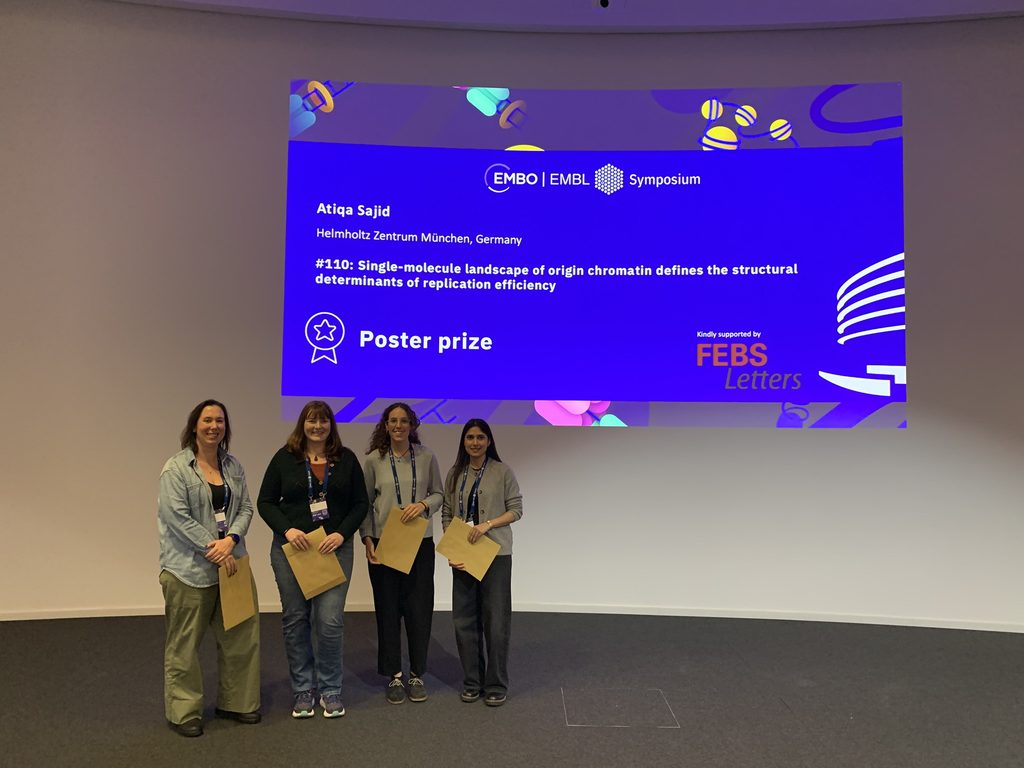
The EMBO Workshop ‘DNA replication and genome maintenance: from basic biology to human health’ took place from 20 – 23 October 2026 at EMBL Heidelberg and virtually.
Find out more about the #EESReplication meeting from the blog post written by Zaher Abdul-Fattah, who participated as an event reporter.