Where chemistry meets computation: the EMBO Workshop ‘Chemical biology 2026’ through the eyes of a doctoral student
From AI-designed proteins to drugs that target RNA, the EMBO Workshop ‘Chemical biology 2026’ showed how chemical tools and computation are coming together to change drug discovery.
Written by Krishnasalini Gunanathan, second-year PhD student, Sri Sathya Sai Institute of Higher Learning, India
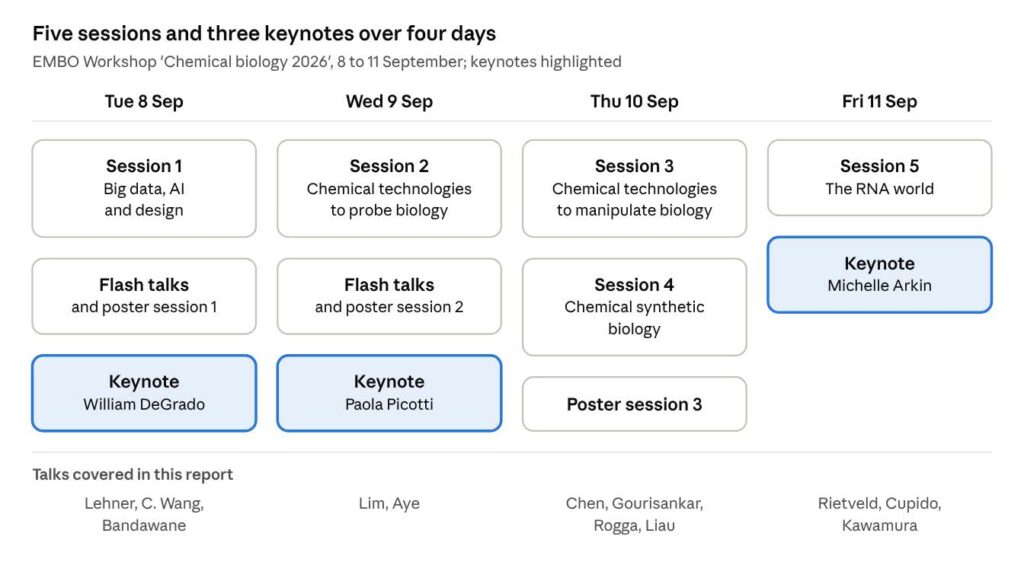
From 8 to 11 September 2026, chemical biologists from around the world gathered at EMBL Heidelberg and online for the EMBO Workshop ‘Chemical biology 2026’. It was organised by Bryan Dickinson (University of Chicago, USA), Maja Köhn (University of Bonn, Germany), Edward Lemke (Institute of Molecular Biology, Germany), and Xiao Wang (Massachusetts Institute of Technology, USA). The programme had five themed sessions, three keynote lectures, flash talks, and three poster sessions.
I am a second-year PhD student at the Sri Sathya Sai Institute of Higher Learning in India, working on neurodegeneration and computational drug discovery, and I took part online. Most of my working days are spent on molecular dynamics simulations, structure prediction, and docking. So I came to this meeting hoping to see where wet-lab chemistry and computation meet. I found that meeting point in almost every session.
Big data, AI, and design
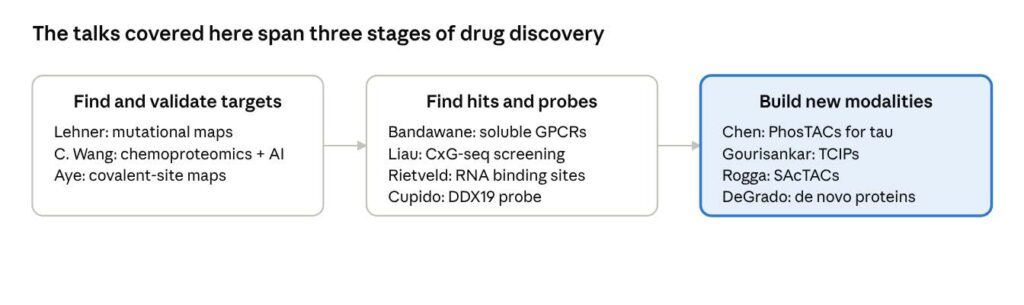
The first session, ‘Big data, AI, and design’, chaired by Xiao Wang, felt tailor-made for a computational biologist. Ben Lehner (Centre for Genomic Regulation/Wellcome Sanger Institute, UK) opened with ‘Mutate everything’. His group pairs mutagenesis at very large scale with model fitting to measure how millions of sequence variants change proteins and RNAs. So far this covers more than 1,000 human protein domains, and it has produced the first complete experimental allosteric maps of proteins. One detail held my attention: using mutations to probe the transition states of amyloid nucleation. Protein aggregation sits at the centre of the ALS models I work with, and this is the kind of data that predictive models of aggregation need.
Chu Wang (Peking University, China) followed by combining activity-based protein profiling with AI-based computational methods to find the functional targets of ligands and post-translational modifications across whole proteomes. Later that afternoon, Pooja Dnyaneshwar Bandawane (University of Washington, USA) gave a talk that spoke directly to my own toolkit. Her team used RFdiffusion, ProteinMPNN, and AlphaFold2 to design soluble versions of G protein-coupled receptors (GPCRs). These keep the native ligand-binding site but no longer need a membrane. Several designs bound their native ligands with nanomolar affinity, and a lead Y1R antagonist reduced pain-related hypersensitivity in a mouse model. Watching a fully computational pipeline end in an in vivo result showed how far design tools have come.
That evening, at close to 10 pm in India, William DeGrado (UC San Francisco, USA) gave the opening keynote, ‘De novo design of functional proteins’. He described proteins built from scratch that bind small molecules for drug targeting and delivery, enzymes designed from first principles, and engineered membrane proteins that act as ion channels for DNA and RNA sequencing. By the end of day one, my takeaway was simple: computational design is no longer a support tool in chemical biology, it is where many experiments now begin.
Chemical technologies to probe biology
The talks on neurodegeneration were closest to my own research. In Session 2, ‘Chemical technologies to probe biology’, Mi Hee Lim (KAIST, South Korea) presented ‘Chemical strategies to study multiple facets in dementia’. She described Alzheimer’s disease not as one problem but as a network of linked ones: amyloid-β plaques, disrupted metal-ion balance, and inflammation and oxidative stress driven by reactive oxygen species. Her group designs chemical tools that can act on several of these at once, or reveal how they interact. It is a useful challenge to the one-target, one-drug thinking that still shapes much computational screening, my own included.
On day three, Pohan Chen (National Cheng Kung University, Taiwan) turned a familiar problem around. Rather than trying to block the many kinases that add phosphate groups to tau, an approach held back in the clinic by kinase redundancy and off-target toxicity, his phosphorylation-targeting chimeras (PhosTACs) recruit a phosphatase to take them off. His togoPhosTAC platform combines small-molecule PhosTACs, engineered phosphatases and lipid nanoparticles. In tau-transgenic mice, it reduced phosphorylation at several sites and improved behaviour. It made me look again at the aggregation-prone proteins in my own ALS work, TDP-43, and FUS through the lens of induced proximity.
The second day ended with Paola Picotti’s (ETH Zurich, Switzerland) keynote, ‘Probing the hidden shapes of proteins’, a fitting close to a day devoted to chemical tools for probing biology.
Chemical technologies to manipulate biology
A theme that ran through the whole meeting was induced proximity: small molecules that bring two proteins together to change what they do. In Session 3, ‘Chemical technologies to manipulate biology’, chaired by Allie Obermeyer, Sai Gourisankar (Stanford University/Memorial Sloan Kettering Cancer Center, USA) presented transcriptional and epigenetic chemical inducers of proximity (TCIPs). These two-sided molecules link epigenetic regulators to DNA-binding transcription factors, switching on cell-death genes using only small amounts of the cell’s own proteins. Vanessa Rogga (Imperial College London, UK) introduced S-acylation-targeting chimeras (SAcTACs). They use non-inhibitory ligands to strip a lipid modification from selected proteins, opening a new type of proximity-based pharmacology.
Brian Liau (Harvard University, USA) showed how chemical and genetic ‘glues’ can rewire protein–protein interactions. He described how a molecular glue degrader and cancer-associated mutations in an E3 ligase converge on the same mechanism, degrading the HDAC1–CoREST complex. He also presented CxG-seq, a sequencing-based screen of chemical-by-genetic interactions for testing small molecules against protein targets at scale. Earlier, Yimon Aye (University of Oxford, UK) had shown how maps of reactive metabolite signalling, made in living systems, can predict which protein sites are functional and can be targeted covalently. For anyone who ranks druggable sites computationally, this is valuable experimental ground truth.
The RNA world
The final morning, Session 5, ‘The RNA world’, chaired by Rebecca Buller, made a strong case for RNA and RNA-processing enzymes as drug targets. Lin Rietveld (Utrecht University, Netherlands) presented SOLiD-MaP, a photoproximity labelling platform driven by singlet oxygen. It maps where small molecules bind on RNA and how specific they are, without relying on the crosslinking chemistry that current methods need. Tommaso Cupido (St Jude Children’s Research Hospital, USA) explained how ‘kinetic gating’, a feature of induced-fit binding, made it possible to find inhibitors of a highly dynamic DEAD-box RNA helicase, DDX19. The result was a chemical probe for nuclear RNA export. It reminded me that conformational dynamics, which I study with molecular dynamics simulations, can be a route into hard targets rather than a barrier.
Akane Kawamura (Newcastle University, UK) traced how JmjC histone demethylases, once seen simply as epigenetic ‘erasers’, act on a wider range of substrates and reactions than first thought, and how this opens them up as drug targets.
Michelle Arkin (UC San Francisco, USA) closed the workshop with her keynote, ‘Chemical biology opens new avenues for drug discovery’. After four days in which nearly every technology pointed towards new kinds of medicines, it was a fitting last word.
Virtual participation in a hybrid event – was it worth it?
Joining online did not mean missing out. The event’s virtual platform carried the live sessions, and the abstract book made it easy to read ahead and revisit the details afterwards. Several talks were not available on demand, so following the event live from India meant late evenings, as the keynotes in Heidelberg started at around 10 pm my time. It was worth it. Early-career researchers also had a real voice in the programme: PhD students and postdocs gave short talks alongside invited speakers in every session, and flash talks introduced each poster session.
In conclusion
‘Chemical biology 2026’ left me convinced that the line between chemistry and computation is fading fast. AI-designed receptors, proteome-scale mutational maps, proximity-based drugs and RNA-targeting chemistry all rely on tight cycles of design, prediction, and experiment. As a second-year PhD student, I came away with concrete ideas for my own work: targeting aggregation-prone proteins in a new way and treating dynamic binding sites as opportunities rather than obstacles. My thanks go to the organisers, EMBO, the EMBL Course and Conference Office, and all the speakers, and to the team that made the virtual format work so smoothly.
The EMBO Workshop ‘Chemical biology 2026’ took place between 8 – 11 September 2026 in Heidelberg, Germany, and virtually.
Read also about the #EMBOChemBio poster prize winners and find out more about their research in another blog post from the meeting.
Did you know that you can become an event reporter and receive a conference fee waiver in exchange? Find out how to do that by visiting our Become an event reporter page.