Meet the best poster prize winners of ‘Microtubules’
The EMBO | EMBL Symposium ‘Microtubules: from atoms to complex systems’ took place from 17 to 20 June, bringing together 232 on-site and 37 virtual participants from around the world.
First launched in 2010 and held every two years since, this symposium has become a key meeting for researchers studying microtubule biology and its implications for human health and disease. Microtubules are essential for a wide range of cellular processes, including chromosome segregation, intracellular transport, cell motility, and the establishment of cell polarity. Dysfunction of the microtubule cytoskeleton is linked to diseases such as cancer and neurodegenerative disorders, making it an important focus of biomedical research. The symposium showcased the latest advances in the field, highlighting interdisciplinary approaches spanning cell biology, genetics, molecular biology, biochemistry, biophysics, structural biology, and mathematical modelling.
Throughout the meeting, participants presented 150 posters, sharing their latest research and engaging in lively scientific discussions. The poster sessions provided an excellent opportunity for networking, feedback, and collaboration, and three presenters were recognised with poster prizes. Congratulations to the winners: Matthieu, Valeria, and Jasper!
Structural characterization of C- and D-type lateral interactions in microtubules
Presenter: Matthieu P.M.H. Benoit
Authors: Charlotte Guyomar, Clément Bousquet, Siou Ku, Claire Heichette, Laurence Duchesne, Romain Gibeaux, Matthieu P.M.H. Benoit, Denis Chretien

Institute of Genetics and Development of Rennes, France
Abstract:
Tubulin polymerizes into microtubules with a delay between assembly and GTP hydrolysis, generating GTP/GDP-Pi caps at growing microtubule ends that protect the unstable GDP-tubulin lattice from depolymerization. In prevailing models, cap shrinkage or loss triggers catastrophe, the stochastic switch from polymerization to depolymerization. However, the structural organization of the GTP cap and the molecular mechanisms underlying these events remain poorly understood. To gain insight into this, we used cryo-electron microscopy to characterize microtubules assembled with a range of GTP analogs and found previously uncharacterized lateral interactions between two protofilaments in a substantial fraction of microtubules, which we term C- and D-types. Relative to canonical A- and B-type interactions, C- and D-types are shifted longitudinally by ~2 nm in opposite directions and involve pronounced inward rotation of the interacting protofilaments, yielding fewer and weaker lateral contacts. Notably, these interaction types occur at high frequency at the onset of microtubule self-assembly in the presence of GTP, under conditions in which large GTP/GDP-Pi caps are expected to form. Together, our results suggest that C- and D-type lateral interactions are intrinsic to the GTP-like state of tubulin in microtubules and that, in conjunction with GTP hydrolysis, they may destabilize growing microtubule ends, thereby promoting the stochastic depolymerization events characteristic of dynamic instability.
Due to the confidentiality of the unpublished data, we cannot show the poster.
EB2 controls microtubule growth geometry to shape cell morphology
Presenter: Valeria Catapano
Authors: Valeria Catapano, Marie-Claire Velluz, Joshua Tran, Mireia Andreu-Carbò, Charlotte Aumeier

University of Geneva, Switzerland
Abstract:
End-Binding (EB) proteins are key regulators of microtubule plus-end dynamics and act as hubs for +TIPs recruitment. While EB1 and EB3 are extensively studied as promoters of microtubule growth, the cellular roles of EB2 remain comparatively unexplored, despite evidence that its spatiotemporal expression influences microtubule reorganization during cellular differentiation. Here we combine live-cell imaging, automated comet tracking and quantitative analysis of cell morphology to define how EB2 modulates microtubule growth geometry and, consequently, cellular architecture.
We find that changes in EB2 levels alter microtubule growth dynamics and network organization. EB2 overexpression produces comets with reduced directional persistence, resulting in a network dominated by curved microtubules and cells with increased roundness. Conversely, EB2 knock-out promotes more linear microtubule polymerization producing parallel microtubule arrays and highly elongated cell morphologies.
The functional relevance of this mechanism becomes evident during skeletal muscle differentiation. While EB2 is physiologically downregulated as myoblasts reorganize their cytoskeleton and fuse into highly elongated and thin multinucleated myotubes, sustained EB2 expression blocks proper morphogenesis, affecting cell-cell fusion and producing strikingly rounded myotubes with centrally clustered nuclei, both hallmarks of defective muscle fibres.
Although the molecular basis of EB2-dependent curvature (whether through altered MAP recruitment, protofilament assembly, interactions with actin or potentially tubulin geometry) remains to be defined, our findings identify EB2-mediated control of microtubule growth geometry as a key determinant of cell morphology. Together, these results suggest that regulation of proteins at the growing microtubule plus-end directs growth trajectories and thereby shapes cellular architecture.
Kinesin-1 selectivity for stable microtubules is mediated by MAP7D1’s recognition of expanded lattices
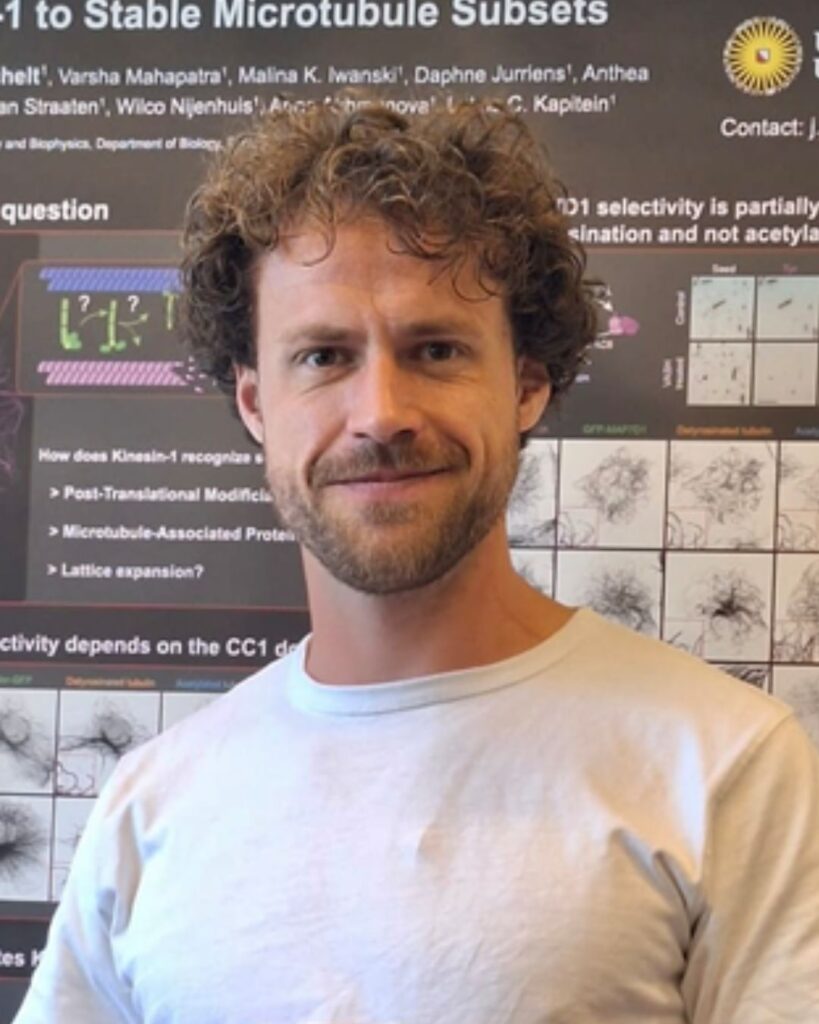
Presenter: Jasper van Schelt
Authors: Jasper van Schelt, Varsha Mahapatra, Malina K. Iwanski, Daphne Jurriens, Anna Akhmanova, Lukas C. Kapitein
Utrecht University, The Netherlands
Abstract:
The motor protein Kinesin-1 drives long-range intracellular transport and selectively moves along a subset of microtubules that are long-lived, highly post-translationally modified, and have an expanded lattice spacing compared to dynamic microtubules. However, the molecular basis for this selectivity toward stable microtubules has remained unresolved. Here, we identify MAP7D1 and microtubule lattice expansion as the key determinants of Kinesin-1 selectivity. Using Kinesin-1 truncation constructs and MAP7 family member depletions, we demonstrate that Kinesin-1 subset selectivity requires its coiled-coil 1 region, which mediates binding to MAP7 family members. While depletion of both MAP7D1 and MAP7D3 completely abolishes Kinesin-1 motility in COS7 and U2OS cells, loss of MAP7D1 alone results in non-selective motility along all microtubules. Notably, whereas MAP7D3 is largely diffuse, MAP7D1 is enriched on the stable microtubule subset, and this localization is governed by lattice structure rather than post-translational modifications. Consistent with this, in vitro reconstitution assays directly demonstrate that MAP7D1 preferentially binds expanded microtubule lattices, which are a hallmark of long-lived microtubules. Together, our findings reveal that Kinesin-1 selectivity is determined neither by post-translational modifications nor by its direct recognition of distinct lattice states, but rather by MAP7D1’s preferential recognition of expanded lattices, which ensures Kinesin-1 activation specifically on stable microtubules.
Due to the confidentiality of the unpublished data, we cannot show the poster.
The EMBO | EMBL Symposium ‘Microtubules‘ took place from 17 – 20 June 2026 at EMBL Heidelberg and virtually.