Best poster prize at ‘AI and biology’
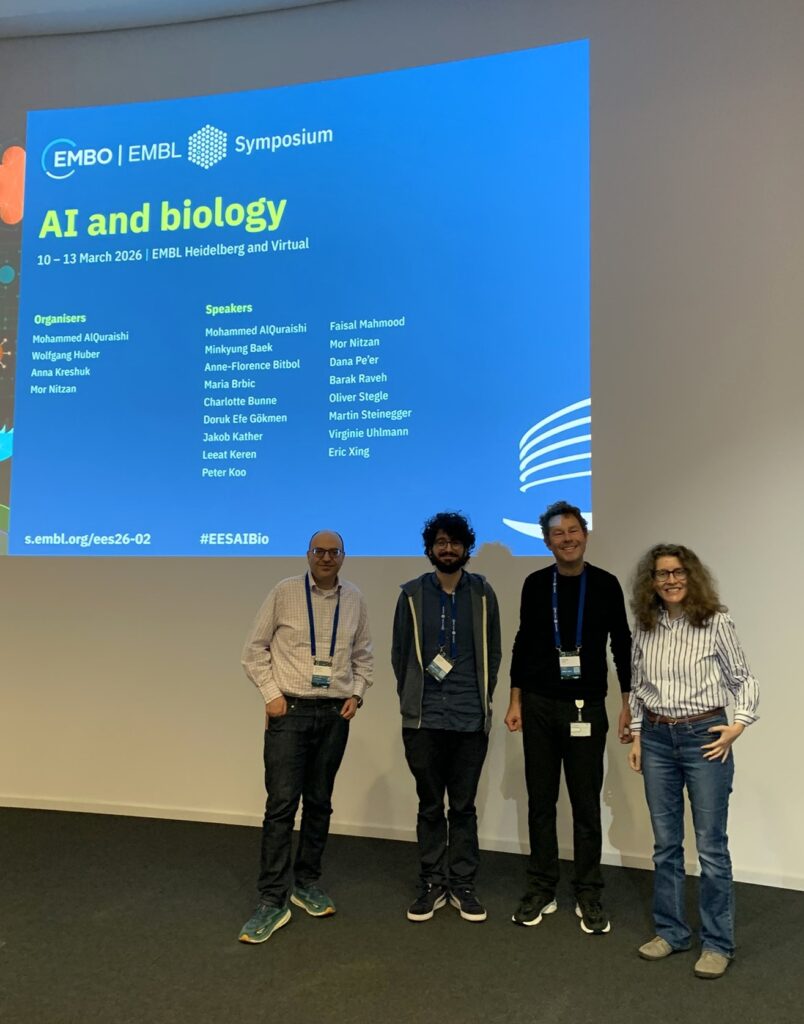
The EMBO | EMBL Symposium ‘AI and biology’ took place in March at EMBL Heidelberg and virtually.
The 2026 meeting was the second edition of #EESAIBio. The aim of this symposium is to catalyse synergistic interactions between AI researchers in different subfields of biology and biomedicine by exploring shared theoretical approaches, cross-domain experiments, foundation models, and data integration, as well as shared topics in dissemination of tools, agent-based workflows, and collaboration with experimental labs.
For this year’s edition of the meeting, we had 300 people attending on-site and 295 participants joining remotely. There were 19 financial assistance grants provided by the EMBL Corporate Partnership Programme and EMBO. With the total of 139 posters to view, we held three poster sessions during which the presenters could discuss their research — their work was then voted for by all participants. There was a single best poster prize awarded during the meeting and we’re pleased to share with you more information on the winner and their research!
ESMRank: A ranking-based AI framework for interpretable prediction of protein variant effects
Presenter and author: Riccardo Arnese

TIGEM, Italy
Abstract:
Predicting the functional effects of protein variants remains a central challenge in both clinical genomics and protein engineering. Despite the growing availability of Deep Mutational Scanning(DMS) datasets, their integration is hindered by assay heterogeneity and batch effects. Here, we present ESMRank, a novel AI-framework that reformulates variant effect prediction as a learn-to-rank problem and trained on over 2M variants from MAVEdb, harmonized through a Reciprocal Rank Fusion strategy we developed. Built on the LambdaMART algorithm, ESMRank directly optimizes the ordering of variants by functional relevance, integrating rich protein representations from the ESM-2 language model, including sequence embeddings and residue–residue contact maps, with physicochemical descriptors of mutational impact. When benchmarked on protein stability assays, ESMRank consistently outperformed state-of-the-art sequence- and structure-based predictors. On the Human Domainome dataset (~500,000 mutations across 500 human protein domains; Beltran et al., Nature 2025), ESMRank achieved a Spearman correlation coefficient (ρ) of 0.62 versus 0.46 for ThermoMPNN, representing a 35% improvement in predictive accuracy. On ProteinGym, it again ranked first on stability assays (mean ρ = 0.64 vs0.59 for ProSST), confirming a 10% performance gain. On VariBench, ESMRank’s predictions strongly correlated with both protein folding (ρ = 0.55) and unfolding rates (ρ = –0.49), further corroborating its ability to identify stability-affecting mutations. By combining ranking-based learning with protein language models, ESMRank bridges AI and molecular biology, providing a scalable, interpretable, and biologically grounded framework for variant interpretation and protein design.
Find out more about the #EESAIBio conference from the blog post written by Ananta Kapoor, who participated as an event reporter!
The EMBO | EMBL Symposium ‘AI and biology’ took place from 10 – 13 March 2026 at EMBL Heidelberg and virtually.