
Bork Group
Deciphering function and evolution of biological systems
EditThematically distinct research groups, headed by EMBL and EMBO leadership
The Bork group focuses on the computational analysis of microbiome data, from the human gut and the environment. It works across spatial scales, from genes, proteins, and small molecules to networks and microbial communities. The group’s goal is to understand microbial community interactions among microbes and between microbes and their environment. Additionally, it works to identify microbial biomarkers for man-made pollutants. The group will establish comprehensive maps of species and gene fluxes on earth to understand, for example, the spread of antimicrobial resistance. It also helped to initiate and participated in the TREC Expedition along Europe’s coastlines, and is now analysing TREC data.
The Birney group focuses on inter-individual variation in humans and Japanese rice paddy fish (Medaka fish) and new algorithmic methods for genomics. The group is interested in the interplay of natural DNA sequence variation with basic biology from molecular and cellular processes to complex physiology and behaviour. It pursues association analysis for a number of both molecular (e.g. RNA expression levels and chromatin levels) and organ physiology levels (heart function, retinal function). The group established the first vertebrate near-isogenic wild panel in Japanese rice fish to explore and dissect gene × environment effects and aspects of variance in phenotypes.
The Hentze group combines biochemical and systems-level approaches to investigate the connections between gene expression, cell metabolism, and their role in human disease. Key goals of the group include collaborative efforts to: uncover the biological roles of unexpected RNA-binding proteins (‘enigmRBPs’) in cell metabolism, differentiation, and development; explore, define, and understand REM networks; help elucidate the role of RNA metabolism in disease, and to develop novel diagnostic and therapeutic strategies based on this knowledge; and to understand the molecular mechanisms and regulatory circuits underlying physiological iron homeostasis.
The Watt group is investigating how adult stem cell renewal and lineage selection are controlled by reciprocal interactions with the cellular microenvironment, or niche. The focus of our research is mammalian skin, which we study using human cells in culture and genetically modified mice. We have previously found markers to isolate epidermal stem cells and elucidated several of the signalling pathways that regulate stem cell behaviour, two of which – integrin and Notch signalling – are a focus of our current research. We are also exploring the remarkable plasticity of epidermal stem and differentiated cells and ways in which epidermal-dermal communication controls skin homeostasis. We make extensive use of single-cell analysis and are defining how biophysical cues elicit transcriptional responses in epidermal stem cells. Having demonstrated the existence of different skin fibroblast lineages in mice, we are analysing different subpopulations of human skin fibroblasts, with the goal of developing new strategies to treat skin scarring.
Deciphering function and evolution of biological systems
Edit
Intraspecies variation in medaka fish and humans
Edit
RNA-binding proteins in RNA biology and riboregulation
Edit
Regulation of stem cell fate
Edit
Planctonic ecosystems in Tara Oceans expeditions
Edit



Advancing molecular biology research to study life in context
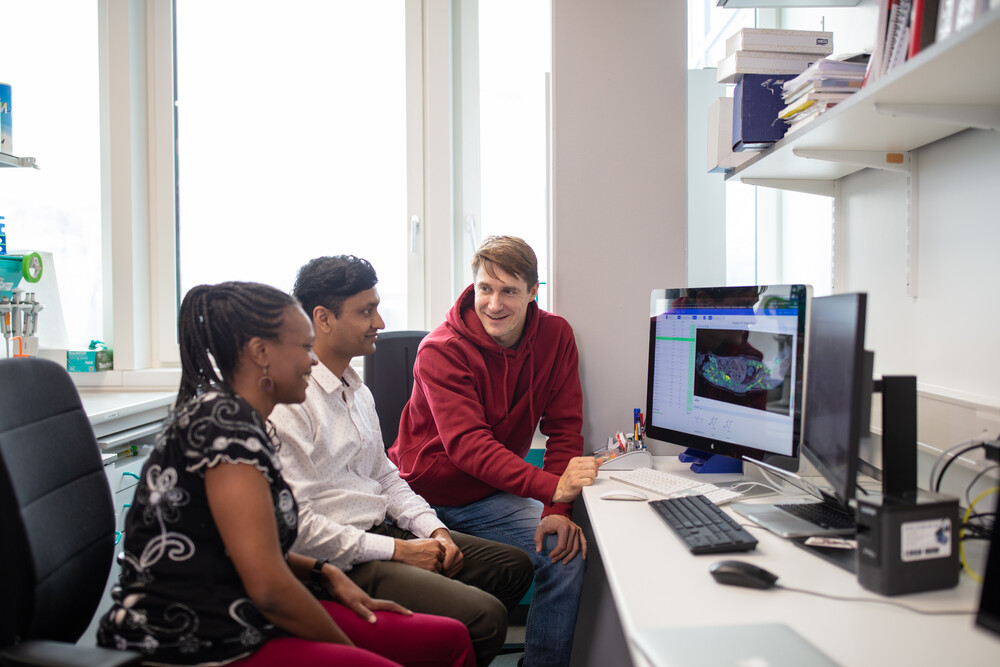
Research groups at EMBL are organised into nine units spanning six European sites

Explore our latest vacancies and sign up for job alerts to get notified when something suitable comes up