Research project in Heidelberg-Heilbronn to advance precision medicine
EMBL, MOLIT, and the Dieter Schwarz Foundation join forces to accelerate the capacity of this field, using AI and cutting-edge technologies
A new public-private partnership is ‘embracing’ ways to expand the capacity of precision medicine by harnessing cutting-edge technologies and artificial intelligence to better understand and improve how we treat disease – even on an individual basis.
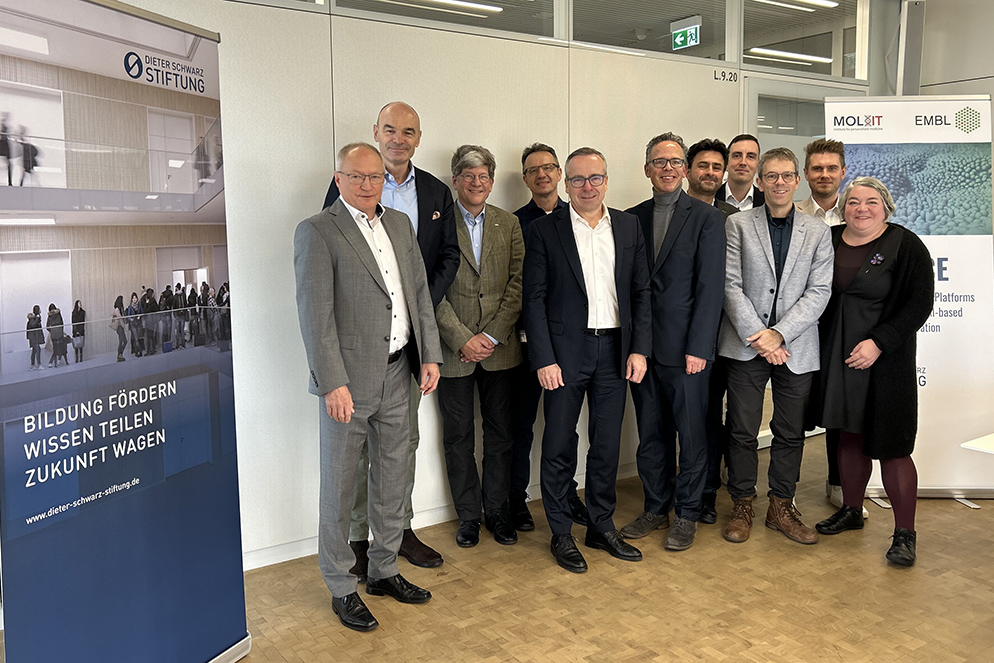
With substantive funding from the Dieter Schwarz Foundation, EMBL and the Heilbronn-based Institute for Personalised Medicine (MOLIT) launched an ambitious collaborative research endeavour this week. EMBRACE (Engineered Models and platforms for BiomoleculaR and AI-based Cell & tissue Exploration) is a Heilbronn-Heidelberg-based project that aims to develop advanced biomolecular platforms and expand the capacity of precision medicine.
“This collaboration brings together highly complementary strengths,” said Jan Korbel, Interim Head of Site, EMBL Heidelberg. “MOLIT has developed an extensive collection of patient-derived organoids, while EMBL contributes expertise in artificial intelligence, advanced imaging, molecular perturbation, and AI-guided automation.”
Funded through 2029, EMBRACE combines advanced microscopic imaging and other laboratory techniques with artificial intelligence to improve how researchers study human biology and the molecular signatures underlying disease.
Starting with colorectal cancer, the EMBRACE project will incorporate miniature, lab-grown human tissue (organoids) and AI-generated virtual models to explore how individual patients might respond to both disease and treatment. By combining the high level of expertise from both EMBL and MOLIT, the scientists aim to accelerate discoveries and reduce the need for animal testing.
“Together, we aim to connect observations in organoid models with molecular insights at single-cell resolution,” Korbel said. “With the generous support of the Dieter Schwarz Foundation, this partnership opens exciting new opportunities for discovery in the life sciences.”