Aissam Ikmi
Group Leader
ORCID: 0000-0001-6310-8404
EditControl of morphological flow
Group Leader
ORCID: 0000-0001-6310-8404
EditBiological forms are inherently dynamic. Throughout life, organisms build, maintain, and sometimes rebuild their bodies; across evolutionary time, changes in developmental processes give rise to morphological diversity. Yet how form arises, persists, and changes remains a central question in biology. By morphological flow, we refer to this continuous, regulated transformation of organismal form across both the life cycle and evolutionary time. At the core of this flow lies morphogenesis—the processes through which tissues are generated, remodeled, and reorganized to shape the body.
Our lab investigates morphogenesis across the life cycle and evolution, treating form not as the outcome of embryogenesis alone but as an ongoing process unfolding through continuous interaction with the environment. We focus on how mechanics, physiology, and environmental inputs shape morphogenetic dynamics, and we hypothesize that variation in these parameters provides the substrate for evolutionary diversification of form.
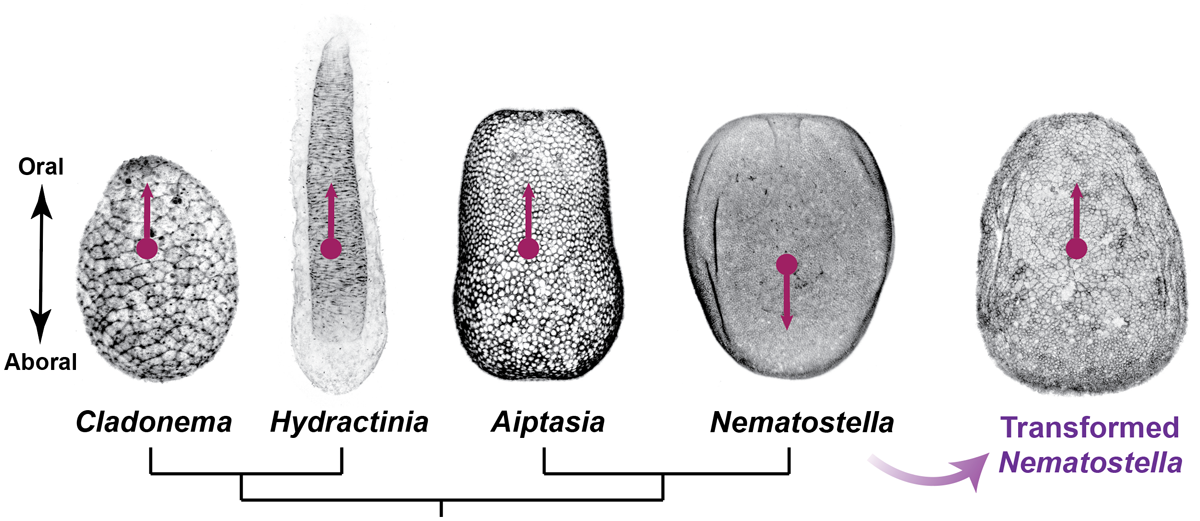
We use cnidarian model systems—including sea anemones, jellyfish, and corals—which offer exceptional access to life-cycle plasticity, regeneration, and whole-body imaging. By combining precise genetic perturbations (including CRISPR/Cas9 tools we pioneered in a sea anemone), quantitative live imaging (Movie 1), and biophysical approaches, we aim to identify general design principles underlying morphogenetic robustness and plasticity. Comparative analyses across species (Figure 1) further allow us to assess how these processes are tuned over evolutionary time.
Developing animals contract, move, and continuously engage with their environment, yet how behavior feeds back onto tissue morphogenesis remains poorly understood. Using the sea anemone Nematostella vectensis, we study behaviorally active life-cycle transitions—such as swimming, crawling, and burrowing—and have shown that muscular hydraulics not only mediate movement but also drive tissue remodeling (Stokkermans et al., 2022; Basu et al., biorxiv 2025). Ongoing work aims to distinguish reversible deformations from long-term structural change and to uncover how the nervous system coordinates these transformations.
Developmental programs are often conditional on physiological state. We have shown that tentacle formation in Nematostella is a metabolically gated morphogenetic decision, activated only under sufficient nutritional conditions (Ikmi et al., 2020). Current work investigates how metabolic states are organized across the organism and how they interface with developmental signaling, using spatial transcriptomics, metabolomics, and targeted perturbations.
Rather than viewing regeneration as a purely local response to injury, we study it as an organism-wide phenomenon. We have shown that local damage triggers systemic responses, including extracellular matrix remodeling, that preserve global shape homeostasis (Cheung et al., 2024). Ongoing efforts seek to define the long-range signals coordinating these responses across tissues.
Through comparative morphogenesis and theory, we investigate biophysical principles underlying shape diversity. Across multiple cnidarian species, we have identified a small number of tissue-scale mechanical modules that predict larval shape despite extensive molecular divergence (Bailleul et al., biorxiv 2025). These mechanical modules act as intermediaries between genotype and phenotype, providing a substrate through which evolution can sculpt new forms. By perturbing these modules, we can reprogram morphology toward forms resembling related species. We are now extending this framework across additional life-cycle stages.