
Eugeni Belda
Sorbonne Université, IRD,
France
EMBO Practical Course
This course provides a comprehensive overview of current metagenomic approaches for studying microbial communities, integrating experimental and computational methodologies within a single training framework. It covers the complete workflow, from environmental sampling and DNA extraction from diverse matrices (soil and water) to advanced sequencing and in silico data analysis.
Participants will receive hands-on training in DNA extraction methods and metabarcoding analysis using third-generation sequencing technologies (Nanopore/PacBio), enabling in situ characterisation of microbial diversity. Cutting-edge topics such as phage genomics and single-cell approaches in metagenomics will also be addressed. The bioinformatics component will guide participants from raw sequence data processing through genome assembly, metagenome-assembled genome (MAG) reconstruction, functional annotation, and statistical analysis, using current best-practice and reproducible workflows.
Through lectures, practical sessions, and guided discussions, the course will present the latest advances in metagenomics and highlight its connections with related disciplines. Dedicated sessions on experimental design will allow participants to critically evaluate methodological choices and test their understanding.
Active learning will be promoted through poster sessions, discussion rounds, quizzes, and collaborative group work. Overall, the course equips participants with state-of-the-art skills and fosters international scientific exchange and collaboration in metagenomics research.
The course equips participants with state-of-the-art skills and fosters international scientific exchange and collaboration in metagenomics research. After the course, participants will be able to:
This course is aimed at advanced PhD students and early post-doctoral researchers who are doing or planning to start research in the field of metagenomics.
“The course was an excellent blend of theoretical knowledge and practical experience, providing valuable insights into cutting-edge techniques and fostering meaningful connections with experts and peers in the field. It was an enriching and highly beneficial experience for my research and professional development.” – Muhammad Umair Amjad, National Institute for Biotechnology and Genetic English – Pakistan Institute of Engineering and Applied Sciences, Pakistan
“It is difficult to find a course that succeeds in combining the lab part with the bioinformatics part but this course succeeded perfectly! The organization was perfect and the speakers were fantastic.” – Eleonora Moretti, Stazione Zoologica Anton Dohrn, Italy
This event has been granted the following EMBO sustainability badge:
Sorbonne Université, IRD,
France
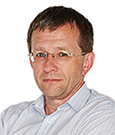
EMBL Heidelberg
Germany
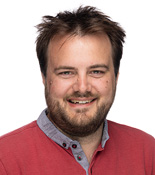
EMBL Heidelberg
Germany
Umeå University
Sweden
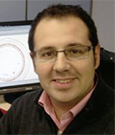
Foundation for the Promotion of Health and Biomedical Research of the Valencian Community (Fisabio)
Spain
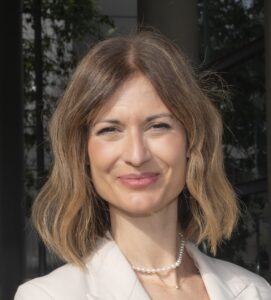
Institute for Integrative Systems Biology
Spain

Ghent University
Belgium
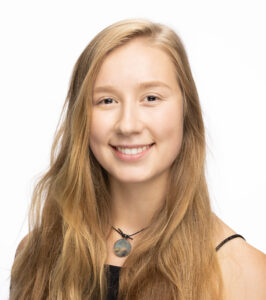
EMBL Heidelberg
Germany
University of Tübingen
Germany
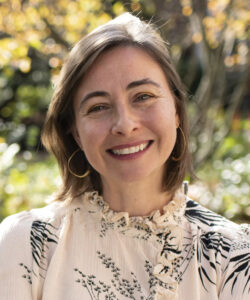
Albert Einstein College of Medicine
USA
Virtual speaker
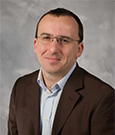
Georgia Institute of Technology
USA
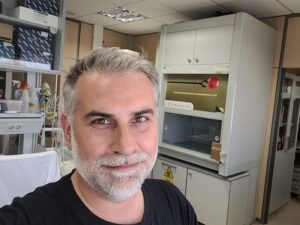
MNCN-CSIC
Spain
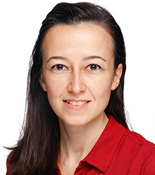
EMBL Heidelberg
Germany
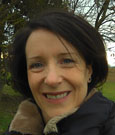
French National Institute for Agricultural Research (INRA)
France
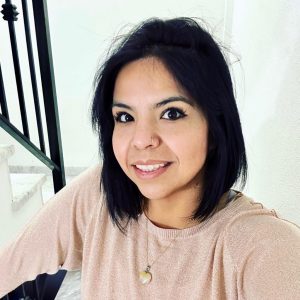
Foundation for the Promotion of Health and Biomedical Research of the Valencian Community (Fisabio)
Spain

Aalborg University
Denmark
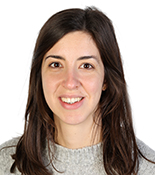
EMBL Heidelberg
Germany
University of Zagreb
Croatia

Pontificia Universidad Católica de Chile
Chile
Virtual Speaker
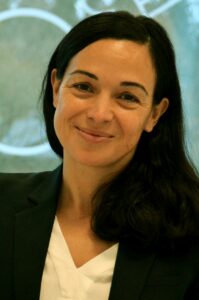
University of Aberdeen
UK
Centro de Astrobiologia, INTA, Spain
EMBL Heidelberg
Germany
Foundation for the Promotion of Health and Biomedical Research of the Valencian Community (Fisabio)
Spain
MNCN-CSIC
Spain
Foundation for the Promotion of Health and Biomedical Research of the Valencian Community (Fisabio)
Spain
EMBL Heidelberg
Germany
EMBL Heidelberg
Germany
EMBL Heidelberg
Germany
Are you on social media? Post using #EMBOMetaG (Event hashtag) and don’t forget to tag @EMBLEvents.
| Time (Europe/Berlin) | Speaker | Location |
|---|---|---|
| 15:00 – 17:00 | Overview of pre-course work, introduction to course content on EMBL eCampus and troubleshooting Testing cloud / VM Giuseppe D’Auria – FISABIO, Spain Kostas Konstantinidis – Georgia Institute of Technology, USA Elisabeth Zielonka – EMBL Heidelberg, Germany | Zoom |
| Time (Europe/Berlin) | Speaker | Location |
|---|---|---|
| 08:40 – 08:50 | Shuttle transfer to EMBL from Hotel | ISG Hotel |
| 09:00 – 09:15 | EMBL Welcome and house notes / Introduction to Training Lab and safety Elisabeth Zielonka – EMBL Heidelberg, Germany | Courtyard Room A & B |
| 09:15 – 09:30 | Introduction to the course Giuseppe D’Auria – FISABIO, Spain | Courtyard Room A & B |
| 09:30 – 10:30 | Flash talks by participants chaired by Elisabeth Zielonka – EMBL Heidelberg, Germany | Courtyard Room A & B |
| 10:30 – 10:45 | Coffee break | Courtyard Room A & B |
| 10:45 – 11:45 | Metagenomics: Concepts, historical milestones, next advances, code of conduct in sampling and data usage Giuseppe D’Auria – FISABIO, Spain | Courtyard Room A & B |
| 11:45 – 12:45 | Lunch at EMBL canteen | EMBL Canteen |
| 12:45 – 13:45 | Metagenomics library preparation for NGS Vladimir Benes – EMBL Heidelberg, Germany | Courtyard Room A & B |
| 13:45 – 14:45 | Participants challenges, expectations and case studies Elisabeth Zielonka – EMBL Heidelberg, Germany | Courtyard Room A & B |
| 14:45 – 15:45 | The impact of Metagenomics, on genes and genomes discovery Gabrielle Potocki-Veronese – INRA-LISBP, France | Courtyard Room A & B |
| 15:45 – 16:15 | Coffee break | Courtyard Room Foyer |
| 16:15 – 17:15 | Solving problems and questions: Introduction to Linux and R based on pre-recorded lecture 1 and 2 Giuseppe D’Auria – ISABIO, Spain | Courtyard Room A & B |
| 17:15 – 19:15 | Poster numbers (dedicated 1-10 slots) with drinks | Helix A |
| 19:15 – 20:15 | Dinner at EMBL Canteen | EMBL Canteen |
| 20:15 – 20:25 | Shuttle transfer to Hotel | ATC Entrance |
| Time (Europe/Berlin) | Speaker | Location |
|---|---|---|
| 08:40 – 08:50 | Shuttle transfer to EMBL from Hotel | ISG Hotel |
| 08:50 – 09:00 | Overview of the day Raúl Muñoz – MNCN-CSIC, Spain | Courtyard Room A & B |
| 09:00 – 10:45 | Practical session 1: Water and soil/biofil sampling from EMBL’s pond Starting DNA extraction Trainers: Raúl Muñoz Jiménez – MNCN-CSIC, Spain Pilar Domingo-Calap – University of Valencia, Spain Celia Ferriol-González – Ghent University, Belgium 2 helpers from EMBL Heidelberg | Training Lab B |
| 10:45 – 11:15 | Coffee break | Courtyard Room Foyer |
| 11:15 – 12:45 | Practical session 2: Extraction of environmental DNA in groups and DNA quality control Trainers: Raul Muñoz – MNCN-CSIC, Spain and 4 EMBL helpers | Training Lab B |
| 12:45 – 13:45 | Lunch at EMBL canteen | EMBL Canteen |
| 13:45 – 14:30 | Practical Session 3: Nanopore 16S PCR setup Trainers: Hilal Özgür Weidner – EMBL Heidelberg, Germany, Laura Villacorta – EMBL Heidelberg, Germany and 2 trainers from EMBL Heidelberg | Courtyard Room A & B |
| 14:30 – 15:30 | Single cells genomics in droplets Tobias Wenzel – Pontificia Universidad Católica de Chile, Chile (Virtual speaker) | Courtyard Room A & B |
| 15:30 – 15:45 | Coffee break | Courtyard Room Foyer |
| 15:45 – 17:00 | Practical session 3: Nanopore (continued) 16S PCR cleanup, finishing library preparation and starting sequencing run, followed by Genomics Core Facility Tour Trainers: Hilal Özgür Weidner – EMBL Heidelberg, Germany Laura Villacorta – EMBL Heidelberg, Germany and 2 trainers from EMBL Heidelberg | Training Lab B |
| 17:00 – 17:15 | Coffee break | Courtyard Room Foyer |
| 17:15 – 19:15 | Practical session 3: Nanopore (continued) 16S analysis/ DNA cleanup and Sequencing start, followed by Genomics Core Facility Tour Trainers: Hilal Özgür Weidner – EMBL Heidelberg, Germany Laura Villacorta – EMBL Heidelberg, Germany and 2 trainers from EMBL Heidelberg | Training Lab B |
| 19:15 – 20:15 | Dinner at EMBL Canteen | EMBL Canteen |
| 20:15 – 20:30 | Shuttle transfer to Hotel | ATC Entrance |
| Time (Europe/Berlin) | Speaker | Location |
|---|---|---|
| 08:40 – 08:50 | Shuttle transfer to EMBL from Hotel | ISG Hotel |
| 08:50 – 09:00 | Overview of the day Giuseppe D’Auria – Fisabio, Spain | Courtyard Room A & B |
| 09:00 – 10:00 | Phages as biotechnological tools against superbugs Pilar Domingo-Calap – University of Valencia, Spain | Courtyard Room A & B |
| 10:00 – 10:30 | Group Discussion: Metagenomic DNA extraction results Moderators: Raul Muñoz – MNCN-CSIC, Spain and Giuseppe D’Auria – FISABIO, Spain | Training Lab B |
| 10:30 – 11:00 | Coffee break | Courtyard Room Foyer |
| 11:00 – 12:00 | Practical session 4: Phage technology Phage 4.1 – Samples preparation, cleaning and inoculation Pilar Domingo-Calap – University of Valencia, Spain Celia Ferriol-González – Ghent University, Belgium Raúl Muñoz Jiménez – MNCN-CSIC, Spain 2 trainers helpers from EMBL Heidelberg | Training Lab B |
| 12:00 – 13:00 | Lunch | EMBL Canteen |
| 13:00 – 14:00 | What brings a metagenomic approach in cardiometabolic and nutrition-related disorders? Eugeni Belda – National Institute for Health and Medical Research (Inserm), France | Courtyard Room A & B |
| 14:00 – 14:30 | Coffee break | Courtyard Room Foyer |
| 14:30 – 15:30 | Metagenomics for planetary protection and the search for life on Mars Maria Paz Zorzano Mora – University of Aberdeen, United Kingdom / Centro de Astrobiologia, INTA, Spain | Courtyard Room A & B |
| 15:30 – 16:15 | Comparison of sequencing technologies Nanopore, 16S, PacBio Giuseppe D’Auria – FISABIO, Spain | Courtyard Room A & B |
| 16:15 – 16:45 | Coffee break | Courtyard Room Foyer |
| 16:45 – 17:45 | Pacific Bioscience (PacBio) sequencing for metagenomics Vladimir Benes – EMBL Heidelberg, Germany | Courtyard Room A & B |
| 17:45 – 18:30 | Emerging young scientist lecture: Community structure and functional potential of psychrophiles in Patagonian glaciers Anastasiia Grekova – EMBL Heidelberg, Germany | Courtyard Room A & B |
| 18:30 – 19:15 | Using AI to annotate phage genomes in metagenomic samples Libusha Kelly – Albert Einstein College of Medicine, USA (virtual speaker) | Courtyard Room A & B |
| Time (Europe/Berlin) | Speaker | Location |
|---|---|---|
| 08:40 – 08:50 | Shuttle transfer to EMBL from Hotel | ISG Hotel |
| 08:50 – 09:00 | Overview of the day Pilar Domingo-Calap -University of Valencia, Spain | Courtyard Room A & B |
| 09:00 – 10:45 | Practical session 4: Phage technology (continued) Phage 4.2 – Checking phage plaques and piking Pilar Domingo-Calap – University of Valencia, Spain Celia Ferriol-González – Ghent University, Belgium Raúl Muñoz Jiménez – MNCN-CSIC, Spain 2 trainers helpers from EMBL Heidelberg | Training Lab B |
| 10:45 – 11:45 | Coffee break | Courtyard Room Foyer |
| 11:45 – 12:45 | Metabolomic profiling of microbial communities Mariana Reyes Prieto – FISABIO, Spain | Courtyard Room A & B |
| 12:45 – 13:45 | Lunch | EMBL Canteen |
| 13:45 – 14:45 | Practical session 5: Functional and taxonomic analysis with MGnify TBC | Computer Training Lab |
| 14:45 – 15:15 | Coffee break | Courtyard Room Foyer |
| 15:15 – 16:15 | Practical session 5: Functional and taxonomic analysis with MGnify (continued) TBC | Computer Training Lab |
| 16:15 | Free evening with walking tour of Heidelberg downtown (shuttle transfer to city centre) | ATC Entrance |
| Time (Europe/Berlin) | Speaker | Location |
|---|---|---|
| 08:40 – 08:50 | Shuttle transfer to EMBL from Hotel | ISG Hotel |
| 08:50 – 09:00 | Overview of the day Mariana Reyes – FISABIO, Spain | Courtyard Room A & B |
| 09:00 – 10:00 | EPI2ME and data analysis of Nanopore 16S soil samples Giuseppe D’Auria – FISABIO, Spain Mariana Reyes Prieto – FISABIO, Spain | Courtyard Room A & B |
| 10:00 – 10:15 | Coffee break | Courtyard Room Foyer |
| 10:15 – 11:45 | Practical session 4: Phage (continued) Phage 4.3 – Phage amplification titration Pilar Domingo-Calap – University of Valencia, Spain Celia Ferriol-González – Ghent University, Belgium Raúl Muñoz Jiménez – MNCN-CSIC, Spain 2 trainers helpers from EMBL Heidelberg | Training Lab B |
| 11:45 – 12:45 | Lunch | EMBL Canteen |
| 12:45 – 14:45 | Practical session 6: Genomics and species definition The microbial species definition and its challenges The MiGA web-server for species identification: the genome-equivalent of RDP/Silva SSU web-servers Kostas Konstantinidis – Georgia Institute of Technology, USA Luis-Miguel Rodriguez-R – Aalborg University, Denmark Giuseppe D’Auria – FISABIO, Spain Mariana Reyes Prieto – FISABIO, Spain | Computer Training Lab |
| 14:45 – 15:15 | Coffee break | Courtyard Room Foyer |
| 15:15 – 17:15 | Practical session 6: Genomics and species definition (continued) Analysis of 100s of metagenomes shows that bacterial species exist Tools for specialized analyses of metagenomes Kostas Konstantinidis – Georgia Institute of Technology, USA Luis-Miguel Rodriguez-R – Aalborg University, Denmark Giuseppe D’Auria – FISABIO, Spain Mariana Reyes Prieto – FISABIO, Spain | Computer Training Lab |
| 17:15 – 18:00 | From Community to Cell: Resolving Complex Microbial Communities Using Single-Cell Metagenomics Laura Carroll – Umeå University, Sweden | Courtyard Room A & B |
| 18:00 – 19:00 | Canteen dinner | EMBL Canteen |
| 19:00 – 21:00 | Poster numbers (dedicated 11-20 slots) with drinks | Helix A |
| 21:00 – 21:10 | Shuttle transfer to Hotel | ATC Entrance |
| Time (Europe/Berlin) | Speaker | Location |
|---|---|---|
| 08:40 – 08:50 | Shuttle transfer to EMBL from Hotel | ISG Hotel |
| 08:50 – 09:00 | Overview of the day Giuseppe D’Auria – FISABIO, Spain | Courtyard Room A & B |
| 09:00 – 10:00 | Practical lecture: Introduction to 16S rDNA profiling (Illumina/PacBio) Mariana Reyes Prieto – FISABIO, Spain | Courtyard Room A & B |
| 10:00 – 10:30 | Coffee break | CTL Foyer |
| 10:30 – 12:30 | Practical session 7: 16S rDNA profiling Introduction to 16S rDNA profiling (Illumina/PacBio) Mariana Reyes Prieto – FISABIO, Spain Giuseppe D’Auria – FISABIO, Spain Luis-Miguel Rodriguez-R – Aalborg University, Denmark 1 helper from EMBL | Computer Training Lab |
| 12:30 – 13:30 | Lunch | EMBL Canteen |
| 13:30 – 14:45 | Practical session 7: 16S rDNA profiling (continued) Practice to 16S rDNA profiling (Illumina/PacBio) Mariana Reyes Prieto – FISABIO, Spain Giuseppe D’Auria – FISABIO, Spain Luis-Miguel Rodriguez-R – Aalborg University, Denmark 1 helper from EMBL | Computer Training Lab |
| 14:45 – 15:00 | Coffee break | CTL Foyer |
| 15:00 – 16:30 | Practical session 8: Genome-Resolved Metagenomic Kostas Konstantinidis – Georgia Institute of Technology, USA Luis-Miguel Rodriguez-R – Aalborg University, Denmark Mariana Reyes Prieto – FISABIO, Spain Giuseppe D’Auria – FISABIO, Spain | Computer Training Lab |
| 16:30 – 17:00 | Coffee break | CTL Foyer |
| 17:00 – 19:00 | Practical session 8: Genome-Resolved Metagenomic (continued) Kostas Konstantinidis – Georgia Institute of Technology, USA Luis-Miguel Rodriguez-R – Aalborg University, Denmark Mariana Reyes Prieto – FISABIO, Spain Giuseppe D’Auria – FISABIO, Spain | Computer Training Lab |
| 19:00 – 19:15 | Shuttle transfer to Hotel | EMBL bus stop |
| 19:30 – 21:30 | Dinner at ISG hotel followed by guided discussion on responsible conduct of research in microbial metagenomics studies | ISG hotel |
| Time (Europe/Berlin) | Speaker | Location |
|---|---|---|
| 08:40 – 08:50 | Shuttle transfer to EMBL from Hotel | Hotel |
| 08:50 – 09:00 | Overview of the day Kristian Vlahovicek – University of Zagreb, Croatia | Computer training lab |
| 09:00 – 10:00 | Practical session 9: Metagenomic profiling, ORF finding and functional annotation Giuseppe D’Auria – FISABIO, Spain Kristian Vlahovicek – University of Zagreb, Croatia Mariana Reyes Prieto – FISABIO, Spain 1 helper from EMBL | Computer training lab |
| 10:00 – 10:30 | Coffee break | CTL Foyer |
| 10:30 – 12:30 | Analysis Tools Overview: Translational optimization for functional profiling of metagenomes Kristian Vlahovicek – University of Zagreb, Croatia | Computer training lab |
| 12:30 – 13:30 | Lunch | EMBL Canteen |
| 13:30 – 14:45 | Practical session 10: coRdon (Bioconductor) Kristian Vlahovicek – University of Zagreb, Croatia Giuseppe D’Auria – FISABIO, Spain Mariana Reyes Prieto – FISABIO, Spain 1 helper from EMBL | Computer training lab |
| 14:45 – 15:00 | Coffee break | CTL Foyer |
| 15:00 – 17:00 | Case Studies – student presentation time All trainers and speakers | Computer training lab |
| 17:00 – 17:45 | Shuttle transfer to downtown with a short stop at the hotel | |
| 17:45 – 22:00 | Free time and Downtown dinner |
| Time (Europe/Berlin) | Speaker | Location |
|---|---|---|
| 08:40 – 08:50 | Shuttle transfer to EMBL from Hotel | ISG Hotel |
| 08:50 – 09:00 | Overview of the day Giuseppe D’Auria – FISABIO, Spain | Courtyard Room A & B |
| 09:00 – 10:00 | Practical session 11: Microscopic observation of natural populations Giuseppe D’Auria – FISABIO, Spain Raúl Muñoz Jiménez – MNCN-CSIC, Spain Mariana Reyes Prieto – FISABIO, Spain 1 helper from EMBL Heidelberg | Training Lab B |
| 10:00 – 10:30 | Coffee break | Courtyard Room Foyer |
| 10:30 – 12:00 | Practical session 12: Optimizing analysis of large metagenomic datasets. MEGAN Daniel Huson – University of Tübingen, Germany Kristian Vlahovicek – University of Zagreb, Croatia Giuseppe D’Auria – FISABIO, Spain Mariana Reyes Prieto – FISABIO, Spain | Computer Training Lab |
| 12:00 – 13:00 | Lunch | EMBL Canteen |
| 13:00 – 14:30 | Practical session 12: Optimizing analysis of large metagenomic datasets. MEGAN (continued) Daniel Huson – University of Tübingen, Germany Kristian Vlahovicek – University of Zagreb, Croatia Giuseppe D’Auria – FISABIO, Spain Mariana Reyes Prieto – FISABIO, Spain | Computer Training Lab |
| 14:30 – 15:00 | Getting what we cannot see: a deep dive into modern sampling strategies in metagenomics Giuseppe D’Auria – FISABIO, Spain Raúl Muñoz Jiménez – MNCN-CSIC, Spain | Courtyard Room A & B |
| 15:00 – 15:30 | Course wrap-up by organisers, students’ feedback | Courtyard Room A & B |
| 15:30 – 16:00 | Shuttle transfer to Heidelberg train station | ATC Entrance |
The course is limited to 20 participants. For selection purposes, please note that your application will not be considered without a letter of motivation.
Your registration for the event includes:
For this EMBO course, the fees include accommodation and transportation to and from the ISG Hotel to the venue
| Academia | €550 |
| PhD Student | €550 |
| Industry | €1000 |
The registration fee should be paid only after acceptance to the course. The results will be announced approximately 3 weeks after the application deadline.
If you are no longer able to take part in the course, please inform your course contact responsible for this event. Your registration and the submitted motivation letter will be deleted.
Please also check our Terms and Conditions for the cancellation policy.
After you have logged in and successfully registered, you will receive an email asking you to submit your motivation letter. Click on the link provided and enter your motivation letter in the text box provided. Alternatively you can submit your motivation letter by clicking on the link on the confirmation page directly after registering.
Instructions
Please note:
For detailed instructions, please watch our video on how to submit a course motivation letter.
Please note it is not possible to apply after the motivation letter deadline!
The selection results will be announced by email to all applicants. We aim to announce 3 weeks (21 days) after the motivation letter submission deadline but delays may occur.
For further information about registration and motivation letter submission please refer to the FAQ page.
Limited financial assistance is provided by the EMBL Advanced Training Centre Corporate Partnership Programme and EMBO in the form of travel grants, childcare grants, and accessibility grants.
Your place in the meeting is only confirmed by paying the registration fee, which is mandatory even when receiving a fee waiver.
The travel grant will cover the cost of travel (airfare, train, bus, taxi, and visa) and/or registration fees and is provided up to specified caps which are normally as follows:
The organisers may reduce the grant cap to accommodate more participants. Recipients will be notified of their travel cap amount when they are informed of the outcome of their application. Original receipts must be provided with your signature for all costs incurred within two months of completion of travel. Scanned copies cannot be accepted.
There is the possibility to apply for a childcare grant to offset child care costs incurred by participants, speakers, trainers, and organisers when attending a course. Eligible costs include (but are not limited to) fees for a babysitter, child-care facility, or travel costs for a caregiver. Please note that priority will be given to early-stage researchers. There is a limited amount of funding available for the childcare grants and funds will be distributed amongst eligible applicants.
Applies to selected courses only. Availability will be indicated during the abstract or motivation letter submission process.
This grant covers costs related to your attendance to the course (registration, travel, and accommodation costs). The grant is restricted to PhD students and postdocs who conduct basic biomedical research.
Whether you are eligible to apply for a travel grant, depends on when you received your university entrance qualification (e.g. Abitur, A-Levels, High School Diploma, Final State Examination):
For EMBO Practical Course participants with accessibility needs, there is the possibility to apply for an accessibility grant to offset costs incurred by participants or speakers when participating at a course. Eligible costs include costs incurred for equipment or adaptations to the course environment, or travel costs for an event companion to assist the participant or speaker during the course where necessary. While we do our best to accommodate needs, please note that extensive changes to the course environment might not be possible. Priority will be given to early-stage researchers.
A maximum amount of €500 can be awarded per participant applying for an EMBO accessibility grant. In order to apply for this grant for EMBO Practical Courses, you must be registered by the application deadline.
You may apply for financial assistance when submitting your motivation letter. In the application system, you will be asked which type of grant you want to apply for.
Applications for financial support will not influence the outcome of the selection results.
Grant allocations are announced by email to all applicants after the selection results.
Selection for financial assistance is based on scientific merit, your current work or study location, the reasons for needing financial support, and the impact this event will have on your career.
Please note that for childcare grants, priority will be given to early-stage researchers.
Check out this list of external funding opportunities.
For further information about financial assistance please refer to the FAQ page.
We can send you a registration confirmation to support your visa procedure (not an official invitation letter). Please contact the Conference Officer responsible for your event. Read our FAQ for more information.
If you are travelling to Heidelberg via aeroplane, train, car, or long-distance bus, you can find useful information on our travel information page.
Accommodation in twin rooms, including breakfast, is also part of the registration fee. Accommodation will be booked for the selected participants at the ISG Hotel for the default dates of 4 to 12 April 2027 (8 nights).
In case you would like to have a single room, please let the hotel know and please note that you will be required to pay a surcharge per night (availability of single rooms may be limited). This should be paid by you directly to the ISG Hotel during your stay.
We recommend that all course participants stay at the ISG Hotel for the course.
Shuttle buses will go from the ISG Hotel to EMBL and back, mornings and evenings. A bus schedule and location of the bus stops will be made available prior to the meeting.
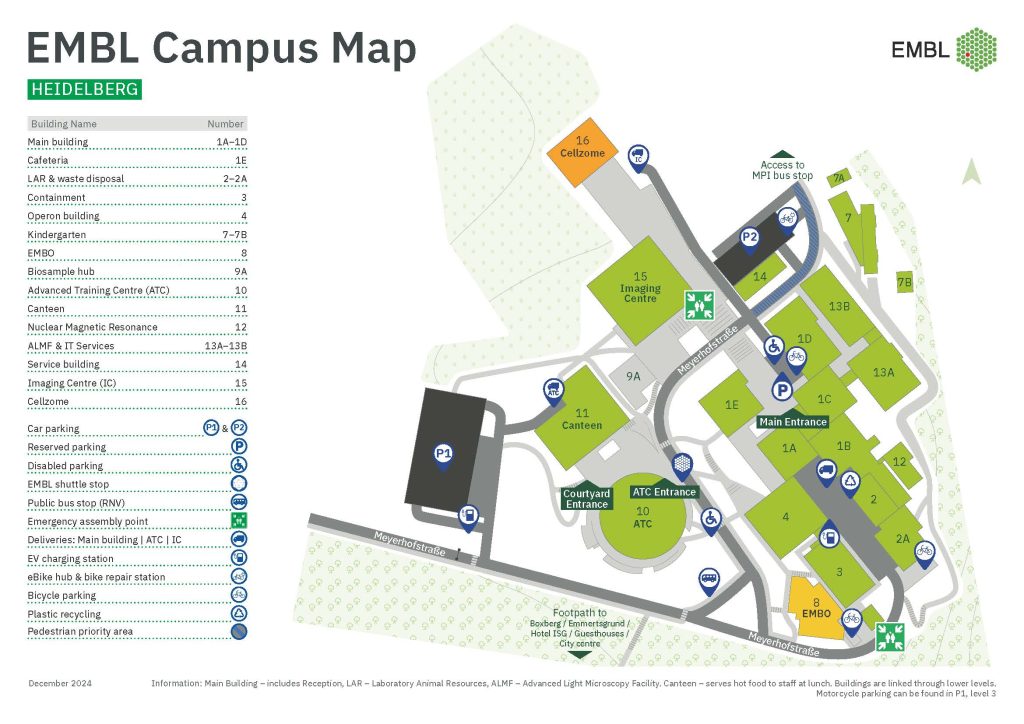
In addition to the shuttle busses, there is also the public bus 28 that serves the EMBL campus and taxis can be easily booked at any time. For more information, please refer to the local transportation (RNV) website.
You may also walk from the ISG Hotel to EMBL (takes up to 30 minutes)
Map to walk from ISG Hotel to EMBL
Address: EMBL Heidelberg, Meyerhofstraße 1, 69117 Heidelberg, Germany
For more information about accommodation and travel, please refer to the FAQ page.
Here you will find useful information for when you are onsite at the event.
All meals and coffee breaks are included in the registration fee. Our catering staff will prepare a variety of vegetarian meals, meat and fish dishes, soups, pasta, fresh fruit and vegetables, as well as a variety of desserts.
Please wear your badge at all times when serving yourself.
No food or drinks are allowed in the computer training lab or wet labs.
Wi-Fi is available on campus using the EMBL-Events network and the event specific password, which will be provided on site. The eduroam network (secure, worldwide roaming access service developed for the international research and education community) is also available.
During the conference, an EMBL Photographer may be taking photos. If you would not like to appear in these, please inform the photographer or a member of the Course and Conference Office.
There are lockers available next to the stairs leading down into the Auditorium. You will find some of those equipped with sockets to charge your smartphone/tablet etc.
In most places the electricity is 220 volts AC (50 cycles). An adaptor and a plug that fits the German socket may be needed for your appliances/laptop (i.e. American, Japanese, etc.). A USB charging station for electronic devices is available at the registration desk.
We can help to print your boarding pass/train ticket. Please send it to events@embl.de and collect your print-outs at the registration desk.
There are lockers available on-site to store your luggage, which require a 2 EURO coin to operate. There is another luggage room on level E0, which is free to use but remains unlocked during the course.
‘’Lost and Found’’ items are kept at the registration desk until the end of the course.
There is a nursing room available in the ATC Rooftop Lounge on level A29.
There is a room for prayer, yoga, and meditation, located on level E0 behind the Auditorium. Please be respectful of others using the room.
Please take a moment to read our health and safety policy.
If first aid is required
In case of fire
Beyond first aid
The Heidelberg University Hospital or ‘Universitätsklinikum‘ has a 24 hour accident and emergency facility and is at ‘Im Neuenheimer Feld 672’. It is an 8 km or a 20 minute taxi ride away from EMBL. In a medical emergency, the ambulance service generally transports patients to this hospital.
Please remember to bring your own medication, if needed, to the conference. Note that the next pharmacy is a 4-minute drive from the EMBL, but for many medications you will be required to see a doctor to get a prescription.
Ensure in advance that your medical insurance will cover you during your visit in the event that you do need to see a doctor while in Heidelberg.
The EMBL course and conference office team are able to advise you on where to turn for emergency or non-emergency medical treatment in Heidelberg and can assist you in making appointments and / or arranging transport to get to the pharmacy or a doctor of your choice if necessary. Please note, we are not however permitted to personally accompany you off-campus.
A variety of activities in Heidelberg can be found on the website of Heidelberg Marketing.
Below you will find the software and technical requirements for this course. You will need admin rights to be able to install the software on your computer and we recommend you try this before the course. If you do not have admin rights, please contact your technical support team in advance to make sure the software can be installed.
The EMBL eCampus learning platform will be used to collaborate, communicate, and network with all course participants. All participants will receive information on how to join shortly before the course. We recommend using Chrome, Safari or Mozilla Firefox browsers for eCampus.
While using the software during the course, please make sure you have nothing else using your bandwidth. We recommend using a wired connection.
Please find additional information including FAQs and terms and conditions on our Information for Participants page.
Sponsorship opportunities
We offer a variety of event sponsoring possibilities, with the flexibility to select a set sponsorship package or combine individual sponsorship options to suit your event budget. Discounts are available for companies sponsoring multiple events at EMBL Heidelberg. View other conferences, or contact sponsorship@embl.org. for further information.
If you are interested in becoming a media partner of this event, please visit our media partnerships webpage.
EMBL wishes to warn sponsors of EMBL conferences and courses of fraudulent schemes purporting to offer sponsorship opportunities on behalf of EMBL or affiliated with EMBL officials. One current scam campaign of which we are aware is conducted using the name ‘Judy Eastman’ (judy@gopcontact.a2hosted.com) and entails approaches to sponsors offering sponsorship opportunities on EMBL’s behalf. Please be kindly advised that all relevant communication regarding sponsorship of EMBL conferences, symposia and courses is handled by EMBL directly and is sent from an official EMBL account. EMBL does not work with any external providers on sponsorship acquisition.
Please also note that:
Suspicious communications purportedly from, for or on behalf of EMBL should be reported to EMBL at the following email address sponsoring@embl.de.
Want to let others know you’re attending this event? Take a look at our shareable media and feel free to use them in your social media channels or presentations.

Date: 5 - 12 Apr 2027
Location: EMBL Heidelberg
Venue: EMBL Advanced Training Centre
Deadline(s):
Application: 30 Nov 2026
Organisers:
Contact: Iva Gavran
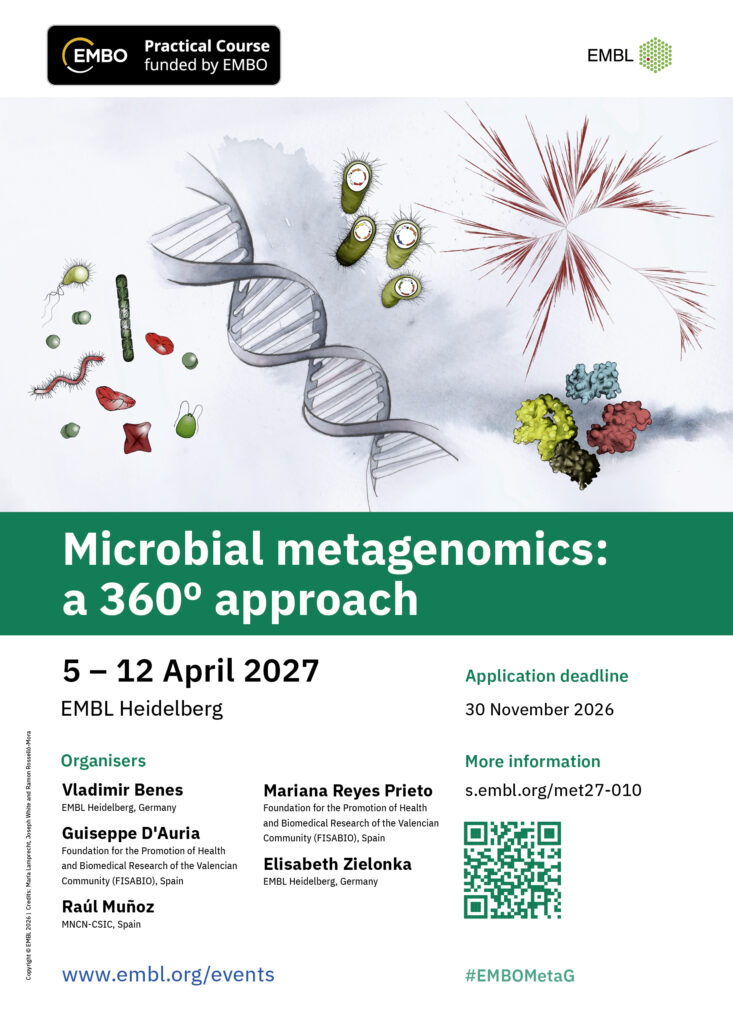
Download event poster
empty