Niccolo Banterle
EMBL Heidelberg
Germany
EMBL Course
This practical course will cover advanced light microscopy techniques, and participants will learn how to derive qualitative and quantitative insights into molecular mechanisms in cells, tissues and developing organisms. Guest researchers, together with microscopy experts from EMBL, will foster an intensive exchange of information through a balance of lectures and practical workshops. The focus of the course will be on the use of fluorescence microscopy to obtain information about the localisation and functions of proteins and other biomolecules at different spatial scales.
This course is directed towards researchers in the life sciences with access to light microscopy equipment, who have an immediate need to apply the techniques they will learn to solve biological problems at the cellular and molecular level in vivo. As the course will primarily focus on advanced techniques, we expect participants to have basic knowledge of light microscopy.
The course will include lectures and hands-on practicals covering multiple fluorescence microscopy techniques:
For demanding applications, we will cover the aspects of image processing and analysis. The modules will cover all the necessary knowledge to conduct similar pipelines in your home lab, enabling you to answer emerging biological questions.
This course is kindly supported by the core facility EMBL Advanced Light Microscopy Facility.
“I highly recommend this course if you are looking to take your fluorescence microscopy experiments to the next level.” – Josefina Marin-Rojas, Universidad de Chile, Chile
EMBL Heidelberg
Germany
Wyss Center for Bio and Neuro Engineering
Switzerland
Abbelight
France

VisiTech International
UK
University of Zurich
Switzerland

University of Bonn
Germany
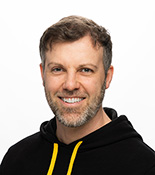
EMBL Heidelberg
Germany
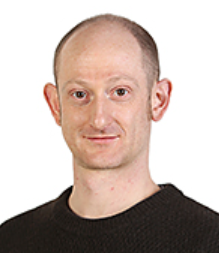
EMBL Heidelberg
Germany
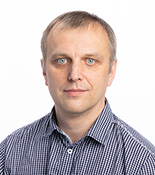
EMBL Heidelberg
Germany
University of Amsterdam
The Netherlands
EMBL Heidelberg
Germany
Evident
Germany
EMBL Heidelberg
Germany

EMBL Heidelberg
Germany
EMBL Heidelberg
Germany
Université de Lorraine
France
EMBL Heidelberg
Germany
Euro-BioImaging
Germany

EMBL Heidelberg
Germany

EMBL Heidelberg
Germany
EMBL Heidelberg
Germany
EMBL Heidelberg
Germany
EMBL Heidelberg
Germany
University of Zurich
Switzerland
Rapp OptoElectronic
Germany
University of Zurich
Switzerland
EMBL Heidelberg
Germany
EMBL Heidelberg
Germany
Evident
Germany
Scientific Training Officer
EMBL Heidelberg
Germany
Course and Conference Officer
EMBL Heidelberg
Germany
Are you on social media? Post using #EMBLFluorImaging and don’t forget to tag @EMBLEvents.
| Time (Europe/Berlin) | Speaker | Location |
|---|---|---|
| 15:30 – 16:00 | Welcome and house notes and course overview | ISG Hotel |
| 16:00 – 17:00 | Lecture: Concepts in light microscopy Urs Ziegler – University of Zurich, Switzerland | ISG Hotel |
| 17:00 – 17:30 | Coffee break | ISG Hotel |
| 17:30 – 18:15 | Lecture: Live cell imaging Joana Delgado Martins – University of Zurich, Switzerland | ISG Hotel |
| 18:15 – 19:15 | Lecture: Adaptive feedback microscopy Aliaksandr Halavatyi – EMBL Heidelberg, Germany | ISG Hotel |
| 19:15 – 21:15 | Dinner | ISG Hotel |
| Time (Europe/Berlin) | Speaker | Location |
|---|---|---|
| 09:00 – 09:05 | Overview of the day | Courtyard Room A & B |
| 09:05 – 09:50 | Lecture: An introduction to image scanning microscope Steven Coleman – VisiTech International, UK | Courtyard Room A & B |
| 09:50 – 10:45 | Lecture: Expansion microscopy Niccolo Banterle – EMBL Heidelberg, Germany | Courtyard Room A & B |
| 10:45 – 11:00 | Coffee break | |
| 11:00 – 12:30 | Practical: Preparation of expansion microscopy samples Caroline Simon – EMBL Heidelberg, Germany | Training lab |
| 12:30 – 13:30 | Lunch | EMBL Canteen |
| 13:30 – 13:40 | Introduction to the practicals | Courtyard Room A & B |
| 13:40 – 16:10 | Practical Session 1: Live cell imaging Joana Delgado – University of Zurich, Switzerland Steven Coleman – VisiTech International, UK (Group 1) 3D imaging of model organisms with CLSM Martin Fritsch – EMBL Heidelberg, Germany Manuel Gunkel – EMBL Heidelberg, Germany (Groups 3+4) Imaging expanded samples Caroline Simon – EMBL Heidelberg, Germany (Group 2) | Microscopy rooms |
| 16:10 – 16:30 | Coffee break | |
| 16:30 – 19:00 | Practical Session 2: Live cell imaging Joana Delgado – University of Zurich, Switzerland Steven Coleman – VisiTech International, UK (Group 4) 3D imaging of model organisms with CLSM Martin Fritsch – EMBL Heidelberg, Germany Manuel Gunkel – EMBL Heidelberg, Germany (Groups 1+2) Imaging expanded samples Caroline Simon – EMBL Heidelberg, Germany (Group 3) | Microscopy rooms |
| 19:00 – 21:00 | Pizza dinner and flash talks | Rooftop Lounge |
| Time (Europe/Berlin) | Speaker | Location |
|---|---|---|
| 09:00 – 09:05 | Overview of the day | Courtyard Room A & B |
| 09:05 – 10:05 | Lecture: Whole organ lightsheet microscopy as a tool for neuroscience Laura Batti – Wyss Center for Bio and Neuro Engineering, Switzerland | Courtyard Room A & B |
| 10:05 – 11:05 | Lecture: Introduction to SMLM Sébastien Bellow – Abbelight, France | Courtyard Room A & B |
| 11:05 – 11:30 | Coffee break | |
| 11:30 – 12:30 | Lecture: Single-molecule microscopy and tracking as a quantitative tool for biochemical and cell biological in vivo studies in (micro)biology Ulrike Endesfelder – University of Bonn | Courtyard Room A & B |
| 12:30 – 13:30 | Lunch | EMBL canteen |
| 13:30 – 13:40 | Introduction to the practicals | Courtyard Room A & B |
| 13:40 – 16:10 | Practical Session 3: Live cell imaging Joana Delgado – University of Zurich, Switzerland Steven Coleman – VisiTech International, UK (Group 2) Deconvolution Urs Ziegler – University of Zurich, Switzerland Martin Fritsch – EMBL Heidelberg, Germany Vishwachi Tripathi – EMBL Heidelberg, Germany (Groups 3+4) Imaging expanded samples Caroline Simon – EMBL Heidelberg, Germany (Group 1) | Microscopy rooms & Computer Training Lab |
| 16:10 – 16:30 | Coffee break | |
| 16:30 – 19:00 | Practical Session 4: Live cell imaging Joana Delgado – University of Zurich, Switzerland Steven Coleman – VisiTech International, UK (Group 3) Deconvolution Urs Ziegler – University of Zurich, Switzerland Martin Fritsch – EMBL Heidelberg, Germany Vishwachi Tripathi – EMBL Heidelberg, Germany (Groups 1+2) Imaging expanded samples Caroline Simon – EMBL Heidelberg, Germany (Group 4) | Microscopy rooms & Computer Training Lab |
| 19:00 – 21:00 | Tapas dinner and flash talks |
| Time (Europe/Berlin) | Speaker | Location |
|---|---|---|
| 09:00 – 09:05 | Overview of the day | Courtyard Room A & B |
| 09:05 – 10:05 | Lecture: Studying biological tissues using contrast mechanisms generated by two photon excitation microscopy Guy Malkinson – Université de Lorraine, France | Courtyard Room A & B |
| 10:05 – 10:45 | Lecture: Photomanipulation techniques and applications Anja Zimmermann – Rapp OptoElectronic GmbH | Courtyard Room A & B |
| 10:45 – 11:05 | Coffee break | |
| 11:05 – 11:30 | Lecture: How Euro-BioImaging can support your research with access to the best imaging Marianna Childress Poli –EuroBioImaging | Courtyard Room A & B |
| 11:30 – 12:30 | Lecture: Measuring interactions and biosensors using FRET Mark Hink – University of Amsterdam, The Netherlands | Courtyard Room A & B |
| 12:30 – 13:30 | Lunch | EMBL canteen |
| 13:30 – 13:40 | Introduction to the practicals | Courtyard Room A & B |
| 13:40 – 16:10 | Practical Session 5: Multicolor Single molecule Localization Microscopy with Spectral Demixing Sébastien Bellow – Abbelight, France Manuel Gunkel – EMBL Heidelberg, Germany (Group 2) Multiphoton imaging and Second Harmonic Generation (SHG) Robert Kasper – Evident, Germany Guy Malkinson – Université de Lorraine, France (Group 1) FRET Mark Hink – University of Amsterdam, The Netherlands Stefan Terjung – EMBL, Heidelberg, Germany (Group 4) Applying adaptive feedback microscopy for high-throughput photoactivation of specific cell phenotypes Aliaksandr Halavatyi – EMBL Heidelberg, Germany Anja Zimmermann – Rapp OptoElectronic GmbH, Germany (Group 3) | Microscopy rooms |
| 16:10 – 16:30 | Coffee break | |
| 16:30 – 19:00 | Practical Session 6: Multicolor Single molecule Localization Microscopy with Spectral Demixing Sébastien Bellow – Abbelight, France Manuel Gunkel – EMBL Heidelberg, Germany (Group 4) Multiphoton imaging and Second Harmonic Generation (SHG) Robert Kasper – Evident, Germany Guy Malkinson – Université de Lorraine, France (Group 3) FRET Mark Hink – University of Amsterdam, The Netherlands Stefan Terjung – EMBL, Heidelberg, Germany (Group 2) Applying adaptive feedback microscopy for high-throughput photoactivation of specific cell phenotypes Aliaksandr Halavatyi – EMBL Heidelberg, Germany Anja Zimmermann – Rapp OptoElectronic GmbH, Germany (Group 1) | Microscopy rooms |
| 19:00 – 22:00 | Dinner downtown |
| Time (Europe/Berlin) | Speaker | Location |
|---|---|---|
| 09:00 – 09:05 | Overview of the day | Courtyard Room A & B |
| 09:05 – 10:05 | Lecture: Visualizing chromosomes during meiosis Simone Köhler – EMBL Heidelberg, Germany | Courtyard Room A & B |
| 10:05 – 11:05 | Lecture: Development of novel protein tags ’NovoTags’ for multiplex fluorescence imaging and cryogenic correlative light and electron microscopy (cryo-CLEM) Steffen Klein – EMBL Heidelberg, Germany | Courtyard Room A & B |
| 11:05 – 11:30 | Coffee break | |
| 11:30 – 12:30 | Lecture: A DNA toolbox for spatial biology Sinem Saka – EMBL Heidelberg, Germany | Courtyard Room A & B |
| 12:30 – 13:30 | Lunch | EMBL Canteen |
| 13:30 – 13:40 | Introduction to the practicals | Courtyard Room A & B |
| 13:40 – 16:10 | Practical Session 7: Multicolor Single molecule Localization Microscopy with Spectral Demixing Sébastien Bellow – Abbelight, France Manuel Gunkel – EMBL Heidelberg, Germany (Group 1) Multiphoton imaging and Second Harmonic Generation (SHG) Robert Kasper – Evident, Germany Guy Malkinson – Université de Lorraine, France (Group 2) FRET Mark Hink – University of Amsterdam, The Netherlands Stefan Terjung – EMBL, Heidelberg, Germany (Group 3) Applying adaptive feedback microscopy for high-throughput photoactivation of specific cell phenotypes Aliaksandr Halavatyi – EMBL Heidelberg, Germany Anja Zimmermann – Rapp OptoElectronic GmbH, Germany (Group 4) | Microscopy rooms |
| 16:10 – 16:30 | Coffee break | |
| 16:30 – 19:00 | Hands-on Practical Session 8: Multicolor Single molecule Localization Microscopy with Spectral Demixing Sébastien Bellow – Abbelight, France Manuel Gunkel – EMBL Heidelberg, Germany (Group 3) Multiphoton imaging and Second Harmonic Generation (SHG) Robert Kasper – Evident, Germany Guy Malkinson – Université de Lorraine, France (Group 4) FRET Mark Hink – University of Amsterdam, The Netherlands Stefan Terjung – EMBL, Heidelberg, Germany (Group 1) Applying adaptive feedback microscopy for high-throughput photoactivation of specific cell phenotypes Aliaksandr Halavatyi – EMBL Heidelberg, Germany Anja Zimmermann – Rapp OptoElectronic GmbH, Germany (Group 2) | Microscopy rooms |
| 19:00 – 20:30 | Dinner | EMBL Canteen |
| Time (Europe/Berlin) | Speaker | Location |
|---|---|---|
| 09:00 – 09:05 | Overview of the day | Computer training lab |
| 09:05 – 10:35 | Practical: FRET data analysis Mark Hink – University of Amsterdam, The Netherland | Computer training lab |
| 10:35 – 11:00 | Coffee break | |
| 11:00 – 12:30 | Practical: SMLM data analysis Sébastien Bellow – Abbelight, France Manuel Gunkel – EMBL Heidelberg, Germany | Computer training lab |
| 12:30 – 13:30 | Lunch | EMBL Canteen |
| 13:30 – 15:00 | Preparation of student presentations | Computer training lab |
| 15:00 – 16:30 | Student presentations | Computer training lab |
| 16:30 – 17:00 | Wrap up of course and departure | Computer training lab |
The course is limited to 16 participants. For selection purposes, please note that your application will not be considered without a letter of motivation.
Your registration for this course includes:
Accommodation and travel are not included in the fees — participants are expected to book and pay their own expenses.
| Academia | €650 |
| PhD Student | €650 |
| Industry | €1150 |
The registration fee should be paid only after acceptance to the course. The results will be announced approximately 2-3 weeks after the application deadline.
If you are no longer able to take part in the course, please inform your course contact responsible for this event. Your registration and the submitted motivation letter will be deleted.
Please also check our Terms and Conditions for the cancellation policy.
For further information about registration, please refer to the FAQ page.
After you have logged in and successfully registered, you will receive an email asking you to submit your motivation letter. Click on the link provided and enter your motivation letter in the text box provided. Alternatively you can submit your motivation letter by clicking on the link on the confirmation page directly after registering.
Instructions
Please note:
For detailed instructions, please watch our video on how to submit a course motivation letter.
For further information about registration and motivation letter submission please refer to the FAQ page.
Limited financial assistance is provided by the EMBL Advanced Training Centre Corporate Partnership Programme and EMBO in the form of registration fee waivers, travel grants and childcare grants.
Your place in the meeting is only confirmed by paying the registration fee, which is mandatory even when receiving a fee waiver.
The fee waiver will cover the registration sum that you have paid to attend the course.
The travel grant will cover the cost of travel (airfare, train, bus, taxi, accommodation, visa) and is provided up to specified caps which are normally as follows:
– up to €400 for participants travelling to an EMBL Course within Europe.
– up to €1000 for participants travelling to an EMBL Course from outside Europe.
The organisers may reduce the grant cap to accommodate more participants. Recipients will be notified of their travel cap amount when they are informed of the outcome of their application. Original receipts must be provided with your signature for all costs incurred within two months of completion of travel. Scanned copies cannot be accepted.
There is the possibility to apply for a childcare grant to offset child care costs incurred by participants, speakers, trainers and organisers when attending a course. Eligible costs include (but are not limited to) fees for a babysitter or child-care facility and travel costs for a caregiver. Please note that priority will be given to early-stage researchers. There is a limited amount of funding available for the childcare grants and funds will be distributed amongst eligible applicants.
Applies to selected courses only. Availability will be indicated during the abstract or motivation letter submission process.
This grant covers costs related to your attendance to the course (registration, travel and accommodation costs). The grant is restricted to PhD students and postdocs who conduct basic biomedical research.
Whether you are eligible to apply for a travel grant, depends on when you received your university entrance qualification (e.g. Abitur, A-Levels, High School Diploma, Final State Examination):
– for PhD and MD students, as well as graduates, the university entrance qualification must not have been obtained more than 11 years ago at the time of the envisaged course
– for postdocs, the university entrance qualification must not have been obtained more than 13 years ago at the time of the envisaged course
You can apply for financial assistance in the submission portal by the abstract deadline. Read the instructions on how to apply for financial assistance. Only submissions for financial assistance will be accepted. Presentation abstracts cannot be submitted here and will be declined.
In your application you will be asked to summarise your current work, answer questions regarding why your lab cannot fund your attendance, and how your attendance will make a difference to your career. Application for financial support will not affect the outcome of your registration application.
*For some events, applications for Childcare Grants will still be done by email. Information about the grant will be sent out shortly after the abstract/motivation letter deadline. Please contact the event Conference Officer if you have any questions.
A selection process will take place with the results announced by email to all applicants / submitters. We aim to announce 3 weeks (21 days) after the abstract submission deadline but delays may occur.
Selection results do not impact your admission to the meeting. Selection for registration fee waivers and travel grants is based on scientific merit, your current work or study location, the reasons for needing financial support, and the impact this event will have on your career.
Childcare grants will be allocated in the same timeframe (6-8 weeks before the event start date). Please note that priority will be given to early-stage researchers.
Check out this list of external funding opportunities.
For further information about financial assistance please refer to the FAQ page.
We can send you a registration confirmation to support your visa procedure (not an official invitation letter). Please contact the Conference Officer responsible for your event. Read our FAQ for more information.
If you are travelling to Heidelberg via aeroplane, train, car, or long-distance bus, you can find useful information on our travel information page.
Accommodation is not included in the registration fee.
A mix of single and twin rooms have been reserved for 6 nights from 16 May to 22 May at the ISG hotel. Single rooms are limited and will be available on a first come, first served basis.
After the selection process, selected participants should contact the hotel directly to make a booking with a booking code EVA26-01 by the deadline of 17 April 2026.
We recommend that all course participants stay at the dedicated hotel for the course.
Shuttle buses will go from the ISG Hotel to EMBL and back, mornings and evenings. A bus schedule and location of the bus stops will be made available prior to the meeting.
In addition to the shuttle busses, there is also the public bus 28 that serves the EMBL campus and taxis can be easily booked at any time. For more information, please refer to the local transportation (RNV) website.
You may also walk from the ISG Hotel to EMBL (takes up to 30 minutes)
Map to walk from ISG Hotel to EMBL
Address: EMBL Heidelberg, Meyerhofstraße 1, 69117 Heidelberg, Germany
For more information about travel and accommodation, please refer to the FAQ page.
Here you will find useful information for when you are onsite at the event.
All meals and coffee breaks are included in the registration fee. Our catering staff will prepare a variety of vegetarian meals, meat and fish dishes, soups, pasta, fresh fruit and vegetables, as well as a variety of desserts.
Please wear your badge at all times when serving yourself.
No food or drinks are allowed in the auditorium.
Wi-Fi is available on campus using the EMBL-Events network and the event specific password, which will be provided on site. The eduroam network (secure, worldwide roaming access service developed for the international research and education community) is also available.
During the conference, an EMBL Photographer may be taking photos. If you would not like to appear in these, please inform the photographer or a member of the Course and Conference Office.
There are lockers available next to the stairs leading down into the Auditorium. You will find some of those equipped with sockets to charge your smartphone/tablet etc.
In most places the electricity is 220 volts AC (50 cycles). An adaptor and a plug that fits the German socket may be needed for your appliances/laptop (i.e. American, Japanese, etc.). A USB charging station for electronic devices is available at the registration desk.
We can help to print your boarding pass/train ticket. Please send it to events@embl.de and collect your print-outs at the registration desk.
There are lockers available on-site to store your luggage, which require a 2 EURO coin to operate. There is another luggage room on level E0, which is free to use but remains unlocked during the conference.
‘’Lost and Found’’ items are kept at the registration desk until the end of the conference.
If you are interested in purchasing EMBL merchandise (products presented in the glass display in the registration area), please email the EMBL shop to place an order.
Kindly note the EMBL shop is only open upon request and all purchases must be made in cash (Euros only).
There is a nursing room available in the ATC Rooftop Lounge on level A29.
There is a room for prayer, yoga, and meditation, located on level E0 behind the Auditorium. Please be respectful of others using the room.
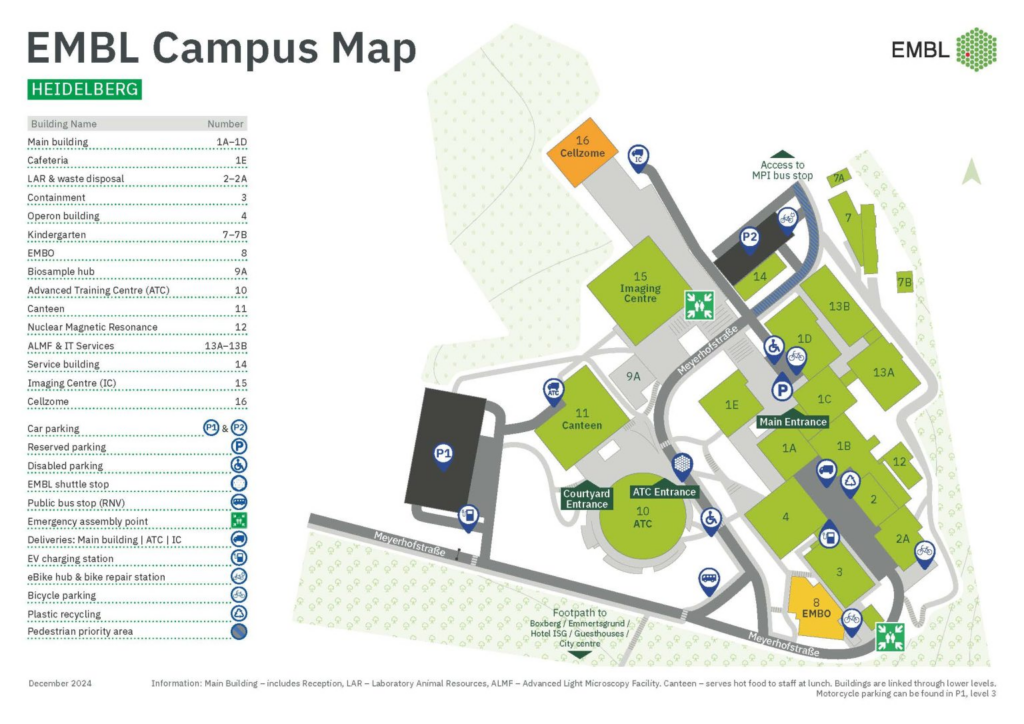
Please take a moment to read our health and safety policy.
If first aid is required
In case of fire
Beyond first aid
The Heidelberg University Hospital or ‘Universitätsklinikum‘ has a 24 hour accident and emergency facility and is at ‘Im Neuenheimer Feld 672’. It is a 8km or a 20 minute taxi ride away from EMBL. In a medical emergency, the ambulance service generally transports patients to this hospital.
Please remember to bring your own medication, if needed, to the conference. Note that the next pharmacy is a 4-minute drive from the EMBL, but for many medications you will be required to see a doctor to get a prescription.
Ensure in advance that your medical insurance will cover you during your visit in the event that you do need to see a doctor while in Heidelberg.
The EMBL course and conference office team are able to advise you on where to turn for emergency or non-emergency medical treatment in Heidelberg and can assist you in making appointments and / or arranging transport to get to the pharmacy or a doctor of your choice if necessary. Please note, we are not however permitted to personally accompany you off campus.
A variety of activities in Heidelberg can be found on the website of Heidelberg Marketing.
Please find additional information including FAQs and terms and conditions on our Information for Participants page.
Sponsorship opportunities
We offer a variety of event sponsoring possibilities, with the flexibility to select a set sponsorship package or combine individual sponsorship options to suit your event budget. Discounts are available for companies sponsoring multiple events at EMBL Heidelberg. View other conferences, or contact sponsorship@embl.de for further information.
If you are interested in becoming a media partner of this event, please visit our media partnerships webpage.
EMBL advises sponsors to beware of fraudulent schemes falsely offering sponsorship opportunities. All legitimate communication about sponsorship for EMBL conferences, symposia, and courses comes directly from EMBL via official EMBL email accounts. EMBL does not use third parties for sponsorship acquisition.
– EMBL does not sell attendee lists.
– EMBL will never ask for credit card details or direct payments.
– All payments are processed by invoice only.
If you receive a suspicious message claiming to be from or on behalf of EMBL, please report it to sponsorship@embl.org.
Want to let others know you’re attending this event? Take a look at our shareable media and feel free to use them in your social media channels or presentations.

Date: 17 - 22 May 2026
Location: EMBL Heidelberg
Venue: EMBL Advanced Training Centre
Deadline(s):
Application: Closed
Organisers:
Contact: Luana Ribeiro