Best poster prizes at ‘Molecular mechanisms in evolution and ecology
The EMBO Workshop ‘Molecular mechanisms in evolution and ecology‘ took place in early October at EMBL Heidelberg with participants also joining virtually.
The focus of this conference series is on interspecies and cell-environment interactions across living organisms and the 2026 edition brought together researchers from a wide range of fields and microbial systems that aimed to gain mechanistic insights on major outstanding ecological and evolutionary questions or that develop novel experimental or computational approaches for doing so.
138 people were attending on-site and 37 participants tuning in remotely. There were 8 financial assistance grants provided by EMBO. We had 91 posters on display on our beautiful helix in the ATC Buidling and during two poster sessions the participants were showcasing and discussing their research. After both sessions the participants then voted for the best poster.
Five winners were awarded poster prizes during the last session and today, we’re pleased to share their brilliant research. Congratulations to the winners!
Toxic exploitation of iron uptake in Pseudomonas
Authors: Paul B. Rainey, Christine Bochynski, David Rogers
Presenter: Christine Bochynski

Max Planck Institute for Evolutionary Biology, Germany
Abstract:
Pseudomonas fluorescens are well-researched bacteria capable of dominating soil environments. One feature that makes P. fluorescens so efficient in colonizing soil is the ability to take-up and sequester iron, an essential nutrient. This is done by producing iron-chelating molecules, called siderophores. These molecules are taken up by a myriad of specialized receptors, facilitating uptake of endogenous siderophores and those produced by other microorganisms. However, this promiscuity inadvertently leads to uptake of unwanted secondary metabolites with a toxic effect on cells. This includes the lesser known microcin-like (Mcc-like) toxin produced by P. fluorescens U114.
I will provide a brief overview of siderophore receptors before moving to describe the genetics and mode of action of the U114 Mcc-like toxin. Through inhibition assays it was determined that this toxin targets close relatives of P. fluorescens U114. Transposon mutagenesis and analytical genetics were used to identify the responsible three-gene operon, coding for: a precursor peptide, a modifying protein and a putative immunity protein. The precursor peptide becomes toxic once fully processed inside target cells, resulting in a toxic analog of aspartyl-tRNA-synthetase. This toxic analog disrupts protein synthesis machinery, leading to cell death. The toxin produced by U114 is able to exploit an otherwise beneficial feature of P. fluorescens and is therefore considered to utilize a Trojan Horse mechanism, having a potentially profound impact on the evolutionary dynamics of P. fluorescens in soil environments.
View the poster
Environmental composition and initial metabolic states shape antifungal resistance evolution in Candida albicans
Authors: Burak Demirbas, Meike Wortel
Presenter: Burak Demirbas

University of Amsterdam, The Netherlands
Abstract:
Antimicrobial resistance evolution is a rapidly growing societal challenge, yet the molecular and ecological drivers that shape resistance trajectories remain poorly understood, particularly in fungal pathogens. Fungal cells can evolve resistance to antifungal compounds through increased efflux activity, target overexpression or modification, or decreased influx of the antifungal agent. Strikingly, resistant cells often deploy these mechanisms simultaneously, with different combinations observed across clinical isolates. Whether this reflects stochastic fixation of mutations or an evolutionarily optimal strategy shaped by selective pressures remains an open question.
To distinguish between these possibilities, we employ a computational resource allocation model to dissect how the environment sculpts the selective landscape for resistance evolution in the fungal pathogen Candida albicans through cellular metabolism. Enzyme-substrate interactions are represented through Michaelis-Menten kinetics, bridging molecular mechanisms and population-level evolutionary dynamics. Our simulations reveal that which antifungal resistance mechanisms evolve is contingent on both nutrient availability and antifungal concentration, highlighting the role of cell-environment interactions in driving evolutionary outcomes.
The resistance mechanisms do not only differ in the enzymes they use for resistance, e.g. export protein versus target protein, but the whole metabolism is rewired to maximize the efficacy of the particular mechanisms, e.g. by investing in energy production. Furthermore, we demonstrate that a cell’s initial enzymatic state may serve as a predictive signature for which resistance trajectory will likely be favored, suggesting that the metabolic background can bias cells toward specific evolutionary outcomes. Our work bridges evolutionary theory and clinical reality, casting the problem of antimicrobial resistance as both a fundamental evolutionary question and one of urgent societal concern.
View the poster
Evolutionary rescue of human disease mutations
Authors: Brooke Dubyna, Gregory Lang, Ryan Vignogna, Ethan Perlstein, Gregory Lang
Presenter: Brooke Dubyna

Lehigh University, USA
Abstract:
Thousands of human disease-associated genes have clear yeast orthologs, making yeast an ideal model system for advancing a basic understanding of human disease. We used CRISPR/Cas9 to generate 51 yeast strains with 11 human disease-associated variants, focusing on human disease genes involved in protein glycosylation, ribosome maturation, mitochondrial function, and RNA regulation.
We find that most of these variants result in fitness defects in yeast. We used laboratory evolution to select for suppressor mutations. By exerting continuous selective pressure over thousands of generations, we could enrich for even modest fitness benefits, which may be missed from traditional genetic-suppressor screens. Using this approach, we identified both known and previously unknown suppressor mutations. For example, we identify mutations in DPM1 and RPS9B that compensate for disease phenotypes of ALG7 and SDO1, respectively. Reconstructed strains harboring evolved suppressor mutations and the original disease alleles demonstrate that these suppressors rescue fitness and may compensate for defects in molecular function.
Our results will map local genetic interaction networks centered around disease-associated alleles, providing greater insights into disease phenotypes and informing potential targeted therapies for disease management in patients with rare disorders.
View the poster
Riding the heat wave: transcriptomic insights from yeast
Authors: Jennifer Molinet, Chloé Haberkorn, Rike Stelkens
Presenter: Chloé Haberkorn

Stockholm University, Sweden
Abstract:
Extreme climatic events such as heat waves pose major challenges to species survival and have profound impacts on evolutionary processes. Plasticity is thought to buffer organismal stress, yet the molecular mechanisms underlying repeated stress responses, especially the roles of transcriptional plasticity and stress memory, remain mostly unresolved.
Here, we experimentally exposed clonal populations of eight divergent Saccharomyces yeast species with different thermal tolerances to repeated heat waves and compared their phenotypic and transcriptomic profiles after a few generations of mitotic growth. Warm-adapted species maintained higher growth than cold-adapted species across heat wave exposures. Thermo-generalist species showed intermediate outcomes with one species improving growth across repeated heat waves. Using a conceptual framework separating no-memory (gene expression independent from prior exposure) from memory-like responses (expression modulated by prior exposure) showed mostly no-memory responses with conserved transcriptomic signatures of proteostasis induction, and reduced expression of ribosome biogenesis and translation upon repeated heat waves. Memory-like responses were highly species-specific, revealing strikingly opposite patterns of (de)sensitization in ribosomal and translational pathways in species at the two extremes of thermal tolerance.
Together, our results show that thermal resilience in yeast can arise through alternative transcriptional changes and suggest that warm- and cold-temperature specialists use divergent gene regulatory strategies upon repeated heat waves. With climate change projected to increase the frequency and intensity of heat waves, understanding plastic responses across species with diverse ecological and genetic backgrounds is crucial for predicting biological resilience.
View the poster
Not all those who wander are lost: diversity and evolution of the fungal mitochondrial selfish elements
Authors: Ivan Skakov, Tobias Baril, Ammar Abdalrahem, Mohamed Sarhan, Daniel Croll
Presenter: Ivan Skakov

University of Neuchâtel, Switzerland
Abstract:
Selfish genetic elements are widespread components of fungal mitochondrial genomes, yet their evolutionary history has remained poorly understood across large taxonomic scales. We analyzed 3,954 curated mitochondrial genomes spanning all major fungal lineages, including 2,689 newly assembled mitogenomes, to generate the most comprehensive survey of mitochondrial selfish elements to date. We identified tens of thousands of selfish-element ORFs, dominated by homing endonucleases and group II intron-associated proteins, and detected HNH endonucleases in fungal mitochondria for the first time. Selfish elements showed highly heterogeneous distributions across fungi: some families were nearly ubiquitous, whereas others were restricted to specific evolutionary lineages. Sequence clustering revealed contrasting evolutionary patterns, ranging from lineage-specific expansions to highly patchy distributions across distantly related fungi. Phylogenetic incongruence together with codon usage analyses indicate that recurrent horizontal transfer has contributed to the spread of several selfish-element lineages.
We also identified the first mitochondrial integrations of mitoviruses in fungi. Comparative analyses further showed that selfish elements consistently exhibit lower codon adaptation than essential mitochondrial genes, suggesting incomplete adaptation following movement into new genomic backgrounds. Phylogenetic comparative analyses demonstrated that mitochondrial genome expansion is primarily caused by selfish element proliferation, especially LAGLIDADG homing endonucleases and reverse transcriptase-associated elements. Finally, we identified repeated independent losses of selfish elements, suggesting recurrent cycles of invasion, proliferation, and genome purification during fungal evolution. Overall, our large-scale analysis provides the most comprehensive assessment to date of selfish element diversity and dynamics in fungal mitogenomes, offering a new framework for understanding mitochondrial genome evolution across eukaryotes.
View the poster
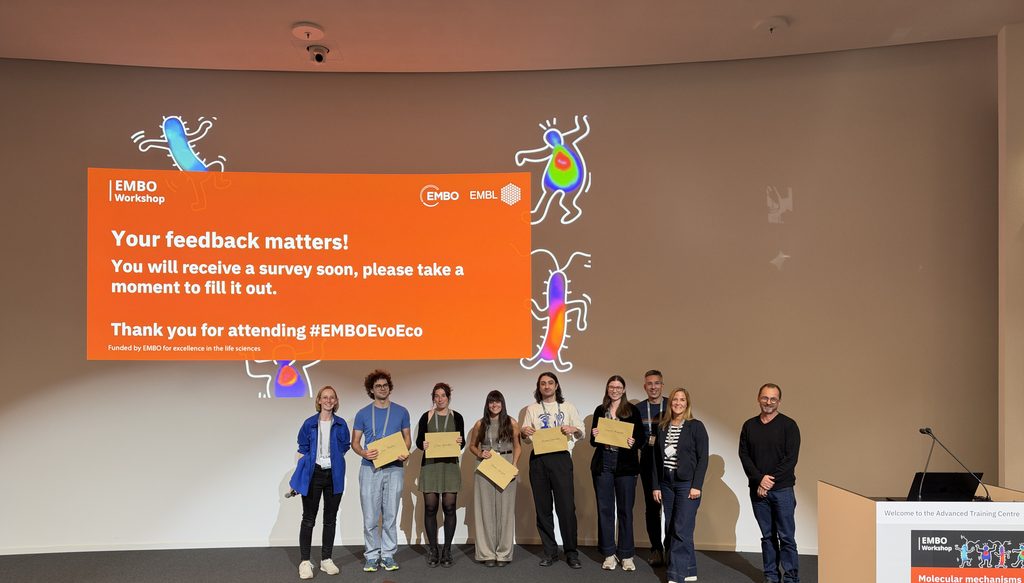
The EMBO Workshop ‘Molecular mechanisms in evolution and ecology’ took place from 6 – 9 October 2026 at EMBL Heidelberg and virtually.
Find out more about the #EMBOEvoEco meeting from the blog post written by our event reporter Noopur Dubey.