Meet the team: Prakash
Prakash Singh Gaur has been a pivotal member of the EMBL-EBI Training team since 2017. Dive into our interview with him to learn how our Technical Lead keeps our users’ journeys smooth and accessible.
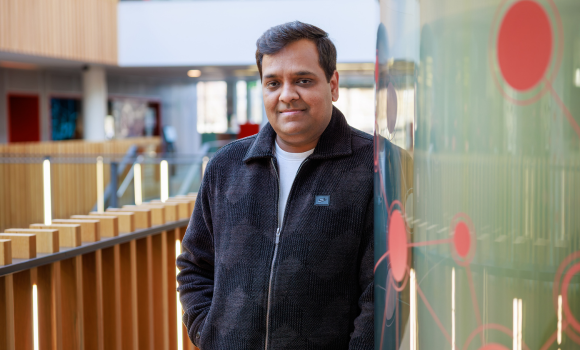
Tell us a bit about yourself and your career background before joining EMBL’s European Bioinformatics Institute (EMBL-EBI).
I’d describe myself as an open-source web technology enthusiast with more than 15 years of experience in web development.
Before joining EMBL-EBI in 2017, I worked with non-profit organisations and large public institutions in India, supporting large-scale digital transformation initiatives. In these roles, I designed and maintained complex backend systems and led the delivery of scalable, high-availability web platforms.
This work involved building solutions, improving access to digital services and positively impacting the users at scale.
You play an essential role in the EMBL-EBI Training team, but you are often hidden behind the scenes. Can you explain your role to those who don’t know what a Technical Lead does?
I am responsible for the overall design, development, and long-term sustainability of the training web ecosystem. This includes the web applications and databases that support our training programmes, as well as ensuring they remain reliable, secure, and performant as usage grows.
Beyond hands-on development, my role also involves setting technical standards, making architectural decisions, and working closely with scientific trainers, content creators, and other stakeholders to translate training needs into robust digital solutions that learners can rely on.
What are some of the projects you’ve worked on whilst in this role?
During my time in this role, I have worked on a range of projects that support and enhance EMBL-EBI’s training mission. One of the key initiatives I led was the development of the Training Content Hub (TCH), which serves as the central backbone for all EMBL-EBI training materials, enabling consistent discovery, delivery, and reuse of content across platforms.
I have also played a significant role in transforming our on-demand training services, focusing on improving usability, performance, and scalability to better serve a growing global audience. In addition, I have contributed to several collaborative projects, including CABANA and ELIXIR, helping to deliver modern, reliable, and visually engaging web platforms for these international partnerships.
The project I am most proud of is Ada, a recently launched AI-powered assistant designed to improve how learners interact with EMBL-EBI’s educational resources. Named after the pioneering mathematician Ada Lovelace, the tool uses a large language model to provide a conversational alternative to traditional keyword-based search. Learners can ask questions in natural language and receive guided, context-aware recommendations drawn directly from EMBL-EBI’s training catalogue, making our extensive archive more accessible and easier to navigate.
Digital accessibility is a fundamental part of your day-to-day work. Can you tell us more about some of the considerations you make for all our users?
Digital accessibility is a core consideration in my day-to-day work and a fundamental principle within our web development processes. Our goal is to ensure that all users, regardless of device, screen size, or ability, can easily access and benefit from EMBL-EBI’s training resources.
From a practical perspective, this means designing and building interfaces that work consistently across desktops, tablets, and mobile devices, while following established accessibility standards. Accessibility checks are embedded into our development process, with automated and manual testing carried out as part of every release cycle.
By treating accessibility as an integral part of development rather than an afterthought, we aim to deliver inclusive, reliable, and high-quality digital experiences for the diverse global community we serve.
Is there anything coming up soon that you’re excited to see go live?
I’m particularly excited about the next phase of development for Ada. We are introducing new features and pairing them with a thoughtfully designed interface that will make the assistant even more intuitive and user-friendly.
These updates will further improve how learners discover and interact with EMBL-EBI’s training resources, and we’ll be sharing more details as the new features go live very soon.
As your time in this job comes to an end, what legacy do you want to leave behind for the team and its users?
The legacy I hope to leave behind is one of sustainable engineering and strong collaboration. This includes embedding agile and Scrum-based ways of working that support transparency, continuous improvement, and shared ownership within the team.
From a technical perspective, I aim to leave a well-structured, decoupled technology stack that is easier to maintain, evolve, and scale over time. Equally important is a strong alignment between user experience, technical implementation, and the wider EMBL digital ecosystem.
And what skills will you take with you to your next role?
Before joining EMBL-EBI, my experience was rooted in building robust backend systems for complex web platforms. Over time, my role here allowed me to broaden that foundation to include frontend development, integration, and modern delivery practices.
Just as importantly, I developed a more product-oriented mindset by working closely with users and stakeholders, focusing on real needs and outcomes rather than process alone. This shift has strongly influenced how I approach design, prioritisation, and delivery.
I have also gained valuable experience in mentoring developers and helping them achieve their professional goals.
As I move into my next role, I will take with me a combination of strong technical delivery skills, product and process awareness, and a collaborative, user-focused approach to building sustainable digital solutions.