From self-organization to biofabrication – a report on the EMBO | EMBL Symposium ’Organoids: modelling organ development and disease in 3D‘
Written by Nils Schütz, PhD (Heidelberg University, Faculty of Theology/Max Planck School “Matter to Life”). The following is an abridged version. You will find the link to the full version below.
Started in 2016 by Jürgen Knoblich (Institute of Molecular Biotechnology, Austria), Mina Bissell (Lawrence Berkeley National Laboratory, USA) and Esther Schnapp (EMBO Press, Germany), the biannual EMBO | EMBL Symposium ’Organoids: modelling organ development and disease in 3D‘ has quickly become a vital and flourishing meeting place for the world-wide organoid research community. And so, it must have come to nobody’s surprise that more than 600 participants (440 on site, 179 virtually) gathered for this year’s meeting (the 5th of the conference series) that took place from 22 – 25 October 2025 at EMBL Heidelberg. Those who attended were presented with a carefully orchestrated program curated by the scientific organizers Meritxell Huch (Max Planck Institute of Molecular Cell Biology and Genetics, Germany), Karl Koehler (Boston Children’s Hospital and Harvard Medical School, USA), Madeline Lancaster (MRC Laboratory of Molecular Biology, UK) and – for the fifth and final time – Esther Schnapp. Over the course of four days, forty main talks, numerous flash talks, and over 200 posters were presented, alongside ample opportunities to meet speakers, socialize and network.
[…]
In their highly anticipated keynote lecture “Passage of time in brain organoids: the journey to understand human brain development” that kicked off the symposium, Paola Arlotta (Harvard University, USA) presented human cortical organoids that were cultured for unprecedent lengths of time ranging from 6 months to over 5 years in vitro, and could be shown to develop and mature while in culture for these extended periods as confirmed by methylation profiling. Notably, they could furtherly report that human brain organoids are capable of “recording and recalling” developmental time in a certain sense as demonstrated by the ability of “old” progenitors to rapidly produce late progeny when exposed to inductive developmental signals. Adding a third achievement to their already impressive talk, Arlotta also introduced chimeroids of differentially patterned neural progenitors that were shown to produce multi-regional organoids following endogenous principles of brain self-organization. (Antón-Bolaños et al, 2024; Faravelli et al, 2025)
Conceptually, Magdalena Sutcliffe’s (MRC Laboratory of Molecular Biology, UK) talk served as a link between Arlotta’s keynote and the presentations on (extra-)embryonic lineages that made up the majority of the remaining talks on Day 1. Not only were they able to show that aberrant transcriptional and chromatin states are responsible for the incompetence of some human PSC lines to differentiate into cerebral organoids. Impressively, they were also successful in resetting these states thereby re-establishing a fully pluripotent and uncommitted regional epiblast identity. (Sutcliffe et al, 2024)
[…]
The main talks on Day 2 were divided into two sessions on ‘Building organoid complexity’.
[…]
Building on a model first described in 2021, Jiyoon Lee (Boston Children’s Hospital / Harvard Medical School, USA) presented “sensing skin organoids” (senSkOs), a novel platform that models how human skin and sensory neurons derived from hPSC develop and interact with each other when they are brought together as floating assembloids or co-cultures on a chip. In both systems successful innervation and functional neural integration were achieved, while Capsaicin treatment and mechanical deflection led to promising results regarding the functional activation of nociceptors and mechanoreceptors, respectively. (Lee & Koehler, 2021)
In another fascinating talk, Minoru Takasato (RIKEN Center for Biosystems Dynamics Research, Japan) explained how they guided hPSC differentiation stepwise into hindgut, cloaca, and then bladder organoids with structural and functional characteristics specific for the bladder that matured further when they were cultured with surrounding mesenchyme. They also reported on their on-going efforts to co-culture bladder and kidney organoids, ideally connected by a ureter and supported by urothelium to improve vascularization and morphogenesis that would ultimately lead to majorly improved models of urinary tract development, functionality and disease.
[…]
The already impressive repertoire of models of embryos, pancreases, skin, urinary tract, cerebellum, neuromuscular system, and liver was then expanded by Joo-Hyeon Lee (Memorial Sloan Kettering Cancer Center, USA) to include patient-derived lung organoids and large-scale organoid models to uncover compounds that reverse pro-fibrotic states and promote alveolar differentiation during early tumorgenesis and fibrosis. Maximiliano Arce (Uppsala University, Sweden), on the other hand, drew the audience’s attention to the topic of vascularization. By their report, IPSCs were generated from patients with cerebral cavernous malformations and vascularization organoids created from these cells that showed an abnormal vascular network and developed macrostructural abnormalities. In addition, the prospect of co-culturing brain and vascularized organoids to recapitulate neurovascular interactions and study environmental-related disease mechanisms was raised. (Arce et al, 2025)
[…]
The first session on the third day was kicked off with a concise talk by Hans Clevers (F. Hoffmann-La Roche Ltd / Hubrecht Institute, The Netherlands), who promoted the use of Invasin as a fully defined, affordable, versatile, and animal-free complement to Matrigel/BME. (Wijnakker et al, 2025) […] Margherita Yayoi Turco (Friedrich Miescher Institute for Biomedical Research, Switzerland) explained their use of trophoblast organoids derived from first-trimester placental tissues to model villous and extravillous differentiation pathways in vitro and to systematically dissect the signalling pathways controlling trophoblast proliferation and differentiation. Their exciting and ambitious goal: Revealing how intrinsic trophoblast programs and extrinsic uterine signals cooperate to drive placental growth and function. (Bondarenko & Turco, 2025)
[…]
Juergen Knoblich opened the second session with a magnificent talk that summarized recent developments in brain organoid research and demonstrated how advanced cerebral organoids matured for more than a year can be used to model processes that can lead to post-natal neuro-developmental disorders, when disrupted. (Pașca et al, 2025; Wong et al, 2025; Li & Knoblich, 2025) […] Amal Fahmi (University of Bern, Switzerland), on the other hand, took things in a unique and completely new direction. They employed human neural organoids to evaluate the neurodevelopmental impact of orthoflavivirus infections like Zika, Dengue and West Nile Virus and found that Zika and West Nile – but not Dengue – were causing toxicity and abnormal neurodevelopment in the models, suggesting a potential risk of fetal brain injury stemming from virus infections.
Fahmi’s presentation was followed by an eagerly awaited talk of Toshiro Sato (Keio University School of Medicine, Japan), in which they pointed out that the preservation of the stem-cell niche in the context of gastrointestinal organoid transplantation markedly improves transplantation efficiency leading them to the general concluding recommendation: “Don’t destroy the niche!”
[…]
The honor of opening the fourth and final day of the symposium fell to Bon-Kyoung Koo (Center for Genome Engineering, Republic of Korea). Building on their collection of diverse bat organoids, (Kim et al, 2025) they announced the establishment of a cross-species “organoid zoo” – a platform of adult stem cell–derived intestinal organoids from 26 vertebrate species (spanning rodents, bats, avians, minipigs, and primates amongst others) that can be robustly maintained in a unified, commercially available medium, enabling systematic cross-species analysis. No less impressive was Holly M Poling (University of Cincinnati, USA), who presented a confined culture system that enables a faster and denser generation of larger small intestinal, colonic, and gastric organoids that co-develop a functional de novo enteric nervous system and exhibit neuromuscular coordination with isometric force contractions comparable to that of native human tissue. (Poling et al, 2025)
[…]
The second keynote lecture “Engineering organoids – Deconstructing and reconstructing intestinal morphogenesis through biofabrication” by Matthias Lütolf (Roche Institute of Human Biology, Switzerland) brought the fifth EMBO | EMBL Symposium ‘Organoids’ to a fitting close. Drawing on their many high-profile collaborations with other expert organoid researchers, Lütolf presented their exemplary efforts in developing intestinal organoids assembled by guiding cell-intrinsic self-patterning through engineered stem cell microenvironments. Among the more recent kinds of model Lütolf showcased, were also the following three: intestinal organoids used to test the theory that intestinal cell extrusion is regulated by intercellular force transmission arising from crowding or other mechanical interactions; gastric, small-intestinal, caecal and colonic epithelial models that faithfully reproduce their respective tissue geometries and that exhibited stem cell regionalization and transcriptional resemblance to in vivo epitheliam; and a patterned homeostatic human gastric organoid-on-a-chip system with bilateral access that is capable of modeling H. pylori niche establishment and persistent colonization of the gastric epithelium. Together, these biofabricated systems contribute to the reconstruction of intestinal morphogenesis, the illumination of failure modes in disease, and the development of next-generation therapeutics. (Hofer et al, 2025a; Hofer et al, 2025b; Krueger et al, 2025)
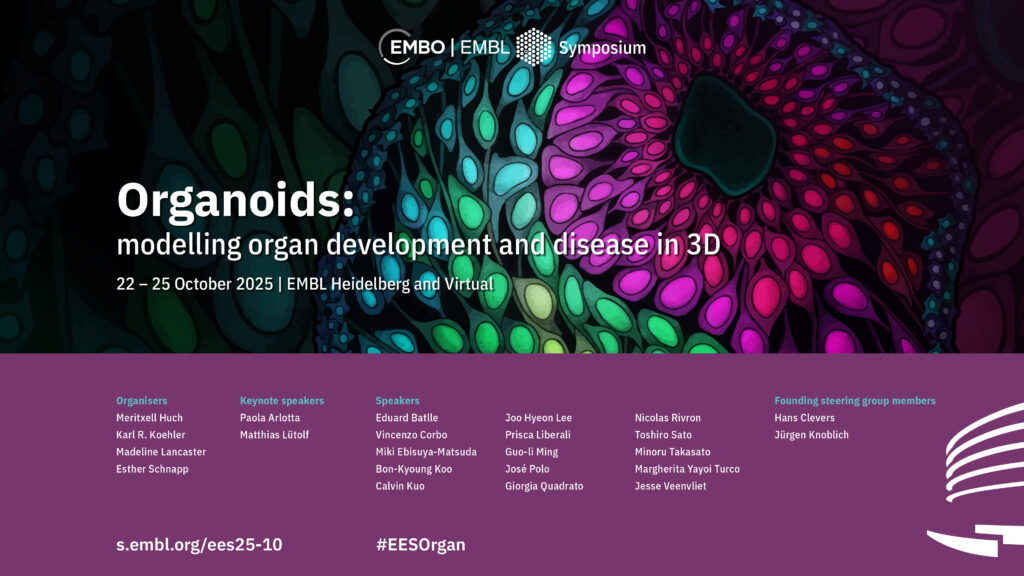
The EMBO | EMBL Symposium ‘Organoids: modelling organ development and disease in 3D’ took place between 22 – 25 October 2025 in Heidelberg, Germany, and virtually.
Read also about the #EESOrganoids poster prize winners and find out more about their research in another blog post from the meeting.
Did you know that you can become an event reporter and receive a conference fee waiver in exchange? Find out how to do that by visiting our Become an event reporter page.