Out in the field: what our team members can learn from attending external conferences and events.
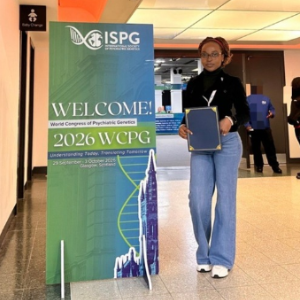
Written by Chioma Oselu, Visiting Predoctoral Fellow, EMBL-EBI Training, who recently attended an external conference to present her work from her PhD.
Glasgow did not go as planned, and that was the point: WCPG2026 through the eyes of an Early Career Investigator awardee.
The first time I presented my PhD work, I had the whole thing written out word for word and read out most of it. The World Congress of Psychiatric Genetics (WCPG) 2026 was around the 27th time I had presented it, and I had long stopped rehearsing. I thought I knew what the week had in store, but I was wrong about most of it.
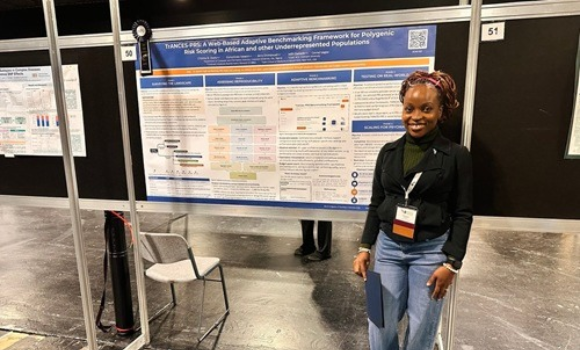
WCPG is the premier international meeting for psychiatric genetics. I presented TrANCES-PRS, the benchmarking framework I built to address a gap in the field, which is that polygenic scores constructed in European-ancestry cohorts lose accuracy when you apply them to African or admixed populations, meaning populations whose genomes carry ancestry from two or more previously separated groups, e.g. African American or Latin American cohorts. Many methods have been developed to address this, but no amount of method development will correct the imbalance on its own. It requires a standardised framework for comparing those methods against each other, and it requires datasets in which the relevant ancestry groups are properly represented. TrANCES-PRS supplies the first of those two.
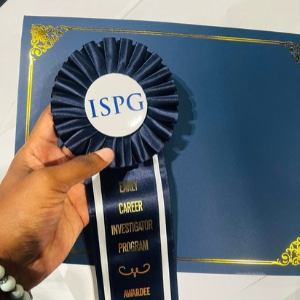
I was also selected as one of this year’s Early Career Investigators at WCPG, and the award came with a mentorship pairing. I was paired with Professor Nancy Cox, and over lunch we had a long conversation about science, building a career in it, and what it takes for a woman to hold a leadership position in this field. More conferences should do this. A young researcher can get onto a programme on the strength of an abstract, but connecting with the people whose work has shaped the field for decades usually depends on your networking skills or who already knows your name, and a formal pairing removes that barrier.
That pairing points to something larger. My Fellowship at EMBL-EBI focuses on building the skills to deliver world-class training, whilst addressing the ancestral imbalance I described from another angle. A method or tool is only as useful as the number of people able to run it, and the researchers closest to that imbalance are too often the ones with the least access to the training that would equip them to build the solutions. My vision for this field brings both halves together, which is to build equitable computational tools and to sustain the capacity of the researchers who will use them.
Here are my two main lessons for the early career researchers reading this, especially those working in Africa.
- Ancestral imbalance in genomic datasets was mentioned in nearly every session I attended, sometimes as a line of caution at the end of a slide, or as the problem the entire talk had been designed to confront. What this tells you is that the field is short of the questions you are positioned to ask and short of the population’s data you have access to. Identify these as your strengths and state them clearly in your research questions, abstracts and thesis. That is leverage, and your research questions, thesis and abstracts should be designed to reflect it.
- Secondly, never shy away from submitting applications to international conferences, courses, and fellowships. Apply for everything. Every application that has taken me somewhere was submitted in the midst of my doubt, while I was far from convinced I would be selected, while the ones I talked myself out of returned nothing at all.
What I took from Glasgow was not merely an award but a reminder that this field still has more open questions than answers, and that there is room in it for the people willing to ask them. I will be back, armed with more answers next time.
—
Chioma is currently visiting the EMBL-EBI Training team as part of the EMBL-UNESCO Residency in Infection Biology Research. You can follow her on LinkedIn, where she frequently posts about her fellowship and lessons learned along the way.
Further information: