Meet the poster prize winners of ‘Brain (epi)genome’
The EMBO Workshop ‘Brain (epi)genome‘ welcomed 138 on-site and 92 virtual participants from 21 – 24 April 2026. The meeting supported early-career researchers through 12 financial assistance grants provided by EMBO, helping to broaden participation from across the scientific community.
The event explored how the brain’s extraordinary diversity of neuronal and glial cell types arises from a single genome through complex regulatory mechanisms. Bringing together experts in genomics, neuroscience, and epigenetics, the programme highlighted recent advances in single-cell, spatial, and 3D genomics technologies, offering new insights into neural identity, connectivity, memory, behaviour, aging, and disease. Discussions focused on key questions, including chromatin architecture, synaptic plasticity, and the molecular basis of neurological disorders.
A total of 83 posters were presented during the poster sessions, showcasing cutting-edge research from across the field. We are pleased to introduce the three poster prize winners, recognised for their outstanding presentations during the workshop.
Single-cell spatial transcriptomic profiling defines a pathogenic inflammatory niche in chronic active multiple sclerosis lesions
Presenter: Ruoqing Feng
Author: Ruoqing Feng

German Center for Neurodegenerative Diseases (DZNE), Germany
Abstract:
Compartmentalized inflammation is a key driver of multiple sclerosis (MS) progression, but the mechanisms sustaining its persistence remain unclear. A hallmark of this persistent and slowly evolving inflammatory process are chronic active MS lesions. We generated a high-resolution, single-cell molecular and spatial atlas of such lesions by combining single-nucleus RNA sequencing (snRNA-seq) with multiplexed error-robust fluorescence in situ hybridization (MERFISH). Within lesion rims, we identified CD8+ T cell niches associated with inflamed, foamy microglia displaying an interferon response and upregulated lipid metabolism. To investigate their function, we deleted ATP-binding cassette transporters A1 and G1 (ABCA1/G1) in microglia of mice with experimental autoimmune encephalomyelitis (EAE), which increased the formation of lipid-storing phagocytes that amplified inflammation. Moreover, pharmacologically targeting sterol metabolism mitigated foam cell formation and inflammatory demyelination in EAE. Thus, our high-resolution map of immune niches in chronic active MS lesions identifies a role for lipid-storing, dysfunctional microglia in persistent neuroinflammation.
Finding determinism in the stochastic olfactory receptor gene choice
Presenter: Camilla Lyons
Authors: Agnieszka Sadowska, Camilla Lyons, Aileen Riesle, Matthieu Boulard

EMBL Rome, Italy
Abstract:
Epigenetic regulation of gene expression is essential for cellular identity and organism survival. In the olfactory system, this regulation reaches its most striking form: each olfactory sensory neuron (OSN) expresses only a single olfactory receptor (OR) gene out of a repertoire of more than 1,000 OR genes. Current models suggest that a network of specialised enhancers, named Greek Islands (GIs), cooperate in cis and trans to form multi-enhancer hubs that promote OR transcription. This interaction allows mono-allelic and random OR gene choice that ensures a correct sense of smell.
Our laboratory has recently discovered TRIM66 as the chromatin factor that is required for the monogenic transcription of OR genes. Genetic disruption of this factor in the mouse disrupts the “one-neuron one-receptor” rule and results in polygenic OR gene expression in OSNs.
Stochastic processes are believed to govern the formation of the GI enhancer hubs and thus lead to random OR gene choice. Yet, using single-cell RNA-seq of Trim66-deficient OSNs, I identified a subset of OR genes that are co-transcribed at abnormally high frequencies. I discovered that their widespread co-expression is driven by their close proximity to GI enhancers.
Transcriptional OR choice is additionally subject to the dorso-ventral location of the OSNs. Thus, I investigated how this zonal patterning is altered in the polygenic mouse mutant.
My research is expected to shed light on the deterministic logic of GI interactions that underlie the seemingly random nature of OR transcription. To achieve this, I will explore the chromatin features of the GIs and OR promoters in both wild type monogenic and mutant polygenic mouse models.
Beyond olfaction, my studies will uncover general principles of enhancer cooperation with broad implications for transcriptional control in neurobiology.
Due to the confidentiality of the unpublished data, we cannot show the poster.
DNMT1-mediated regulation of PV interneuron activity modulates cortical circuits through oligodendroglial remodeling and perineuronal net maintenance
Presenter: Can Yildiz
Authors: Can Bora Yildiz, Jenice Linde, Katharina Vöhringer, Severin Graff, Christoph Weber-Hamacher, Marc Spehr, Björn Kampa, Simon Musall, Geraldine Zimmer-Bensch

RWTH Aachen University, Germany
Abstract:
Parvalbumin-positive (PV) interneurons are central to cortical computation and network stability, and their dysfunction is implicated in a range of psychiatric and neurological conditions. Epigenetic regulators such as DNA methyltransferase 1 (DNMT1) can couple persistent gene control to synaptic function and are often altered in such disorders. In our previous studies, we have shown DNMT1 to modulate endocytosis and inhibitory synaptic transmission in PV interneurons via DNA methylation. To define how DNMT1-dependent transcriptional regulation propagates from PV synapses to circuit dynamics and non-cell-autonomous niche remodeling, we used conditional PV-specific Dnmt1 knockout mice and integrated in vivo Neuropixels recordings with single-nucleus RNA sequencing, histology of perineuronal nets (PNNs), and behavioral phenotyping. DNMT1 loss increased PV spiking yet reduced the effective inhibitory impact of PV activity on surrounding cortical populations, accompanied by disrupted visually evoked gamma oscillations. Behavioral phenotyping revealed reduced spontaneous and reward-seeking activity alongside heightened anxiety-like behavior, indicative of impaired inhibitory control. Single-nucleus RNA-seq revealed pronounced non-cell-autonomous transcriptional remodeling in oligodendrocyte-lineage populations, enriched for extracellular matrix pathways linked to PNN organization. Cell–cell communication analyses indicated weakened PV–oligodendroglial coupling, including reduced signaling axes implicated in perisomatic adhesion and matrix stability (e.g., NRXN–NLGN, TNR–integrin, and NRG1–ERBB4), and histology confirmed reduced PNN integrity around PV interneurons. Together, these findings position DNMT1 as an epigenetic control point in PV interneurons that couples endocytosis-linked gene regulation and inhibitory transmission with coordinated neuron–glia/ECM remodeling that shapes perineuronal net (PNN) integrity and cortical circuit stability.
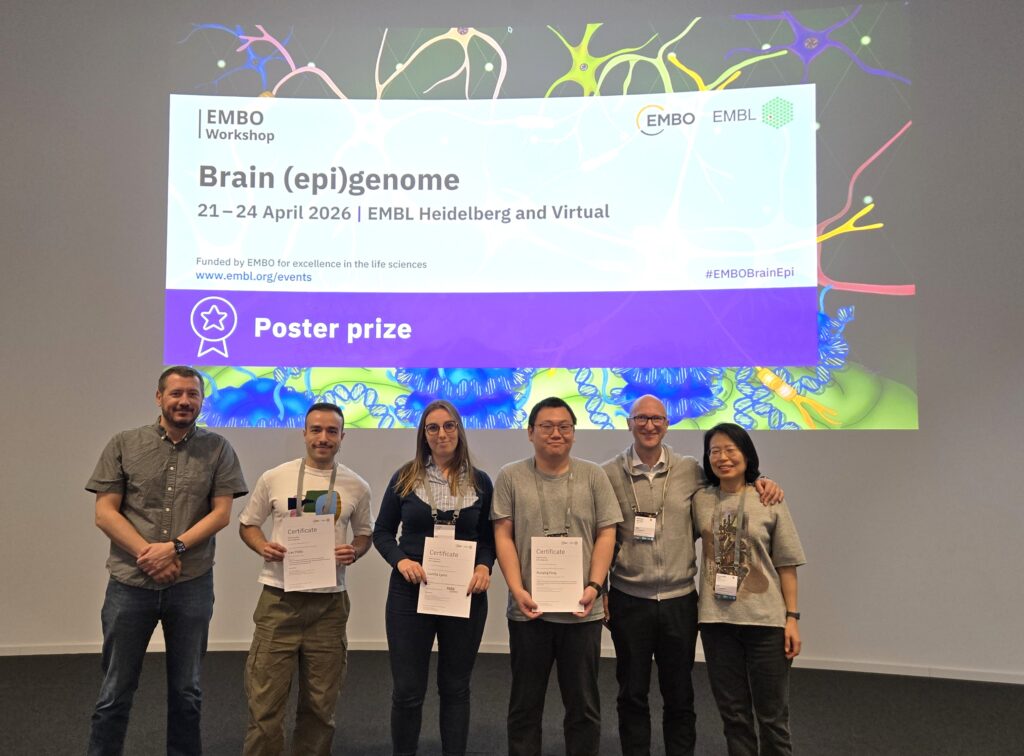
The EMBO Workshop ‘Brain (epi)genome‘ took place from 21 – 24 April 2026 at EMBL Heidelberg and virtually.