How do living systems keep time? Event report from ‘Biological oscillators’ by Shweta Pandey
Highlights from the 5th edition of the EMBO | EMBL Symposium that gathered scientists from molecular biology, ecology, dynamical systems, and computational biology to discuss biological oscillation across every level of biological organisation.
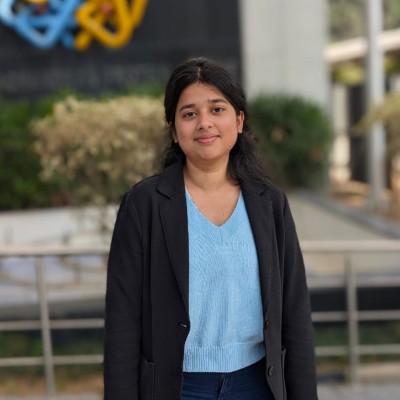
Written by our event reporter Shweta Pandey, PhD Student, CSIR-Institute of Microbial Technology, Chandigarh, India
How do living systems keep time? From tidal creatures in the deep ocean to dividing cells in our gut, biological rhythms are not incidental; they are architectural. The 5th edition of ‘Biological oscillators: rhythms and synchronisation across scales gathered scientists from molecular biology, ecology, dynamical systems, and computational biology to confront this question across every level of biological organisation.
Beyond the Circadian Clock
When most people think of biological timing, they think of the 24-hour circadian rhythm. But the meeting opened with a striking reminder that nature operates on many clocks simultaneously. Audrey Mat (University of Vienna, Austria) presented research on deep-sea organisms that entrain to tidal cycles rather than light-dark cycles and, crucially, can sustain internal rhythms even in the absence of external zeitgebers. Her work on gill tissue rhythmicity suggests that timekeeping is a deeply conserved, cell-autonomous property that persists even in the most isolated and extreme environments.
From Gene Circuits to Dynamical Systems
At the mechanistic core of most biological clocks are transcriptional-translational feedback loops (TTFLs): genes whose protein products cycle back to suppress their own transcription, generating self-sustained oscillations. Hanspeter Herzel (ITB, Humboldt University Berlin, Germany) delivered a conceptual lecture that bridged these molecular networks with the mathematics of nonlinear dynamics, placing TTFLs squarely within the framework of limit-cycle oscillators and phase-response theory. This theoretical grounding was immediately made tangible by Marta del Olmo Somolinos (Nature Communications, Germany), who led a hands-on Python workshop in which participants built and explored simple oscillator models from scratch. For computational attendees, the session was a clean demonstration of how a handful of ODEs can recapitulate surprisingly rich rhythmic behaviours.
Rhythms as Organisational Logic
Oscillations do more than measure time; they coordinate identity and structure. Inna Sonnen (Hubrecht Institute, The Netherlands) showed how periodic Notch signalling governs cell fate decisions in intestinal tissue, with rhythmic signal dynamics determining whether progenitor cells self-renew or differentiate. This positions rhythmicity not just as a temporal phenomenon but as an instructive signal for tissue homeostasis. A complementary perspective came from work on embryonic segmentation, where temperature perturbations were shown to modulate the pace of somitogenesis, highlighting that the segmentation clock, like any physical oscillator, is sensitive to thermodynamic parameters.
Computation, Inference, and the Clock Without a Timestamp
A recurring theme across sessions was the challenge of inferring temporal information from data that lacks explicit time labels, a problem familiar to anyone working with single-cell transcriptomics. Shaon Chakrabarti (National Centre for Biological Sciences, India) presented probabilistic approaches using neural network latent spaces to decode circadian phase from high-dimensional molecular profiles, pushing the limits of what can be inferred without direct temporal measurements. Mathematical models were equally central to understanding synchronisation in ecological contexts: Vishwesha Guttal (Indian Institute of Science, India) examined oscillatory dynamics in predator-prey systems, and work from Arkarup Banerjee (Cold Spring Harbor Laboratory, NY, USA) explored rhythmic vocal communication in singing mice, a system where neural oscillators must synchronise across individuals in real time.
Oscillations at the Physical Interface
The symposium also ventured into the biophysics of oscillatory systems. Min Wu (Yale University) investigated how oscillatory dynamics on the cell surface arise and what the limitations of simple feedback architectures are in that context. Kirsty Wan (University of Exeter, UK) examined how active filaments, cilia and flagella coordinate through symmetry-breaking and metachronal waves, a beautiful example of coupled oscillators producing emergent spatiotemporal order. Coen Elemans (University of Southern Denmark, Denmark) closed the meeting with a tour de force on vocal fold oscillations across species, from mice to whales, revealing how the physics of tissue vibration constrains the evolution of acoustic communication.
Sleep, Evolution, and the Comparative Clock
Studies on lizard sleep presented during the meeting are shedding light on the evolutionary origins of sleep states, suggesting that the neural oscillations underlying REM and non-REM sleep may be more ancient than previously appreciated. This comparative angle reflects the symposium’s broader ambition: understanding not just how rhythms work in model organisms, but how and why they evolved.
Flash talk sessions and two packed poster sessions showcased early-stage research spanning the full breadth of the field, from single-molecule imaging of clock proteins to climate-scale ecological rhythms. The energy in these sessions underscored how rapidly the community is growing and diversifying, with computational and theoretical approaches increasingly central to experimental design.
A Living Record
To capture the complexity of the four days, an interactive web resource was created: ? https://shwdey.github.io/embl-ees26-04/event.html
For a quick day-wise glimpse:
? Day 1 — https://x.com/Shwdey/status/2036665987114652126?s=20
? Day 2 — https://x.com/Shwdey/status/2036734151848546568?s=20
? Day 3 — https://x.com/Shwdey/status/2037285034982363435?s=20
? Day 4 — https://x.com/Shwdey/status/2037794157566058943?s=20
Personal Perspective
From a personal perspective, attending this symposium was an incredibly enriching experience, especially as it was my first EMBL conference and my first meeting focused on circadian biology. Having the opportunity to present my work through both a flash talk and a poster was particularly meaningful. The feedback I received—both encouraging and critical—reassured me that my work is on a meaningful path, and it motivated me to continue learning and improving.
The research community’s humility and openness made interactions feel welcoming and collaborative—rare in academia. I would especially like to thank the organising committee, particularly Chris Stocks (conference organiser, EMBL Heidelberg, Germany), who was incredibly supportive and approachable throughout the event. I felt comfortable asking questions at any stage, and his thoughtful and respectful responses made the entire experience much smoother.
The symposium was very well organised, with plenty of time for discussion, networking, and building new academic connections. The poster sessions were especially well arranged, creating a relaxed and engaging environment for scientific exchange.
The hospitality throughout the event further added to the experience. The food and refreshments were thoughtfully arranged; I appreciated the overall quality and variety provided. Small details, such as the coffee and chocolates during breaks, contributed to a welcoming and enjoyable atmosphere.
Overall, the experience was both inspiring and deeply motivating for my future work.
Career Perspective and Future Direction
This experience will have a lasting impact on my future research direction. Through discussions and networking during the symposium, I was able to connect with researchers working in areas closely aligned with my interests in sleep and circadian genetics.
Interactions with Alexander Aulehla and Lorenz Fenk provided valuable guidance on potential research directions, and Lea’s support in identifying relevant research groups was particularly helpful in shaping my next steps. These exchanges have not only broadened my perspective but have also helped me identify potential labs and collaborations for my future career.
The 5th edition of this symposium reinforced a simple but profound point: biological time is not a single clock running in the background; it is woven into the fabric of how life is built, organised, and sustained. As computational tools grow more powerful and cross-disciplinary collaboration deepens, the field is well-positioned to move from describing rhythms to truly understanding them.
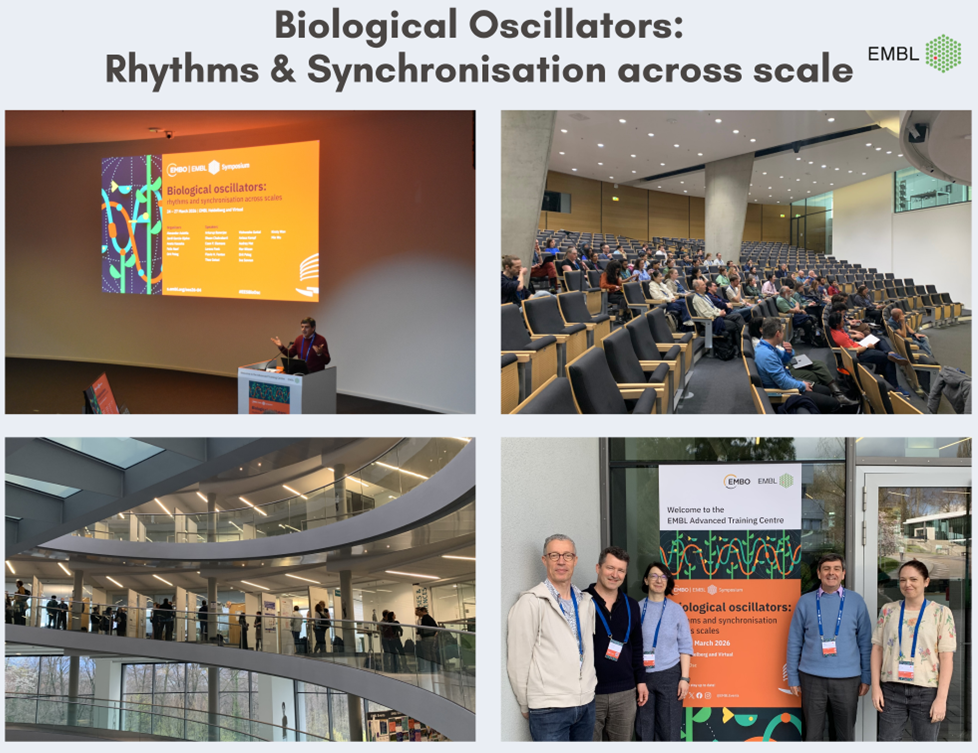
The EMBO | EMBL Symposium ‘Biological oscillators: rhythms and synchronisation across scales and biology’ took place between 24 – 27 March 2026 in Heidelberg, Germany, and virtually.
About the author:
Shweta Pandey is a PhD candidate and Senior Research Fellow specializing in genomics, bioinformatics, and systems biology. Expertise in disease-gene networks, genomic variant interpretation, circadian biology, and antimicrobial resistance. Experienced in developing integrated databases (CircaNet, ARKbase), multi-omics integration, network analysis, and variantprioritization using tools like Ensembl-VEP, ClinVar, and gnomAD. Published in high-impact journals and activelycontributing to translational research on comorbidities and mitochondrial diseases.
Stay tuned to find out about the #EESBioOsc poster prize winners and their research.
Did you know that you can become an event reporter and receive a conference fee waiver in exchange? Find out how to do that by visiting our Become an event reporter page.