It’s time to consider the environmental impact of computing
A new online tutorial from EMBL’s European Bioinformatics Institute (EMBL‑EBI) is helping researchers understand and reduce the environmental impact of their computational work, further advancing EMBL’s commitment to more sustainable science.
From climate modelling and particle-physics simulations to machine learning models for sectors like agriculture and renewable energy, scientific computing has supported groundbreaking discoveries. Researchers are now able to tackle increasingly complex questions and model real-world systems at unprecedented scale.
But as computing power grows, so does an important question: what are the environmental impacts of these computing activities and infrastructures?
The scientific community is facing increasing pressure to improve transparency and embed sustainability in its practices whilst resources and guidance are still limited.
New training materials now available
To help close this gap, EMBL-EBI Training and the Cambridge Sustainable Computing Lab have collaborated on a free and interactive introductory online tutorial on the environmental impacts of computational research.
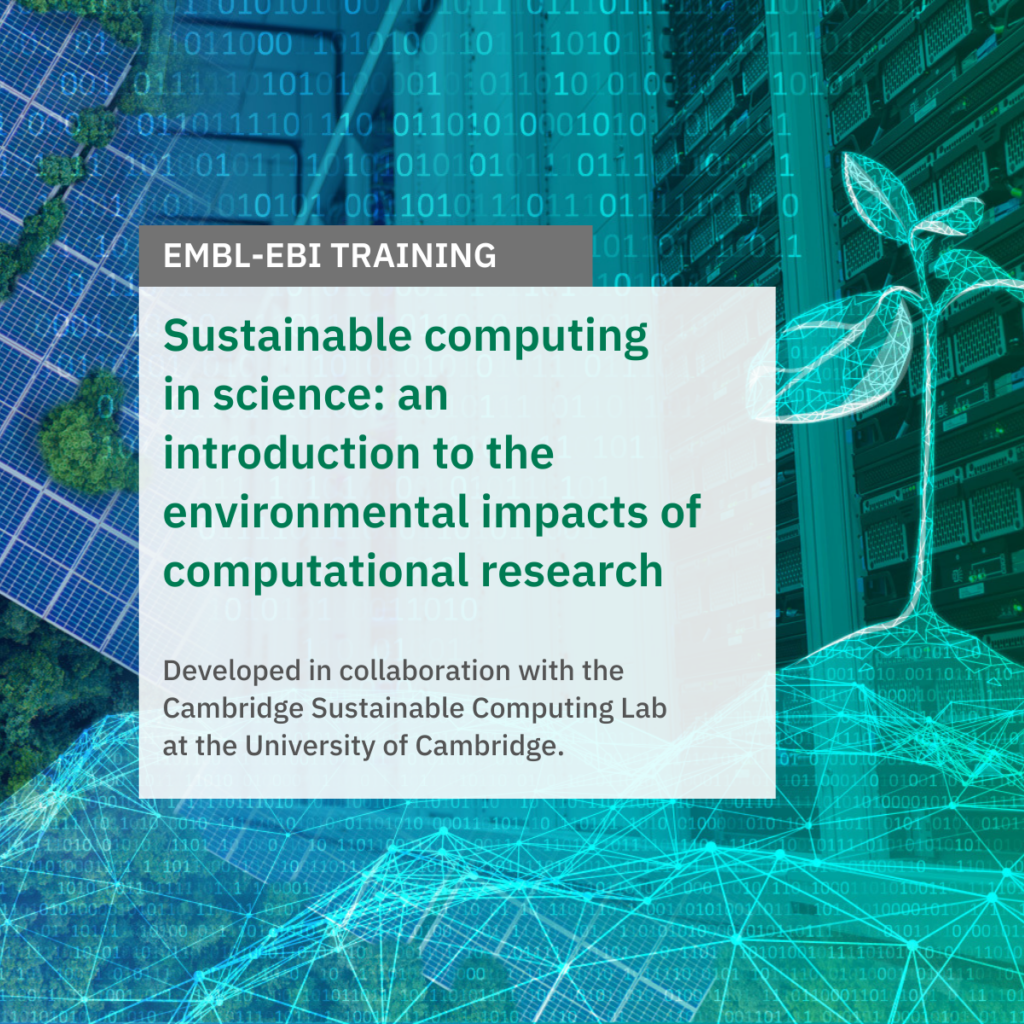
The training can be accessed at any time, regardless of your location. By signing up for a free EMBL-EBI Training account, you can also pause your learning and save your progress to continue another day. We advise that it will take approximately three hours to work through the material.
Who is the tutorial for?
Whether you’re a student or researcher in academia or industry, this free online tutorial is designed for anyone involved in computational work or for anyone simply curious about the sustainability of computing. No prior knowledge of computing infrastructure is required.
Building capacity for sustainable research
The tutorial covers the environmental impacts of computing and breaks down how carbon footprint estimation works. The developers of the training also provide helpful tools to get started, highlight relevant initiatives in green computing, and discuss the limitations and challenges in this space.
The training course was written by Loïc Lannelongue, Assistant Research Professor, Department of Public Health & Primary Care at the University of Cambridge and Flaminia Zane, Scientific Training Officer – Digital Learning at EMBL’s European Bioinformatics Institute, with funding from the Wellcome Trust.
To learn more about green computing, check out these other resources by the same developers:
- The environmental impact of computational biology: recorded webinar
- Green Algorithms Calculator
- Green Algorithms Initiative: resources and publications
- Join the online community on Environmentally Sustainable Computational Science (ESCS) and sign up for the ESCS newsletter
- Apply for Green DiSC certification
- Participate in the Scientific Conference for Responsible Research Computing (SC4RC) Conference from 4 – 8 May 2026
EMBL-EBI Training encourages the reuse and sharing of the tutorial under its CC-BY license. Briefly, this means that you’re free to reproduce it and/or tweak it, so long as you give appropriate attribution to the course authors, Loïc Lannelongue, Assistant Research Professor, Dept of Public Health & Primary Care, University of Cambridge, and Flamina Zane, Scientific Training Officer – Digital Learning, EMBL-EBI. We would also be very grateful if you would refer to EMBL-EBI and the DOI of the original source – DOI: 10.6019/TOL.sustainable-computing-intro-t.2026.00001.1.
A full explanation of the CC-BY-4.0 license terms is available here.
Guest authors: Anica Araneta, Project Coordinator and Community Manager, University of Cambridge and Brendan Rouse, Head of Sustainability, EMBL Heidelberg.
Contributors: Loïc Lannelongue, Assistant Research Professor, University of Cambridge and Flaminia Zane, Scientific Training Officer – Digital Learning, EMBL’s European Bioinformatics Institute.
Edited by: Rebecca Nicholl, Marketing and Communications Manager, EMBL’s European Bioinformatics Institute.