Meet the poster prize winners of ‘Computational structural biology’
The second edition of the EMBO Workshop ‘Computational structural biology‘ brought together a vibrant international community of researchers working at the interface of computation and structural biology from 2 – 5 December 2025. The meeting welcomed 265 on-site participants and 126 virtual attendees. Nine fellowships were awarded by the EMBL Corporate Partnership Programme and EMBO.
Building on the success of the 2023 event, the meeting focused on recent advances in computational studies of biomolecular structures, functions, and interactions. The programme spanned a broad range of topics, from molecular modelling to systems-level analyses and evolutionary perspectives, combining AI-driven innovations with classical computational approaches. New sessions introduced in 2025 addressed drug design, highlighting computational strategies for therapeutic development, as well as infrastructures and software platforms, underscoring the technological foundations of the field’s future.
A total of 156 posters were displayed throughout the workshop, showcasing cutting-edge research from across the community. From this selection, three poster prize winners were chosen, whose outstanding contributions are highlighted below.
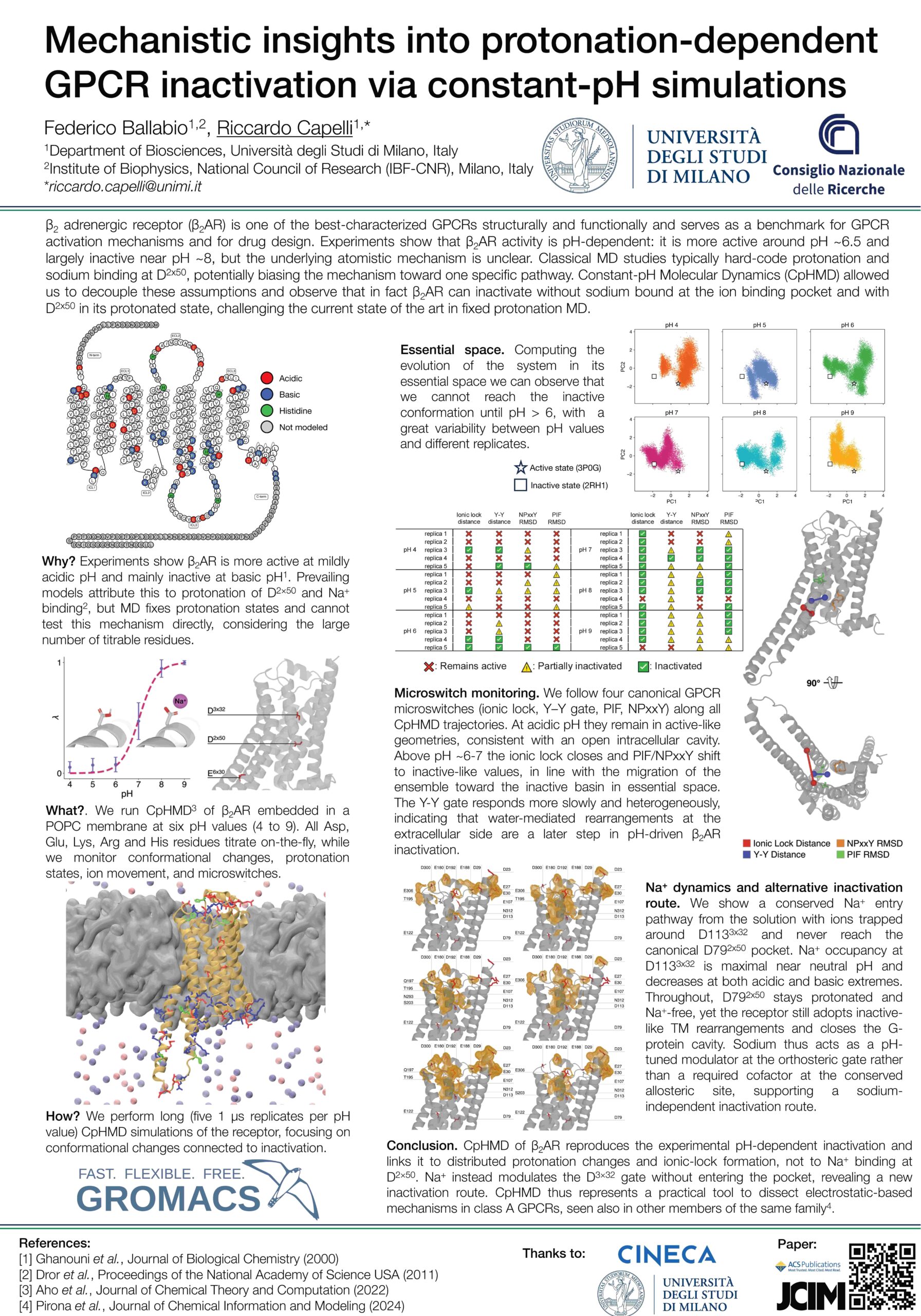
Mechanistic insights into protonation-dependent GPCR inactivation via constant-pH simulations
Presenter: Riccardo Capelli
Authors: Riccardo Capelli, Federico Ballabio

Università degli Studi di Milano, Italy
Abstract:
G protein coupled receptors (GPCRs) often display pH dependent signaling [1], yet the atomistic basis of this regulation remains unclear. We investigated the inactivation of the human β2 adrenergic receptor (β2AR) [2] across physiologically relevant pH values (4–9) using 30 µs of λ dynamics constant pH molecular dynamics simulations [3] starting from the active state. The simulations reveal a consistent pH dependent inactivation pattern linked to the protonation of key acidic residues, most notably E2686x30, which stabilizes the ionic lock. Contrary to prevailing models, inactivation occurred without Na+ binding to the conserved D792x50 site; instead, Na+ ions preferentially bound D1133x32 and were prevented from deeper penetration by a hydrophobic barrier. Protonation analyses showed that D792x50 remained neutral under all conditions, challenging the common assumption that its deprotonation and Na+ coordination are prerequisites for inactivation [4,5]. These findings refine the mechanistic picture of β2AR regulation, demonstrate the utility of λ dynamics constant pH MD for capturing coupled protonation–conformational dynamics in GPCRs, and underscore the importance of accurate electrostatics for modeling ion mediated allosteric modulation [6].
References:
[1] Ghanouni, P. et al. J. Biol. Chem. 2000, 275, 3121–3127.[2] Rasmussen, S. G. F. et al. Nature 2007, 450, 383–387.[3] Aho, N. et al. J. Chem. Theory Comput. 2022, 18, 6148–6160.[4] Wang, X. et al. J. Chem. Inf. Model. 2022, 62, 3090–3095.[5] Katritch, V. et al. Trends Biochem. Sci. 2014, 39, 233–244.[6] Capelli, R. et al. J. Phys. Chem. Lett. 2020, 11, 6373–6381.
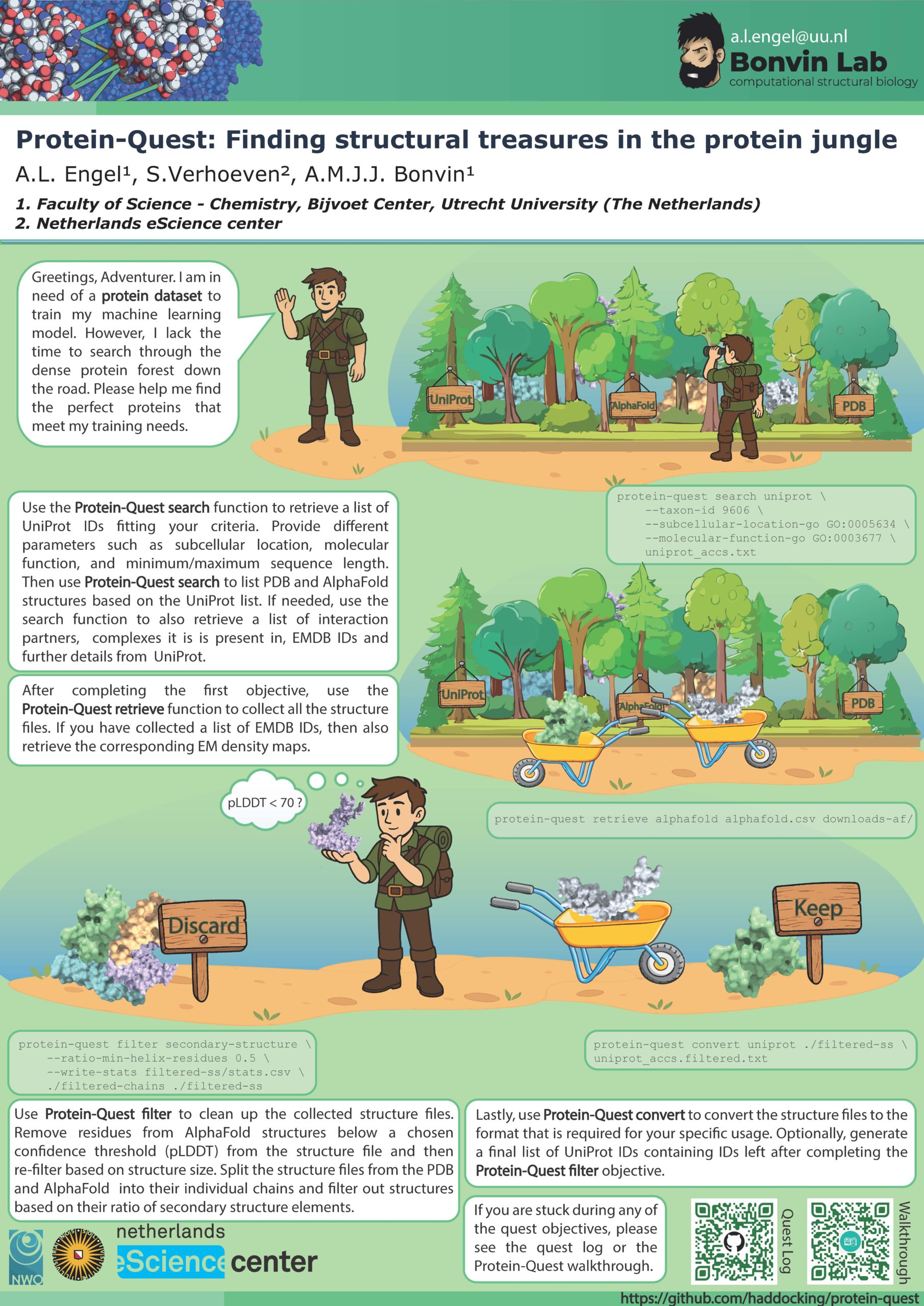
Protein-quest: finding structural treasures in the protein jungle
Presenter: Anna Engel
Authors: Anna Engel, Alexandre Bonvin, Stefan Verhoeven

Utrecht University, The Netherlands
Abstract:
The creation of a protein benchmark for a specific task, such as, for example, assembling a curated dataset for machine learning, is often slowed down by identifying suitable structural targets from the online available databases such as the PDB, Uniprot, and the AlphaFold database. Collecting and processing a large batch of protein models can be a resource intensive and monotonous component of structural biology research.
We present here Protein Quest, an automated and user guided search and retrieval engine that allows users to create and filter a protein benchmark based on a few criteria, such as organism, cellular location, size, and secondary structure content. Protein Quest identifies targets that comply with the user defined criteria and collects them in a list of Uniprot IDs. Subsequently, it will download the most complete PDB model, when available, associated with that Uniprot ID. In addition, it will fetch all AlphaFold models from the AlphaFold2 database and pre process them based on the pLDDT confidence score, automatically removing low confidence regions. The output of Protein Quest is a curated list of Uniprot IDs, with their associated pre processed protein experimental structures or models delivered through a fast and fully customizable workflow.
The software is freely available from: https://github.com/haddocking/protein-quest
Accelerating TCR drug discovery through deep-learning structure prediction
Presenter: Tania Gardasevic
Authors: Tania Gardasevic, Marc Van der Kamp, Saher Shaikh, Stephen Harper, Vijaykumar Karuppiah, Victor Rangel, Christopher Rowley

University of Bristol, United Kingdom
Abstract:
T-cell receptors (TCRs) are an emerging class of cancer therapeutics, offering broad target recognition and the ability to eliminate malignant cells directly. T-cell based biologics leverage affinity enhanced TCRs to engage low abundance antigens and promote CD3 mediated recruitment of endogenous T-cells for highly specific cytotoxic responses. As the development of these therapies expands, computational approaches are increasingly employed to predict TCR–target interactions, reducing experimental demands and accelerating discovery cycles. A key opportunity lies in applying deep learning based structure prediction models to streamline early stage development. These tools support large scale, accurate evaluation of binding modes, affinity, and off target specificity—without the need for protein expression or crystallographic data. This study systematically benchmarks several open source models, functionally analogous to AlphaFold, for predicting TCR–pHLA complex structures. We assess their ability to reproduce canonical CDR loop topologies and intermolecular contacts, and to recapitulate experimentally measured affinity trends using computational scoring functions. The findings can inform the development of a robust, accessible in silico pipeline for TCR drug design. However, deep learning based structure prediction remains a challenge for the highly variable loops involved in binding, indicating the importance to specifically tailor machine learning tools for immuno-oncology applications.
The EMBO Workshop ‘Computational structural biology‘ took place from 2 – 5 December 2025 at EMBL Heidelberg and virtually.
Interested in the topic? Have a look at the virtual EMBL-EBI Course ‘Structural bioinformatics‘ happening 19 – 23 October 2026.