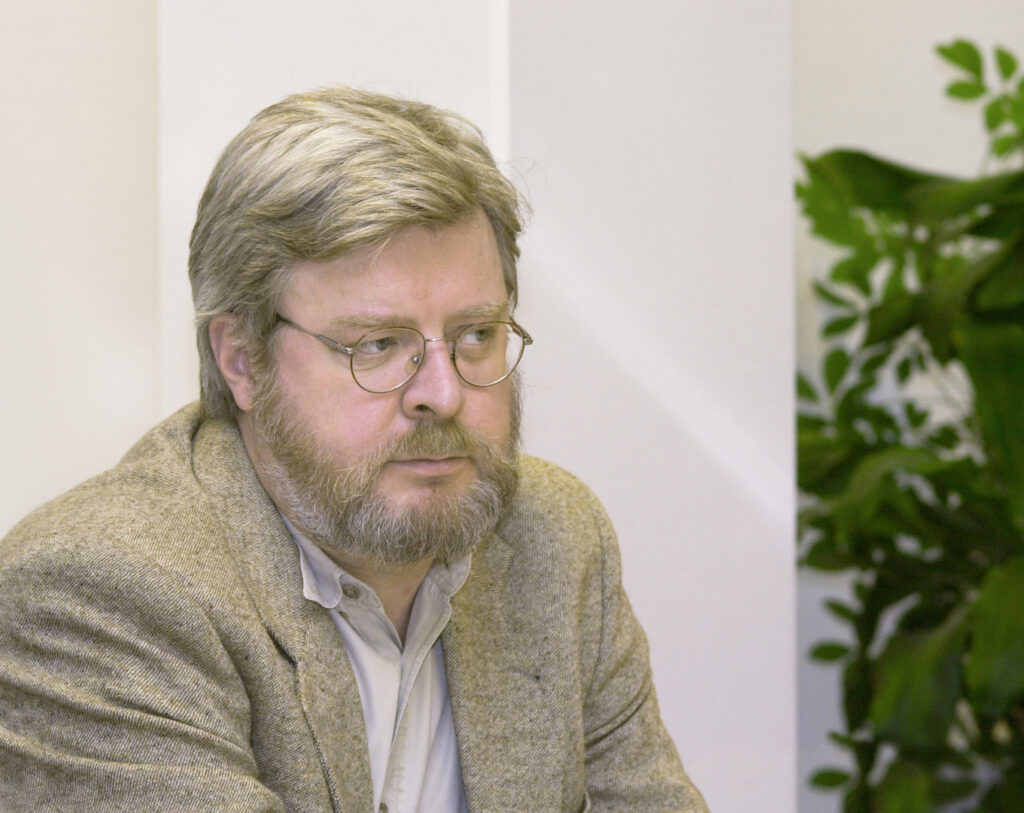
Remembering Matti Saraste and his Unusual Journey as an International Man of Science
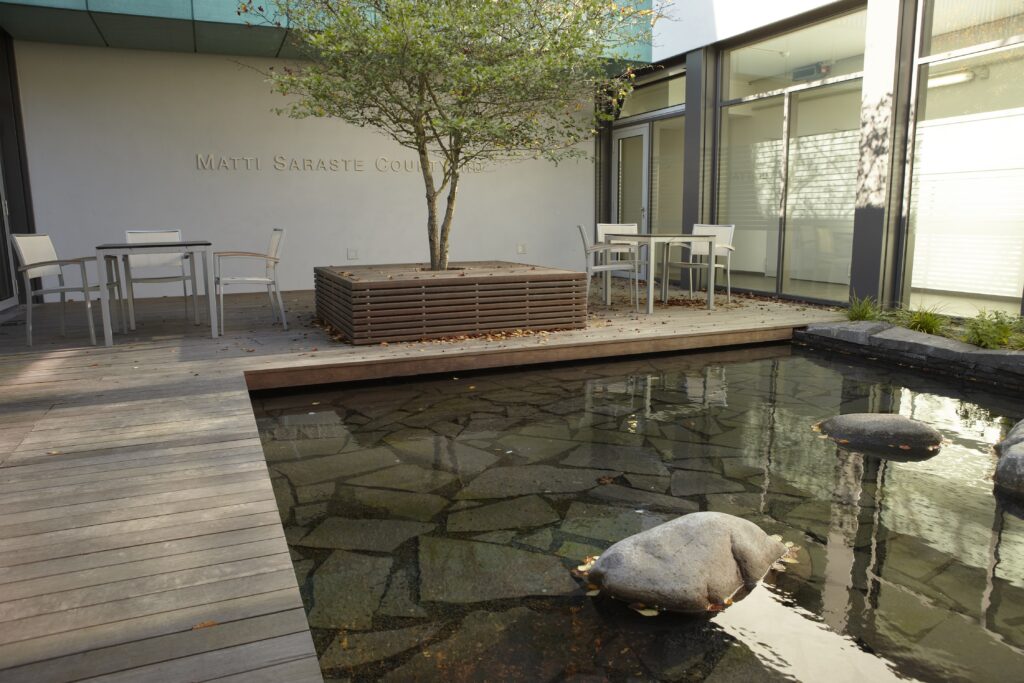
For many at EMBL today, Matti Saraste is known only by the courtyard which bears his name, a space dedicated to his memory by those who knew and loved him best. Yet behind that memorial lies the story of a scientist whose career defied conventions.
A structural biologist, mentor, internationalist, and passionate advocate of scientific independence, Matti was someone who followed his own path. His journey from Finland to Moscow, Cambridge, and ultimately EMBL reflected both his intellectual curiosity and his determination to pursue science on his own terms.
It’s for these reasons and more that his colleagues, family, and friends are remembering him at a special event following EMBL’s Lab Day Celebrations this year, the 25th anniversary of his passing. At the EMBL Archive, we wanted to commemorate the occasion by reflecting on Matti’s life and impacts, based on interviews with his colleagues. We’d also like to encourage anyone with material related to Matti’s life and career to consider donating these items to the archive.
Born into a family with no scientific tradition, Matti’s early interests pointed elsewhere. His father’s side of the family were lawyers, judges and jurists, and as a young student, he was more attracted to literature and the Finnish language than to natural sciences. The turning point came in high school, when a new teacher introduced him to the rapidly developing world of molecular biology. Learning about DNA and the emerging discoveries of modern biochemistry transformed his ambitions.
The intellectual foundation established during those years remained central throughout his career. Matti believed that biological phenomena could only be fully understood by examining them at their most fundamental level. For him, understanding life meant understanding molecules: their structures, their interactions and the mechanisms by which they function. This conviction would shape his scientific work.
Yet while his scientific philosophy was remarkably consistent, his career trajectory was anything but linear. For example, he didn’t conduct his PhD research in a single institution and never really had a doctoral supervisor. Instead, he completed his thesis while moving between laboratories, carrying his work, as he later joked, “in a rucksack from one lab to another.” The image captures something essential about his independence of character and the restless energy that informed his life.
One of the most unusual chapters of that route took him to Moscow in 1975, during the Brezhnev period. At a time when scientists followed paths westwards, Matti chose to spend a year working with the bioenergetics researcher Vladimir Skulachev in the Soviet Union. The decision reflected both scientific curiosity and a broader interest in politics, culture, and international exchange. Coming from Finland, a country that occupied a unique position between East and West during the Cold War, he was fascinated by Russia and eager to experience Soviet scientific life from within.
The experience left a lasting impression. Scientifically, the laboratory was among the leading centres in its field. Personally, it exposed him to a dramatically different culture. Matti recalled the intensity of Russian scientific discussion, where conversations could continue for hours, and intellectual disagreements were expressed openly and passionately. It was, as he later described it, a valuable ’reality check’ that challenged his preconceptions while broadening his understanding of both science and society.
Following this sojourn, Matti traded the bustle of Moscow for hallowed halls of Cambridge, joining biochemist John Walker at the Medical Research Council Laboratory of Molecular Biology. There he encountered what he described as ’big science’ for the first time. Surrounded by scientists working at the highest international level, he absorbed new techniques and a philosophy of scientific inquiry that would influence him the rest of his career.
Returning to Finland, he established his own research group and became part of a generation that helped introduce modern molecular biology to the Finnish scientific community. During these years, he worked on membrane proteins, bioenergetics, and molecular biology. By the late 1980s, however, he was once again looking outward.
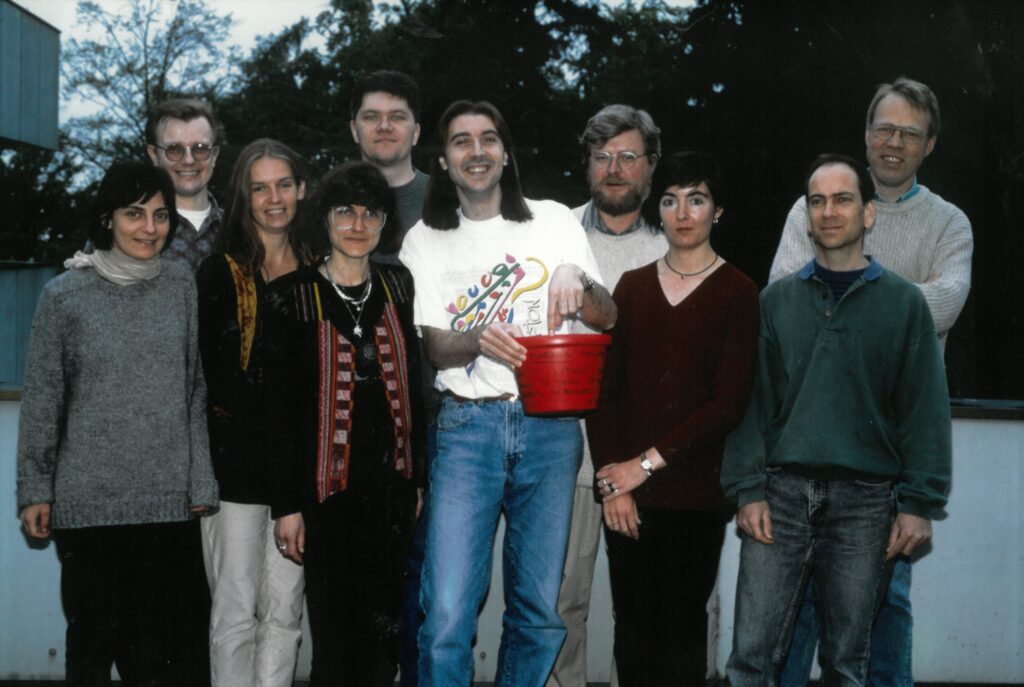
It wasn’t until 1990, at the age of 40, that Matti arrived at EMBL Heidelberg. He liked to joke that he entered the organisation ’through the kitchen door’, arriving later than many colleagues and by a less conventional route. Yet EMBL proved to be the ideal environment for someone with his international outlook and intellectual restlessness.
At EMBL, Matti reinvented himself once again. Having built his reputation through work on membrane systems and bioenergetics, he moved increasingly into structural biology, cytoskeletal research and signal transduction. He was never content simply to remain within established boundaries. New technologies, collaborations, and scientific questions continually drew him into unfamiliar territory.
Equally distinctive was his approach to leadership. Matti was not a manager in the bureaucratic sense. He preferred informal discussions to formal structures and believed that scientific creativity flourished better through collaboration than hierarchy. In his laboratory, students and postdoctoral researchers often worked in pairs, sharing responsibility for projects and supporting one another intellectually. Recruitment decisions, meanwhile, were guided as much by personality as by scientific credentials, with Matti valuing independence, humour, and collegiality in his colleagues.
His peers remember these qualities vividly. Among them is Matthias Wilmanns, who joined Matti’s laboratory as a young scientist and remained close to him throughout his career. Looking back, Wilmanns describes Matti as a passionate scientist, a committed European, and a deeply independent thinker. “He was not a mainstream person,” Wilmmans recalled. “Not at all.”
The description resonates strongly with Matti’s own account of his life. He resisted easy categorisation. He held strong views and valued open debate. He repeatedly crossed disciplinary boundaries in his career and was drawn to international experiences and cultural exchange. Above all, he was deeply committed to the idea of Europe as a community of scientists and saw institutions such as EMBL as embodiments of that ideal.
His commitment to internationalism was reflected not only in his own career but also in the environment he created. Matti delighted in EMBL’s diversity, where researchers from across Europe and beyond worked side by side. He regarded scientific culture as fundamentally international and believed that exposure to different perspectives enriched both science and society.
Now, 25 years after his death, Matti remains an important figure in EMBL’s history. At a time when scientific careers are often measured by increasingly standardised metrics and pathways, his life reminds us that creativity frequently emerges from unexpected directions. Detours, reinventions, and unconventional choices shaped his career, yet those very qualities helped him not only succeed as a scientist but also as a distinctive voice within EMBL.
If you would like to register for the Matti Saraste Reunion on Saturday 11th July 2026, you can do so here: https://www.embl.org/about/info/alumni/events/matti-saraste-reunion-2026/
This article was possible thanks to the transcript of an interview between Halldór Stefansson and Matti Saraste conducted on 27th August 1998 at EMBL Heidelberg, as well as an interview between archivist Alexander Barrington and Matthias Wilmanns on 21st March 2026 at EMBL Heidelberg.
If you have any material related to Matti Saraste’s life and career, or would like to secure your own EMBL legacy, please contact the EMBL archive.