Unlocking the value of biodiversity in the UK and Ireland
Economic report analysing the financial impact of sequencing all complex life in the UK and Ireland shows a strong return on investment and growth in scientific research
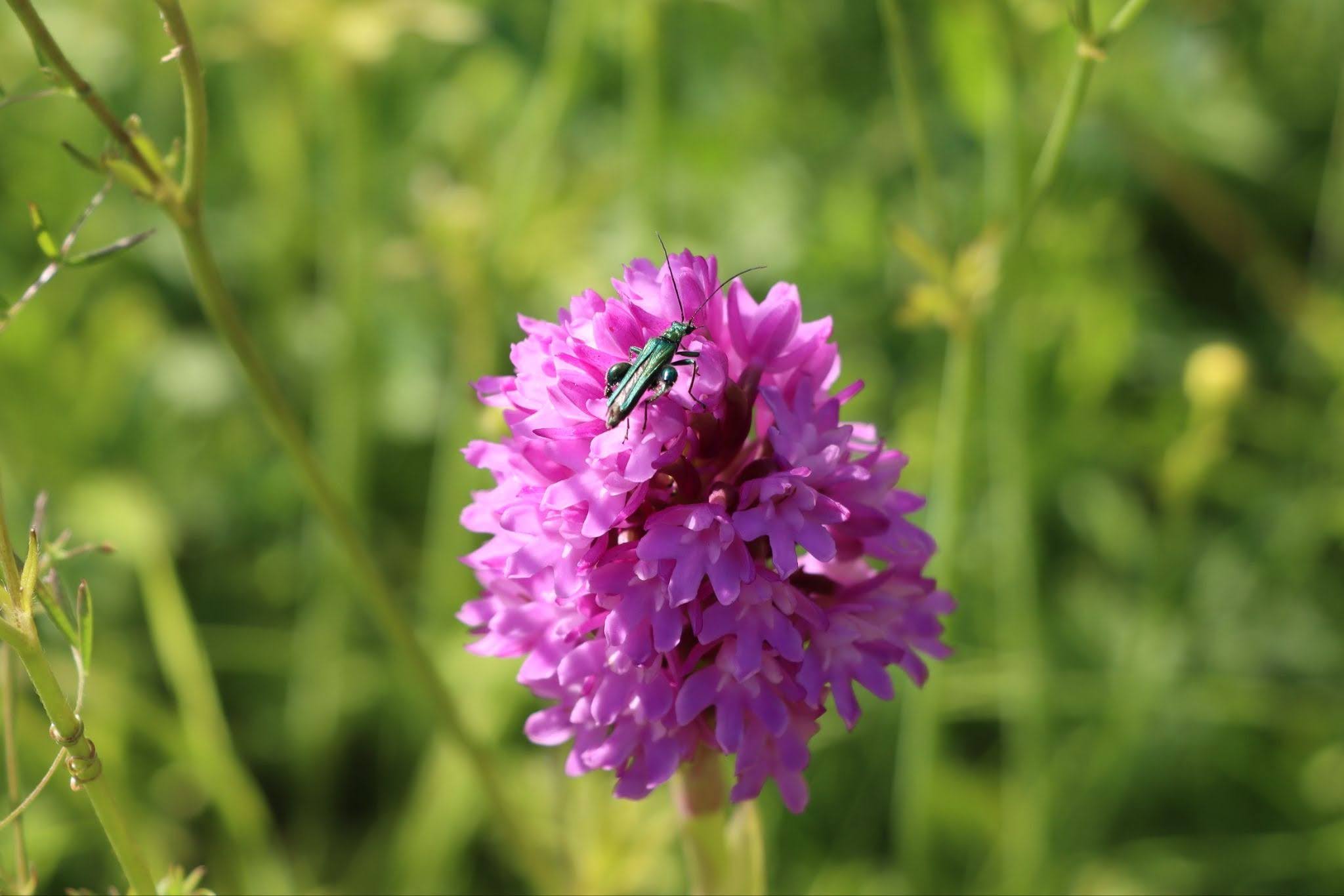
A Thick-legged Flower Beetle (Oedemera nobilis) on a Pyramidal Orchid (Anacamptis pyramidalis) in the Wetlands Nature Reserve on the Wellcome Genome Campus. Credit: Wellcome Sanger Institute
Sequencing the DNA of all complex life in the UK and Ireland will generate up to £3 billion for the economy across agriculture, conservation, and research over the next 30 years, according to a new report.
The Darwin Tree of Life (DToL) project is a collaboration including experts at EMBL’s European Bioinformatics Institute (EMBL-EBI), the Wellcome Sanger Institute, and colleagues. The project aims to sequence the DNA of 30,000 eukaryotic species in the UK and Ireland including animals, plants, and fungi.
A new report, published in Frontier Economics, has calculated how much the Darwin Tree of Life project will benefit the UK economy, including improvements in crop resilience and pest control, advances in medicine and biotechnology, and more efficient conservation projects.
This report showcases the substantial return on investment that the project offers. It highlights how the DToL project has already saved the global scientific community £55 million in research costs to date by providing over 2,500 reference genomes for global open access use.
”The significance of the Darwin Tree of Life project cannot be underestimated, as demonstrated by the huge number and diversity of genomes already sequenced and by the scale of its potential economic impact in the upcoming decades,” said Christiane Hertz-Fowler, Head of Directed Activity at Wellcome. “When we first began funding this ambitious project, we knew that we would unveil a rich tapestry of insights into life and nature throughout the UK & Ireland, creating remarkable scientific impact. Now, this report underscores the importance of investing in ambitious, transformative discovery research to help us better understand life around us, in turn helping us solve health challenges around the world.”
Darwin Tree of Life at EMBL-EBI
EMBL-EBI plays a central role in making Darwin Tree of Life data findable and usable by scientists worldwide. Alongside developing the DToL Data Portal, EMBL-EBI researchers produce high-quality genome annotations that are made openly available and can be explored through the Ensembl genome browser. All DToL genome annotations will also be integrated into the new Ensembl platform, currently in beta.
“This report shows that investing in biodiversity genomics delivers long-term value for science, the economy, and the health of our natural world,” said Fergal Martin, Eukaryotic Annotation Team Leader at EMBL-EBI. “Realising that value depends on making genome data usable, and that’s where annotation comes in by helping us understand the genetics of different species and generate insights that support research and conservation.”
Darwin Tree of Life partners
The Darwin Tree of Life (DToL) partners include the Royal Botanic Garden, Edinburgh, CABI, EMBL’s European Bioinformatics Institute (EMBL-EBI), Wellcome Sanger Institute, Wytham Woods, University of Oxford, University of Cambridge, Royal Botanic Gardens, Kew, the Earlham Institute, the Natural History Museum, the University of Edinburgh, the Marine Biological Association, the Zoological Society London (ZSL) and University College Dublin. There are many more collaborators who are essential to the project, providing samples and expertise across the UK and Ireland.
This press release was adapted from the full press release published on the Wellcome Sanger website.