
Leonie Anton
Group Leader (incoming)
ORCID: 0000-0003-0008-2141
EditCellular structural biology of host-pathogen interactions
Group Leader (incoming)
ORCID: 0000-0003-0008-2141
EditThe continued rise in anti-microbial resistance requires more research into the fundamental biology of bacteria and parasites and how they interact with and impact their hosts on a molecular level.
To understand the native translational landscape of the malaria parasite, we infected red blood cells with Plasmodium falciparum and used in situ cryo electron tomography and subtomogram averaging (STA) to reconstruct the Pf80S ribosome to high resolution. Extensive classification revealed the relative abundance of different Pf80S translational states. Treatment with the translation inhibitor cabamiquine revealed a shift in these intermediates suggesting a potential mode of action of this drug (Anton L*, Cheng W*, Haile M*, 2025).
By using cryo correlative light and electron microscopy (cryoCLEM) on cryo focused ion beam milled (cryoFIB) samples, we could visualize the interaction between the host immune protein Guanylate binding protein 1 (GBP1) and the surface of intracellular Salmonella enterica. With this approach, we were able to reveal perturbation and disruption of the outer membrane of GBP1-coated cytosolic Salmonella inside an infected host cell (Began J, 2026).
Arms Race at the host-pathogen interface
Interactions between host and pathogen are shaped by the requirement to overcome the other’s and defend their own discrete compartment. Proteins of the innate immune system developed strategies to recognize universal molecular signatures present on the surface of vastly different pathogens. In turn, pathogens evolved mechanisms on a molecular and ultrastructural level to avoid detection and clearance by cell-autonomous factors.
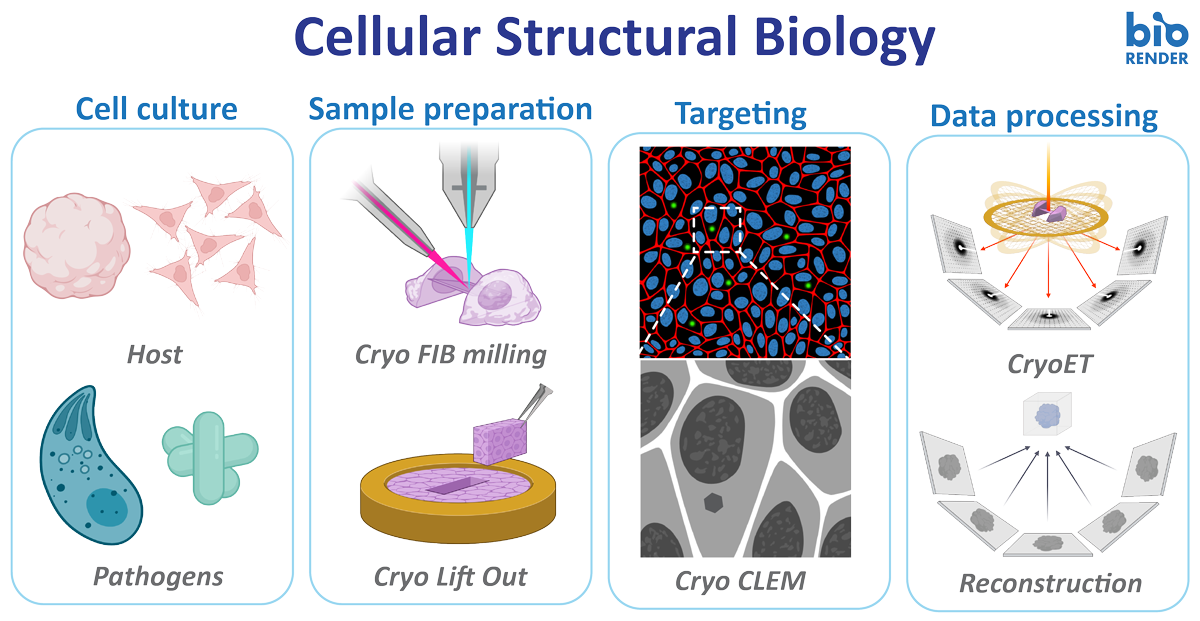
Using cellular structural biology approaches that preserve the interface between host and pathogen in near-native conditions, we aim to reveal the molecular arms-race and uncover key concepts of host mediated detection and clearance of pathogens. We will employ both apicomplexan parasites and bacteria as model pathogens and, to ensure that the host-pathogen interface is preserved, use as native-as-possible infection conditions through advanced cell culture methods including organoids. The different approaches of electron microscopy like single particle cryoEM (SPA), in situ cryoET, cryoFIB milling, STA, cryoCLEM and cryo lift out will enable reconstruction of ultrastructural elements and protein complexes involved in host-pathogen interactions. Based on these findings we will investigate fundamental mechanisms of the molecular arms-race.
Main research questions: