From Starlight to Fluorescent Cells: A Night of Discovery in Mannheim
By Livia Klostermann
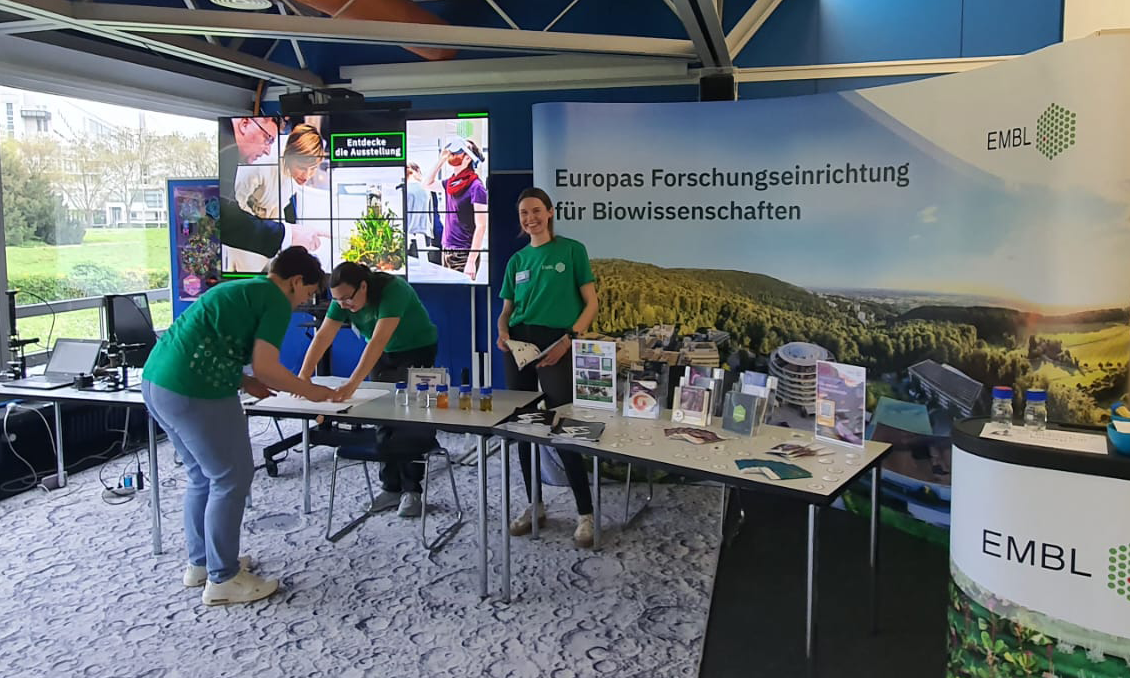
“Have you ever used a microscope?” That was the key question posed to visitors exploring the EMBL stand at the Planetarium Mannheim during the “Lange Nacht der Innovation und Kultur” (“Long Night of Innovation and Culture”) on 11 April 2026. Now all of them can proudly answer: “Yes, I have!”
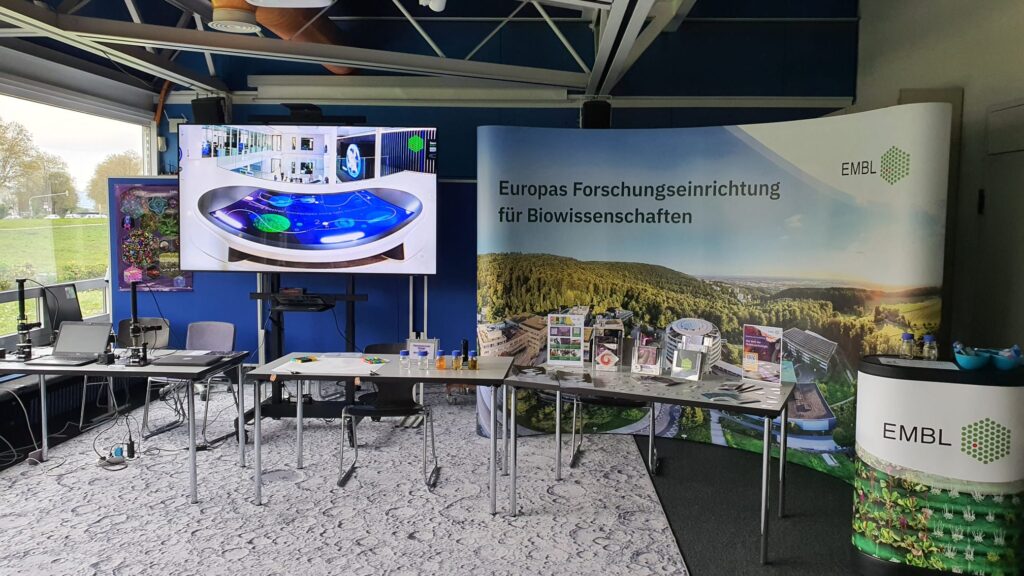
Kindly invited by the Planetarium, EMBL’s Science Education and Public Engagement team (SEPE) joined this event to share insights into EMBL science and fluorescence microscopy. Whilst in the large dome of the Planetarium visitors got the opportunity to gaze at the stars and learn about our Universe, the largest structure we know of, the EMBL stand offered a journey in the opposite direction to explore some of the smallest units that make up life: individual cells.
At different stations, visitors were introduced to the concepts of fluorescence and fluorescence microscopy and explored how this important imaging technique is used in biology to visualise cellular structures and components. At one station, they could discover how certain everyday liquids such as olive oil or tonic water fluoresce under UV light. In tonic water, this effect is caused by the molecule quinine, which is also responsible for its characteristic slightly bitter taste. When excited by UV light, quinine emits a bright icy blue glow. Through these examples, visitors explored the basic principles of fluorescence firsthand: certain molecules absorb light at one wavelength, become excited, and then emit light of a different wavelength.
At another station, visitors got the chance to try out SEPE’s ‘Microscopes in Action’ – fluorescence microscopes designed to be used in the classroom. With these microscopes, they examined fixed samples such as plant roots and hazel flowers but also the cross-section of a rabbit tongue. Looking at that sample, people were fascinated by the diversity of specialised cell types that work together to keep a tongue functioning properly.
However, visitors not only looked at fixed samples but also prepared their own. At a sample-preparation station, they could take one of their own hair and colour it with a highlighter to make it glow under the fluorescence microscope. This allowed them to observe the surface of their hair and see that it has a surprisingly detailed structure when viewed up close.
With a continuous flow of visitors throughout the evening, the “Lange Nacht” provided an excellent opportunity to introduce EMBL to a wide audience and engage with people of all ages. Together with the Planetarium and the Technoseum Mannheim which shared additional exciting science at a neighbouring stand, the venue attracted around 800–900 curious visitors over the course of the event. The setting encouraged many conversations about science, during which visitors could learn more about EMBL’s work, explore educational initiatives, and be invited to the on-campus “World of Molecular Biology” exhibition. Overall, the evening offered a wonderful chance to show how science helps us see and understand our world better – from the stars above us to the cells within us and all living beings on Earth.