
Michael Zimmermann
Group Leader
ORCID: 0000-0002-5797-3589
EditUnderstanding life in its natural context
Food-borne and environmental toxins along the European coastline using high-throughput LC–MS/MS
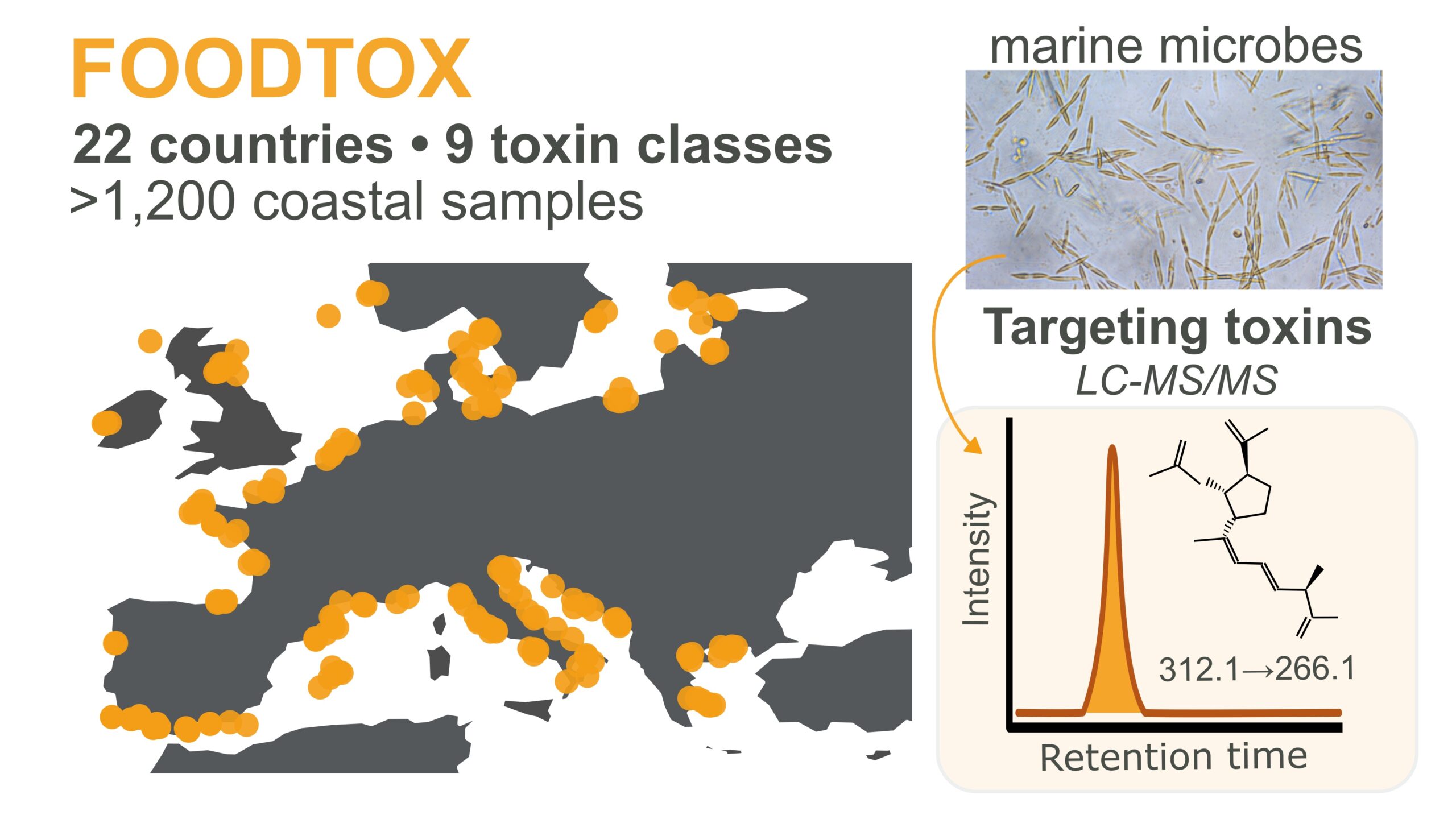
Naturally occurring marine biotoxins, produced by diatoms, dinoflagellates, cyanobacteria, and other marine microorganisms, can accumulate in fish and shellfish and pose significant risks to human health, food safety, and coastal economies. Despite their importance, monitoring remains fragmented. Most monitoring programmes target a limited set of toxin classes using specific analytical protocols, making it challenging to capture their broader chemical diversity and environmental distribution.
FOODTOX will address this challenge by developing and validating a unified high-throughput LC-MS/MS platform for detecting and quantifying chemically diverse marine toxins. The analytical framework will be applied to more than 1,200 environmental samples collected during the TREC expedition. By integrating toxin measurements with metagenomic and environmental data, the project will investigate where marine toxins occur, which microorganisms may produce them, and which environmental conditions influence their distribution. The project will also prioritise emerging analogues within known toxin families, supporting the early detection of evolving food-safety risks.
Objectives:
Group Leader
ORCID: 0000-0002-5797-3589
Edit
Postdoctoral Fellow
Edit
Postdoctoral Fellow
ORCID: 0000-0002-3562-7992
Edit
Postdoctoral Fellow
ORCID: 0000-0003-4173-4847
Edit
ORCID: 0000-0002-8102-8018
Stazione Zoologica Anton Dohrn (SZN)
Italy