
Maria Zimmermann
Group Leader
maria.zimmermann [at] embl.de
EditUnderstanding life in its natural context
Computationally-guided design of marine microbial consortia for biotech applications
Marine microbial communities underpin ocean ecosystem functioning and represent a largely unexplored resource for the blue bioeconomy. Advances in high-throughput sequencing have dramatically expanded access to marine genomic and metagenomic data, revealing immense microbial diversity and metabolic potential. However, much of this information is derived from metagenome-assembled genomes (MAGs), that are reconstructed from complex community samples in contrast to genomes of isolated species, which hampers further experimental investigation. As a result, translating predicted metabolic functions into rational experimental design with culturable organisms remains a major bottleneck.
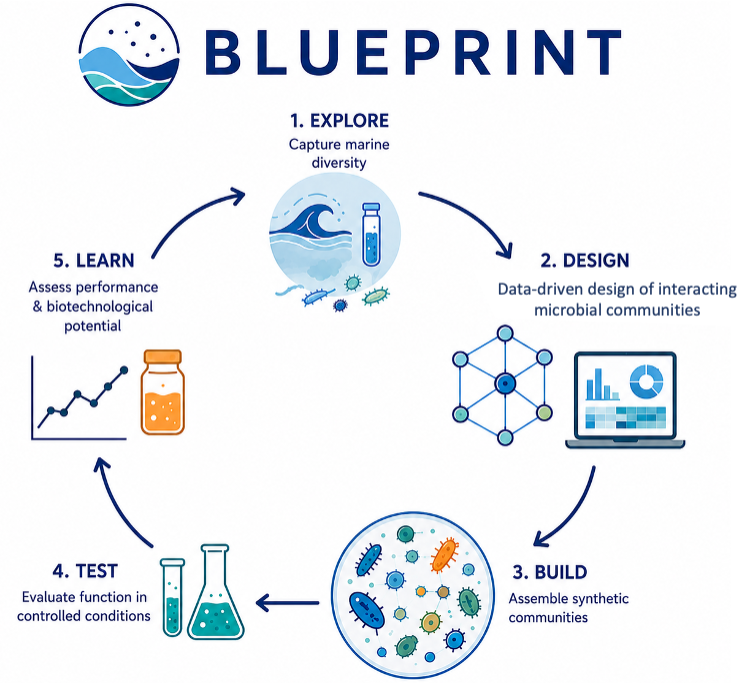
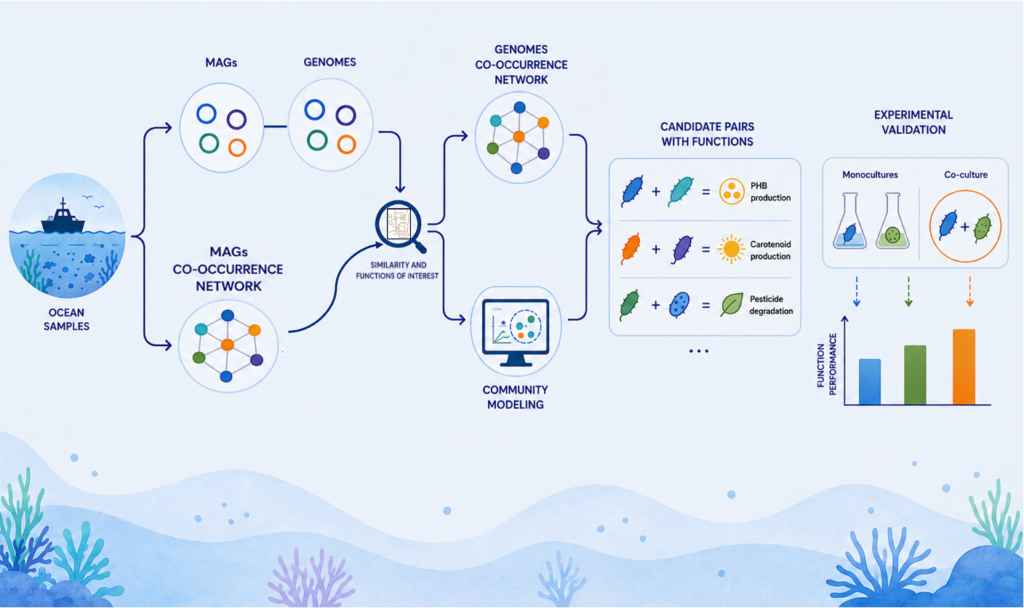
To address this gap, we have developed a computational pipeline to design synthetic marine communities based on the following rationale. We suggest that culturable species which are metabolically similar to MAGs predicted to have a specific function and interact in the wild are likely to enhance each other’s function if co-cultured in vitro. Therefore, our pipeline consists of three modules:
1) Metabolic function search in isolated genomes and MAGs
2) Propagation of species interactions from the MAGs co-occurrence network to isolated genomes
3) Metabolic modelling to predict interacting potential of pairs of species with functions based on exchanged metabolites.
Computationally predicted pairs of species are experimentally tested for relevant biotechnological applications: degradation of pollutants, production of polyhydroxyalkanoates, and production of carotenoids. The abundance of compounds of interest and relative species abundance in co-cultures are being validated using targeted analytical techniques and genomic approaches.
Group Leader
maria.zimmermann [at] embl.de
Edit
Postdoctoral Fellow
sara.benito [at] embl.de
Edit
Postdoctoral Fellow (EIPOD)
Edit
Group Leader
Edit