
Michael Zimmermann
Group Leader
ORCID: 0000-0002-5797-3589
EditUnderstanding life in its natural context
Tracing anthropogenic halogenated pollutants in European coastal waters
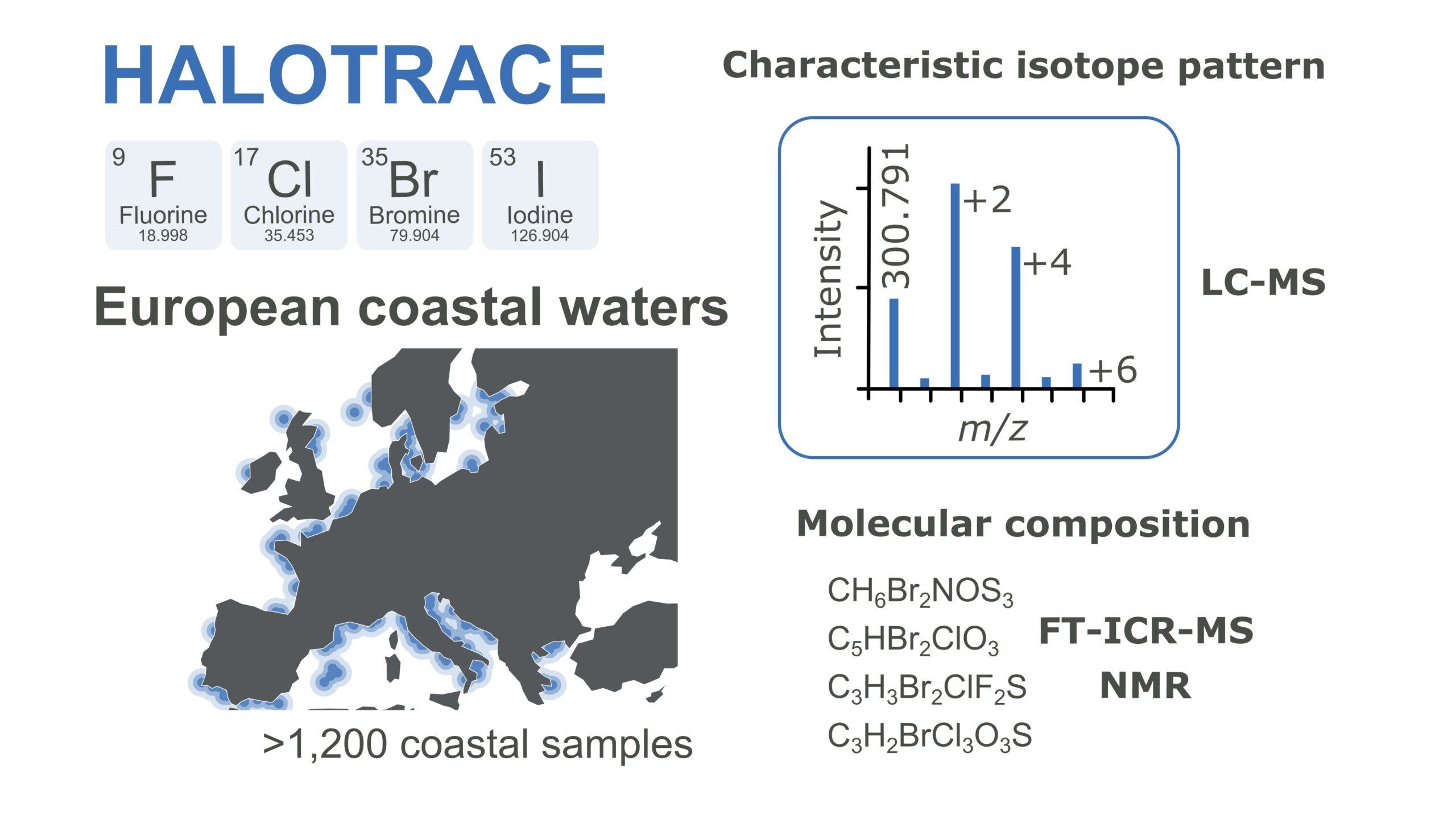
Halogenated chemicals containing fluorine, chlorine, bromine, or iodine and are widely used in industrial, medical, agricultural, and consumer products. Their chemical stability makes them useful, but can also cause them to resist biological and environmental degradation and persist in coastal ecosystems. HALOTRACE will develop a halogen-aware, high-throughput LC-MS protocol to investigate these pollutants across more than 1000 coastal water samples collected during the TREC expedition. Characteristic molecular-mass features, including isotope patterns and mass defects, will be used to identify candidate halogenated compounds, map their distribution, and detect potential pollution hotspots along the European coastline. Selected high-abundance, recurrent, or chemically unusual features will then be examined using ultra-high-resolution FT-ICR mass spectrometry and, where sufficient material is available, complementary NMR analysis. By combining large-scale screening with targeted structural investigation, HALOTRACE will provide new insight into the occurrence and fate of anthropogenic halogenated pollutants in European coastal waters.
Objectives:
Group Leader
ORCID: 0000-0002-5797-3589
Edit
Postdoctoral Fellow
Zimmermann Group
Edit
Postdoctoral Fellow (ARISE)
Zimmermann Group
ORCID: 0000-0002-6777-7012
Edit
Helmholtz Institute for Functional Marine Biodiversity
HIFMB
Institute for Chemistry and Biology of the Marine Environment
Institute for Chemistry and Biology of the Marine Environment, University of Oldenburg